

 Français (France)
  Nederlands (nl-NL)
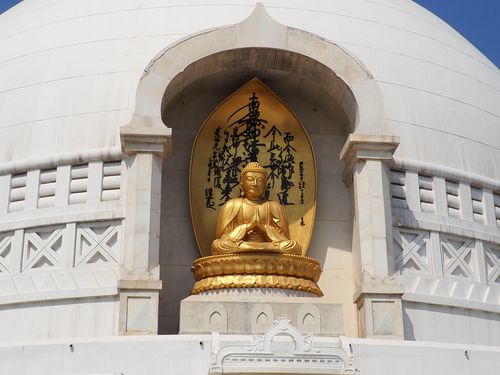
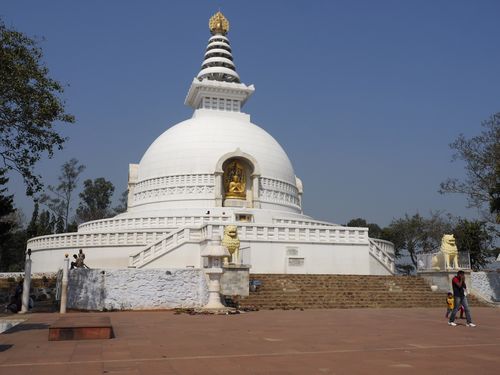
 The Vishwa Shanti Stupa in Rajgir, located in the Indian state of Bihar, is a monument symbolizing peace and unity. Erected in 1969 by the Japanese Buddhist sect Nipponzan-Myōhōji, it is one of 80 peace stupas built around the world to promote these universal values. The stupa sits on Ratnagiri Mountain and is accessible by a cable car, offering panoramic views of the surrounding town. The structure is decorated with golden statues of the Buddha in various postures. The Vishwa Shanti Stupa is not only a pilgrimage site, but also a witness to the aspiration for global peace. It attracts visitors from different parts of the world, interested in its architecture, symbolism and its role in promoting inter-religious harmony.
Monument profile
Vishwa Shanti Stupa
Monument category: Stupa
Monument family: Pagoda or stupa
Monument genre: Religious
Cultural heritage: Buddhist
Geographic location: Rajgir • Bihar • India
Construction period: 20th century AD
• Links to •
• This monument illustrates the following theme •
Buddhist architecture • Stupas : Diversity of Stupas in Asia
• List of videos about Rajgir on this site •
Rajgir, sacred city • Bihar, India
Vishwa Shanti Stupa at Rajgir: Foundation, Symbolism and Modern Development
Creation of the Monument in the Postwar Period
The Vishwa Shanti Stupa at Rajgir belongs to the international Peace Pagoda movement initiated in the twentieth century by the Japanese Buddhist order Nipponzan Myohoji. Founded by Nichidatsu Fujii, the movement promoted monuments dedicated to non-violence, reconciliation and global peace after the devastation of the Second World War.
Rajgir was selected because of its long association with the life of the Buddha and the early Buddhist community. The town had already been recognized as one of the major sacred landscapes of Bihar, and the construction of a modern stupa there linked contemporary Buddhist revival movements with an ancient pilgrimage centre.
The monument was completed during the 1960s, when independent India was encouraging the cultural development of historic religious sites and expanding infrastructure for domestic and international visitors.
Choice of Site and Intended Role
The stupa was erected on Ratnagiri Hill, overlooking the Rajgir valley. This elevated setting gave the structure both symbolic prominence and visual visibility across the surrounding landscape. The ascent to the monument, whether by footpath or later by ropeway, forms part of the experience of pilgrimage.
Its function was not limited to commemorative architecture. The site was designed for prayer gatherings, meditation and ritual circumambulation. It also served as a meeting point for Buddhist visitors from India, Japan and other countries. In this sense, the monument expressed both spiritual devotion and international solidarity.
The white dome rising above the hills became one of the most recognizable modern landmarks of Rajgir.
Development of the Site and Changing Use
Over time, the Vishwa Shanti Stupa became integrated into the broader cultural identity of Rajgir. Visitors often combine the monument with nearby ancient remains, hot springs and other Buddhist locations. The installation of the ropeway significantly increased accessibility and widened the public using the site.
Maintenance works, visitor pathways and viewing areas have been improved periodically to manage growing numbers of pilgrims and tourists. Religious ceremonies continue to take place there, especially on Buddhist festival dates.
Unlike archaeological monuments preserved as relics of the past, the stupa remains an active place of worship. Its continuing ritual use has helped sustain its relevance in the modern era.
Global Historical Context
The principal phase of construction took place during the Cold War. Nuclear anxiety, decolonization and new international peace movements shaped global politics. India was developing its non-aligned diplomatic position. Japan saw strong pacifist activism in the decades following Hiroshima and Nagasaki. Peace Pagodas such as Rajgir’s emerged directly from that historical climate.
Present Significance and Preservation
Today the Vishwa Shanti Stupa functions as a religious monument, scenic landmark and symbol of peace. It represents the twentieth-century renewal of Buddhist connections between India and East Asia. Conservation efforts focus mainly on exterior surfaces, access systems and protection of the hill environment.
Although modern in date, the monument now forms an established part of Rajgir’s historical landscape, linking ancient Buddhist memory with contemporary aspirations for peace.
Monumental Form and Hilltop Design of the Vishwa Shanti Stupa at Rajgir
Hilltop Setting and Site Organization
The Vishwa Shanti Stupa stands on Ratnagiri Hill above the historic basin of Rajgir. Its elevated position is central to the architectural concept. Rather than occupying the urban plain, the monument was placed on a summit platform where it commands wide views over the valley and surrounding ridges. This location gives the stupa visual dominance while associating it with the hill landscapes long connected to Buddhist memory.
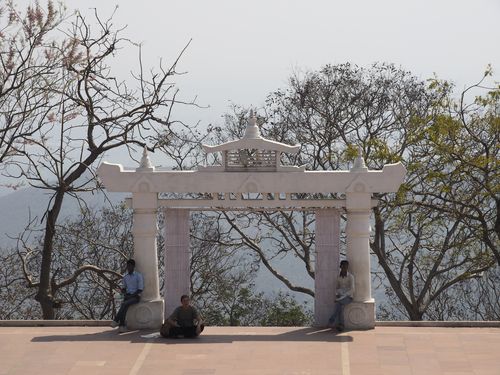
Access to the site is achieved by footpaths and by ropeway. These two approaches create different spatial experiences. The pedestrian route emphasizes gradual ascent, while the ropeway offers an abrupt arrival near the summit. In both cases, the final approach leads to an open terrace where the monument appears as the principal focal point.
The summit precinct is organized with circulation paths, viewing edges and open gathering areas around the central structure. The surrounding emptiness enhances the legibility of the stupa as a solitary sacred form.
Overall Massing and Geometric Composition
The monument follows the recognizable vocabulary of the modern Buddhist peace pagoda. Its composition is based on a raised base supporting a large white hemispherical dome, crowned by a vertical finial. The geometry relies on elementary forms: circle, hemisphere and axial spire.
The dome is proportionally dominant but not excessively heavy. It rises clearly above the plinth while maintaining balanced relations between width and height. This equilibrium gives the building an impression of calm stability. The absence of projecting subsidiary volumes strengthens the purity of the silhouette.
At the summit of the dome, the crowning element extends the upward axis through superimposed symbolic forms derived from traditional parasol motifs. These elements are relatively slender compared with the mass below, allowing the main volume to remain visually primary.
Seen from below in the valley, the building reads as a bright, compact landmark rather than as a complex architectural ensemble.
Materials, Surface Treatment and Decorative Elements
The Vishwa Shanti Stupa was constructed using modern structural methods, generally reinforced concrete or masonry finished with plastered surfaces. These materials permit regular curves, structural efficiency and simplified maintenance. They also allow the monument to achieve a continuous smooth envelope that would be more difficult with traditional carved stone construction.
Its white exterior is one of its defining architectural characteristics. The light colour reflects intense sunlight and increases visibility over long distances. Under changing daylight, the surface shifts from brilliant brightness to softer tonal gradations, giving subtle variation to an otherwise restrained design.
Decoration is concentrated in selected areas rather than spread across the whole monument. Niches containing Buddha images articulate the perimeter of the dome or base levels. Railings, stair approaches and small ornamental details provide secondary enrichment. The contrast between smooth wall planes and sculptural inserts gives the figures clear prominence.
Ritual Circulation and Spatial Experience
The architecture is designed around movement around the central mass. A circumambulatory path allows visitors to walk clockwise around the stupa in accordance with Buddhist devotional practice. This transforms the monument into an experiential structure rather than a static object viewed only from one side.
Stairways and terrace levels organize transitions between arrival areas and the ritual platform. Low boundaries guide circulation without interrupting views of the landscape. Because the monument contains no developed internal halls, the principal spatial experience occurs outdoors, between built form, open sky and distant horizons.
The curved mass of the dome changes appearance continuously as one moves around it. This dynamic perception is an important aspect of the design.
Preservation and Present Architectural Reading
Current conservation concerns focus mainly on exterior coatings, weather exposure, visitor circulation surfaces and maintenance of the ropeway access system. Hilltop conditions expose the monument to wind, rain and seasonal temperature changes.
Today the Vishwa Shanti Stupa can be read as an architecture of symbolic clarity: a luminous dome placed above Rajgir, composed with minimal forms, organized for ritual movement and integrated with the topography of Ratnagiri Hill.