

 Français (France)
  Nederlands (nl-NL)
 The Borobudur Temple, located near Yogyakarta on the island of Java in Indonesia, is one of the most significant Buddhist monuments in the world. Built between the eighth and ninth centuries, it forms a large religious complex reflecting the influence of Buddhism in the Indonesian archipelago during the period of early Javanese kingdoms. The site long served as a place of pilgrimage and religious devotion. Rediscovered in the nineteenth century after centuries of abandonment, it underwent extensive restoration campaigns. Today Borobudur stands as a major symbol of Indonesia’s cultural heritage and attracts visitors from many parts of the world.
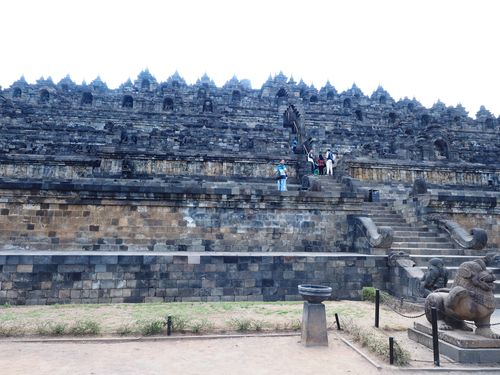
Yogyakarta • Borobudur temple: mountain temple overview
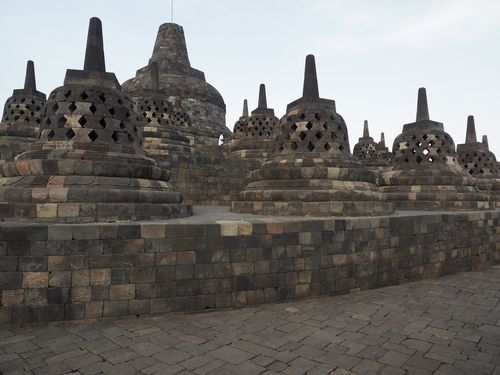
Yogyakarta • Borobudur temple: Yogyakarta • Borobudur Temple: upper floor stupas
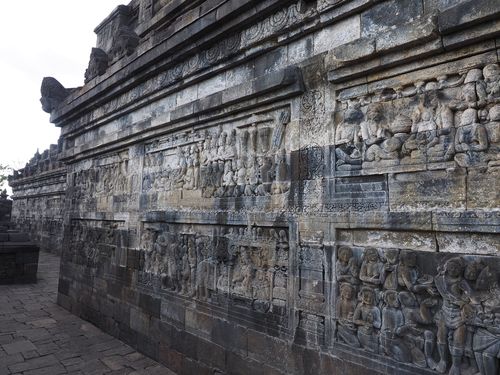
Yogyakarta • Borobudur temple: detail of the bas-reliefs on the first floor
Monument profile
Borobudur temple
Monument category: Buddhist temple
Monument family: Temple
Monument genre: Religious
Cultural heritage: Buddhist
Geographic location: Yogyakarta, Borobudur • Java • Indonesia
Construction period: 8th century AD
This monument in Yogyakarta is inscribed on the UNESCO World Heritage List under the name Borobudur Temple Compounds since 1991.See the UNESCO monuments featured on this site
• Links to •
• List of videos about Yogyakarta, Borobudur on this site •
Indonesia • Java • Borobudur and Yogyakarta
• References •
Wikipedia FR: Temple de Borobudur
UNESCO: Ensemble de Borobudur
World History Encyclopedia: World History Encyclopedia: Borobudur
History of the Borobudur Temple
Political and Social Context of the Construction
Borobudur, located near Yogyakarta in Central Java, Indonesia, is one of the largest Buddhist monuments ever constructed and represents a major achievement of early Southeast Asian civilization. The monument was built between the late eighth and early ninth centuries during the rule of the Sailendra dynasty, a powerful royal house that dominated large parts of Java and maintained cultural and commercial links with other regions of Asia. The Sailendra rulers were known for their strong patronage of Buddhism, particularly the Mahāyāna tradition, and the construction of Borobudur formed part of a broader program of religious and political patronage.
The creation of such a monumental sanctuary served several purposes within the political structure of the time. In early Javanese kingdoms, royal authority was closely linked to religious legitimacy. By sponsoring major religious monuments, rulers demonstrated their role as protectors of the Buddhist faith and as patrons of monastic communities. Borobudur can therefore be interpreted not only as a place of devotion but also as a statement of dynastic prestige and political authority.
At the same time, Central Java was home to multiple religious traditions. The Sailendra dynasty, associated with Buddhism, coexisted with the Sanjaya dynasty, which was connected to Hindu Shaivism. These parallel traditions sometimes existed in competition but also in relative coexistence. Monumental religious construction during this period reflected this complex cultural environment, in which rulers expressed their legitimacy through religious patronage and architectural achievements.
Borobudur’s construction may also have been influenced by broader regional networks. Trade routes linking the Indonesian archipelago with India, Sri Lanka, and mainland Southeast Asia facilitated the circulation of religious ideas, texts, and artistic models. These connections helped shape the intellectual and spiritual context in which the monument was conceived.
Historical Events and Dynastic Transformations
After its construction, Borobudur functioned for several centuries as an important center of Buddhist pilgrimage and ritual practice. The monument’s elaborate reliefs and symbolic architecture suggest that it was intended to guide devotees through a ritual journey reflecting the Buddhist path toward enlightenment.
However, the political landscape of Java changed significantly during the tenth century. The center of political power gradually shifted from Central Java to the eastern part of the island. Historians attribute this relocation to a combination of factors, including internal political struggles, economic shifts, and possibly volcanic activity in the region surrounding Borobudur.
As royal patronage moved elsewhere, the monument gradually lost its central religious function. Buddhist institutions in the region declined, and many monastic communities relocated. Over time, Borobudur fell into disuse, and its terraces were gradually covered by vegetation and layers of volcanic ash.
Although the site was no longer actively used for religious ceremonies, it remained present in local traditions and folklore. Stories associated with the monument continued to circulate among the inhabitants of the surrounding region, preserving a memory of its past significance.
Global Context of Monumental Construction
The construction of Borobudur occurred during a period of remarkable monumental activity across Asia. Between the seventh and ninth centuries, several powerful kingdoms sponsored the construction of large religious complexes designed to express spiritual authority and royal legitimacy.
In South Asia, major Buddhist and Hindu monuments were being built under regional dynasties that sought to promote religious scholarship and pilgrimage. In mainland Southeast Asia, early temple complexes were beginning to emerge in regions that would later become associated with the Khmer Empire. Meanwhile, in China under the Tang dynasty, Buddhist monasteries and pagodas flourished as part of a vibrant religious culture.
Beyond Asia, other parts of the world also experienced significant architectural developments during this period. In Europe, the Carolingian Empire supported the construction of churches and monasteries intended to reinforce imperial authority and Christian identity.
Borobudur belongs to this wider global tradition in which monumental architecture served both religious and political purposes. Its scale and complexity reflect the ambition of the rulers who commissioned it and the cultural networks that linked Java with the broader Buddhist world.
Decline, Rediscovery, and Early Restoration
For many centuries Borobudur remained largely abandoned. Dense vegetation gradually covered the structure, while volcanic deposits from nearby Mount Merapi accumulated over the terraces. The monument became increasingly difficult to access and eventually disappeared from the attention of the outside world.
Its rediscovery occurred in the early nineteenth century during the period when Java was temporarily administered by the British. In 1814 the governor Thomas Stamford Raffles ordered an investigation after hearing reports of a large ancient monument hidden in the forest. Initial clearing efforts revealed the outlines of the structure, attracting the interest of scholars and administrators.
Throughout the nineteenth century, additional clearing and documentation were undertaken by Dutch colonial authorities. These early interventions helped reveal the scale of the monument but did not fully resolve the structural problems affecting the site. Drainage issues, erosion, and unstable foundations continued to threaten the preservation of the temple.
Modern Restoration and International Recognition
During the twentieth century, the need for comprehensive conservation became increasingly evident. A large-scale restoration program was eventually launched with the cooperation of the Indonesian government and international organizations. Between 1973 and 1983 a major restoration project was carried out under the coordination of UNESCO.
This extensive program involved dismantling parts of the monument in order to reinforce its internal structure and improve the drainage system. Thousands of stones were carefully removed, documented, and reassembled. The restoration significantly improved the stability of the monument and ensured the preservation of its sculpted reliefs.
In 1991 Borobudur was inscribed on the UNESCO World Heritage List. This designation recognized the monument’s outstanding universal value as one of the greatest Buddhist architectural complexes in the world. International recognition also strengthened conservation policies and encouraged continued research into the site’s history and cultural significance.
Contemporary Role and Cultural Importance
Today Borobudur is widely regarded as one of Indonesia’s most important cultural and historical landmarks. The monument attracts visitors from around the world and plays a central role in the country’s tourism and cultural heritage sectors.
Despite its transformation into a major tourist destination, Borobudur retains an important religious role. Buddhist communities continue to use the site for ceremonial purposes, particularly during the celebration of Vesak, which commemorates the birth, enlightenment, and passing of the Buddha. During this annual event, processions and rituals take place at the temple, attracting participants from many countries.
Borobudur has also become a symbol of Indonesia’s cultural diversity and historical depth. The monument reflects the complex interactions between local traditions, Buddhist philosophy, and broader Asian cultural exchanges.
Conservation Challenges and Future Preservation
The preservation of Borobudur presents several ongoing challenges. The tropical climate of Central Java exposes the monument to heavy rainfall, humidity, and biological growth that can affect the stone surfaces. Volcanic activity from nearby Mount Merapi also poses potential risks, as ash deposits and seismic vibrations can damage the structure.
Another significant challenge arises from the high number of visitors who come to the site each year. While tourism provides economic benefits, it also increases pressure on the monument’s fragile surfaces. Authorities have introduced management strategies to limit physical impact and protect vulnerable areas of the temple.
Conservation programs continue to combine traditional expertise with modern scientific techniques. Through these efforts, Borobudur remains one of the most significant surviving monuments of the Buddhist world and a remarkable testament to the artistic and spiritual achievements of early Javanese civilization.
Architecture of the Borobudur Temple
Technological and Architectural Innovations
The architectural conception of Borobudur represents one of the most remarkable achievements of early Southeast Asian monumental design. Built during the eighth and ninth centuries in the fertile Kedu Plain of Central Java, the monument reflects a sophisticated understanding of structural engineering, spatial symbolism, and environmental adaptation. Its builders succeeded in creating a massive stone monument that integrates religious cosmology with a carefully planned architectural composition.
Borobudur was constructed on a natural hill that was reshaped into a monumental stepped structure. Rather than building a temple with enclosed chambers, the designers created a massive terraced monument intended to be experienced through movement. The architecture organizes space as a progressive ritual journey, guiding pilgrims upward along a spiraling path that symbolically represents the Buddhist path toward enlightenment.
One of the most significant technical achievements of the monument lies in its structural stability. The builders developed a layered construction system consisting of a central core reinforced by terraces and retaining walls. This arrangement distributes weight evenly across the hillside and prevents structural collapse. The design also allows the monument to withstand minor seismic activity, which is common in the volcanic region of Central Java.
Environmental considerations were also carefully integrated into the architecture. The region experiences intense tropical rainfall, and the monument incorporates an extensive drainage system designed to prevent water infiltration. Stone channels, hidden conduits, and carved spouts direct rainwater away from the terraces and foundations. These drainage elements represent a sophisticated engineering solution that has contributed significantly to the long-term survival of the monument.
Materials and Construction Techniques
Borobudur was constructed almost entirely from blocks of andesite stone, a dense volcanic rock found abundantly in the region surrounding the temple. This material was chosen for its durability, resistance to weathering, and suitability for detailed carving. The stones were extracted from nearby riverbeds and quarries and transported to the construction site, where they were shaped and assembled.
A notable feature of the construction technique is the absence of mortar. The builders used an advanced system of interlocking stone blocks that allowed the structure to remain stable without adhesive materials. Grooves, projections, and carefully fitted joints enabled the stones to lock together securely. This technique also provided flexibility in the structure, allowing it to adapt to slight ground movements without cracking.
The interior of the monument consists of a massive stone core reinforced with additional structural layers. Archaeological investigations have shown that the original design required modifications during construction. A large stone base was added to reinforce the lower levels, possibly to prevent landslides or structural instability. This additional base also concealed a series of relief panels that were originally visible.
The surface of the monument was designed to support an extraordinary sculptural program. Thousands of relief panels were carved directly into the stone walls, illustrating religious narratives and symbolic teachings. The precision of these carvings demonstrates the high level of craftsmanship possessed by the sculptors who worked on the monument.
Architectural Influences and Artistic Traditions
Borobudur’s architecture reflects a synthesis of artistic influences that developed through centuries of cultural exchange across Asia. The concept of the stupa, which forms the central element of the monument, originated in the Buddhist architecture of the Indian subcontinent. In its earliest form, the stupa was a simple hemispherical mound that housed sacred relics.
In Java, this architectural form was transformed into a complex three-dimensional structure. Instead of constructing a single stupa surrounded by subsidiary buildings, the architects of Borobudur created an entire architectural landscape composed of multiple terraces and stupas. This adaptation reflects both Indian religious concepts and indigenous traditions of sacred mountain architecture found in the Indonesian archipelago.
The decorative program of Borobudur also demonstrates strong connections with South Asian artistic traditions. Many of the sculptural motifs, narrative themes, and iconographic elements derive from Buddhist texts and artistic conventions that circulated widely through maritime trade networks linking India, Sri Lanka, and Southeast Asia.
At the same time, the reliefs depict scenes from everyday life in ancient Java. Images of local architecture, vegetation, clothing, and maritime vessels appear throughout the sculptural panels. These representations illustrate how foreign religious traditions were integrated into the local cultural environment.
The perforated stupas located on the upper terraces are another distinctive architectural feature. Each of these bell-shaped structures contains a statue of the Buddha and is decorated with geometric openings that allow light to filter through. This design creates a visual transition between the enclosed narrative galleries below and the open spiritual space of the upper levels.
Spatial Organization and Monumental Structure
The architectural plan of Borobudur is based on a carefully structured vertical arrangement of nine superimposed platforms. The six lower levels are square terraces surrounded by walls and galleries, while the three upper levels are circular platforms supporting rows of stupas.
This spatial organization reflects Buddhist cosmology. The lower terraces correspond to the realm of human existence, where individuals remain bound by worldly desires. The circular terraces above represent higher spiritual states associated with meditation and enlightenment. The monument culminates in a large central stupa that symbolizes the ultimate state of spiritual liberation.
Pilgrims traditionally move through the monument following a prescribed ritual path. Beginning at the lowest level, they walk clockwise around each terrace while gradually ascending toward the summit. This processional route extends for several kilometers and exposes visitors to an extensive series of sculptural narratives illustrating Buddhist teachings.
The entire monument covers approximately 2.5 hectares and consists of more than two million individual stone blocks. The galleries contain over 2,600 relief panels and more than 500 statues of the Buddha. These figures appear in different hand gestures, each associated with specific symbolic meanings.
Dimensions and Notable Characteristics
Borobudur measures roughly 118 meters along each side of its square base. Its height from the surrounding ground level is approximately 35 meters, although the monument originally stood slightly higher before later restorations modified its structure.
The upper terraces contain seventy-two perforated stupas arranged in concentric circles around the central stupa. Each of these structures encloses a seated Buddha statue. The regular spacing of the stupas creates a harmonious geometric pattern that emphasizes the monument’s monumental scale.
One of the most intriguing architectural features is the hidden base discovered during restoration work. This lower section contains additional relief panels depicting moral teachings but was covered during construction, possibly to reinforce the stability of the structure.
The monument also incorporates numerous carved water spouts and drainage channels that protect the structure from the heavy rainfall typical of Central Java.
Architectural Significance and Conservation
The architectural significance of Borobudur extends far beyond Indonesia. The monument represents one of the most sophisticated examples of Buddhist architectural symbolism in the world. Its design combines structural engineering, religious cosmology, and sculptural storytelling within a single unified composition.
In recognition of its cultural and historical importance, Borobudur was inscribed on the UNESCO World Heritage List in 1991. This designation acknowledges the monument as a masterpiece of human creative achievement and a key monument of the Buddhist world.
Conservation efforts remain essential for the protection of the site. The volcanic environment surrounding the temple exposes the stone surfaces to erosion, biological growth, and periodic ash deposits from nearby Mount Merapi. In addition, the large number of visitors each year requires careful management to prevent damage to the fragile relief panels.
Modern conservation programs combine traditional stone conservation techniques with scientific monitoring methods. Through these efforts, Borobudur continues to be preserved as one of the most extraordinary architectural monuments of Southeast Asia and a lasting testament to the artistic and spiritual achievements of ancient Java.