Français (France)
  Nederlands (nl-NL)
 00:00 • intro | 00:01 • Thu Bon river | 02:08 • Chua Cau, Japanese bridge-pagoda | 04:08 • at the market | 06:32 • the city and it's houses | 09:23 • Phuc Kien pagoda | 11:54 • the surrounding countryside
Personal creation from visual material collected during my trip Vietnam & Cambodia (2014)
Map of places or practices in Hoi An on this site
• Use the markers to explore the content •
Hoi An, Historic Port Between River Trade and Asian Sea Routes
A preserved town shaped by commerce
Hoi An is one of Vietnam’s most remarkable historic urban ensembles. Located on the central coast near the mouth of the Thu Bon River, the town prospered for centuries as an active port linking East Asia, Southeast Asia and merchants arriving from more distant regions. Its commercial past, cultural diversity and unusually well-preserved historic center give it a distinctive place within Vietnamese heritage.
This video offers a gradual introduction to that identity. It follows the river, crosses the famous Japanese covered bridge known as Chua Cau, observes activity at the market, moves through streets lined with old houses, visits the Phuc Kien assembly hall, and opens toward the surrounding countryside. Hoi An appears as a place where architecture, trade, spirituality and landscape remain closely connected.
Landmarks and everyday life
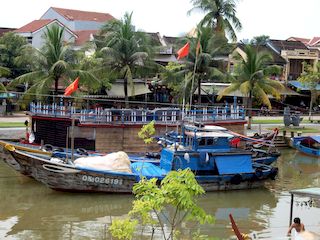
The Thu Bon River is one of the essential elements of Hoi An. For generations it allowed goods, travelers and ideas to reach the town while connecting the port with inland regions. Even today, the presence of water helps define the atmosphere of the site and recalls its former maritime role.
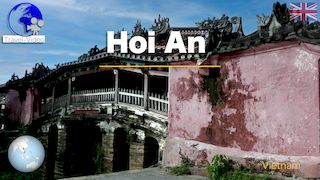
The Japanese bridge-pagoda of Chua Cau is the town’s best-known monument. Built during the period when foreign merchant communities were established in Hoi An, it combines practical function with symbolic meaning. Its covered form, elegant proportions and role as a crossing place make it the most recognizable image of the old town.
The local market reflects the continuity of commercial life. Fresh produce, spices, textiles and daily exchanges continue a long mercantile tradition. Such places show that Hoi An is not a museum setting, but a living urban environment where heritage and routine activity coexist.
The old merchant houses are another major feature of the town. Their narrow façades, timber structures, interior courtyards and mixed residential-commercial layouts reveal an efficient adaptation to the needs of trade. They also illustrate how urban density and climate influenced local architecture.
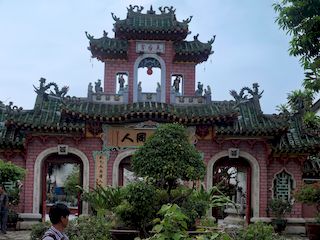
The Phuc Kien complex, founded by migrants from Fujian in China, demonstrates the multicultural character of Hoi An. Decorative gates, courtyards and symbolic details reflect the importance of overseas merchant communities in the town’s history.
An old port on maritime Silk Road networks
Between the sixteenth and eighteenth centuries, Hoi An was one of the leading ports of the region. Japanese, Chinese, Vietnamese and later European ships traded silk, ceramics, spices, timber and many other goods here. The reference to the Silk Road concerns maritime commercial networks linking different Asian worlds rather than a single overland route.
Prosperity encouraged the settlement of foreign communities whose influence remains visible in architecture and religious institutions. Chinese assembly halls, Japanese contributions and Vietnamese building traditions came together in a relatively compact urban space.
The gradual decline of the port, linked in part to changes in waterways and shifting trade patterns, paradoxically helped preserve the historic center. Less transformed than many modernized port cities, Hoi An retained much of its traditional urban fabric.
The surrounding countryside also mattered greatly. Rice fields, gardens, craft villages and river routes formed the economic hinterland that supported the town’s prosperity.
What the videos on this site make especially clear
A video built from carefully selected and animated photographs suits Hoi An particularly well. Slow visual movement allows viewers to study the details of the Japanese bridge, the textures of old façades and the perspectives of narrow streets without haste.
At the market, this method highlights colors, density, circulation and the arrangement of stalls. The viewer can better understand how commerce still structures everyday urban life.
Views of the Thu Bon River also clarify the relationship between water and settlement. Quays, boats, embankments and rows of buildings appear as parts of one coherent historical system.
Finally, the transition toward the nearby countryside shows that Hoi An is more than its historic core. It belongs to a broader landscape shaped by exchanges between sea, river and fertile land.
A rare urban heritage of central Vietnam
Hoi An brings together architectural heritage, mercantile memory and a calm riverside setting in an unusually coherent whole. This video offers a clear and engaging introduction to that legacy. To explore the subject further, the detailed pages devoted to the Japanese bridge, the Phuc Kien complex and the traditional market provide valuable additional insight into one of Vietnam’s great historic ports.
Links to related pages
Audio Commentary Transcript
Once one of the most important ports on the China Sea, political and natural circumstances led to its decline and made it what Hoi An is today: a medium-sized tourist town with an exceptionally well-preserved heritage.
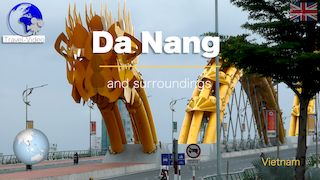
The silting up of the port towards the end of the 19th century as well as political negotiations with France a few decades earlier greatly favored Da Nang to the detriment of Hoi An.
The Chua Cau bridge-pagoda is the symbol of a certain harmony which reigned between the communities at the time of the glory of Hoi An. The bridge was built in 1593 by a Japanese merchant in order to facilitate the exchanges between the Japanese and Chinese districts , and in 1653 a pagoda was erected on the bridge, making it a virtually unique monument. The bridge was rebuilt at the beginning of the 19th century and restored several times thereafter. A couple of statues guard both ends. On one side monkeys and on the other dogs.
Southeast Asia is renowned for the excellence of its gastronomy, and this quality is largely due to the freshness of its ingredients. In Hoi An as elsewhere, lively markets offer something to delight the taste buds, after having delighted the eyes of photographers...
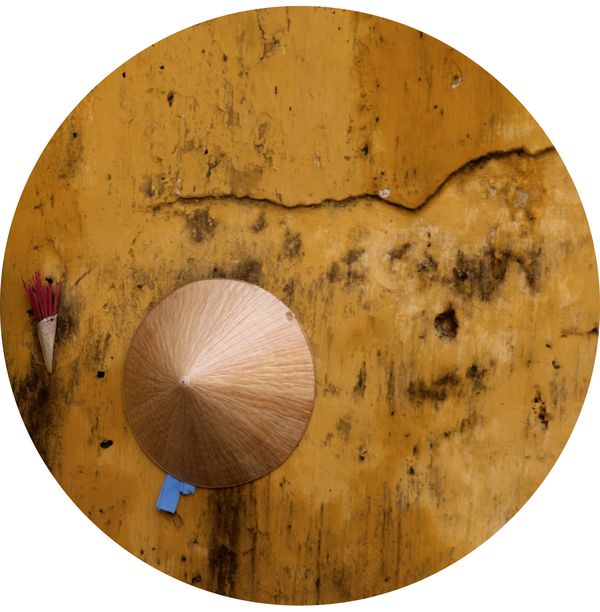
Hoi An is one of the most visited cities in central Vietnam. A certain poetry emerges from its old houses with ocher painted walls and from these lanterns which adorn practically all the streets.
Built on the ruins of a more modest temple built by Vietnamese Buddhists, the temple was rebuilt in 1697 by Chinese families to serve as an assembly hall for the Chinese community of Fujian in Hoi An. The communal house of the Fujian congregation became later the Phuc Kien pagoda, dedicated to the goddess of the sea. Its architecture is remarkable, both outside and inside.
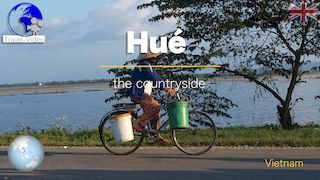
If the old town of Hoi An, classified as a UNESCO World Heritage Site, is magnificent, the surrounding countryside is also worth a visit. Rice fields with buffaloes lounging there, often accompanied by small white waders who rid them of their parasites, as well as bucolic cemeteries are a feast for the eyes. The Vietnamese care more about the beauty of their tombs than that of the houses where they lived during their lifetime... and then there is the mouth of the river with its fishermen, and for the amateurs, the pretty beaches are not lacking neither.
Music:
- - YouTube video library - A Revelation
- - YouTube video library - Constancy Part 2 - The Descent, (© Constancy Part 2 - The Descent by Kevin MacLeod is licensed under a Creative Commons Attribution 4.0 license. https://creativecommons.org/licenses/by/4.0/
- Source: http://incompetech.com/music/royalty-free/index.html?isrc=USUAN1100774
- Artist: http://incompetech.com/)
- - YouTube video library - Dreamy Flashback, (© Dreamy Flashback by Kevin MacLeod is licensed under a Creative Commons Attribution 4.0 license. https://creativecommons.org/licenses/by/4.0/
- Source: http://incompetech.com/music/royalty-free/index.html?isrc=USUAN1100532
- Artist: http://incompetech.com/)
- - YouTube video library - I knew a Guy - Kevin McLeod, (© I Knew a Guy by Kevin MacLeod is licensed under a Creative Commons Attribution 4.0 license. https://creativecommons.org/licenses/by/4.0/
- Source: http://incompetech.com/music/royalty-free/index.html?isrc=USUAN1100199
- Artist: http://incompetech.com/
- )
- - YouTube video library - Lurking Shadows
- - YouTube video library - Outcast
Disclaimer: Despite its appropriateness, copyright issues prevent the use of vietnamese traditional music in "Hoi An, an ancient port on the Silk Road • Vietnam", hence the use of royalty-free music. Despite our careful selection, some might regret this decision, which is necessary to avoid potential lawsuits. Although difficult, this decision is the only viable solution.