

 Français (France)
  Nederlands (nl-NL)
 00:00 • intro | 00:49 • Sagrada Familia | 00:56 • construction site in 1995 | 01:36 • Sagrada Familia in 2011 | 06:25 • Güell Park
Personal creation from visual material collected during my trip Barcelona (2011)
Map of places or practices in Barcelona on this site
• Use the markers to explore the content •
Barcelona, Gaudí and the Creation of a Distinct Urban Landscape
A Major European City Shaped by One Architect
Barcelona stands among Europe’s leading cultural capitals. A Mediterranean port city, it combines medieval heritage, planned modern districts and bold architectural experimentation. Few individuals have influenced its visual identity as deeply as Antoni Gaudí. His buildings transformed the cityscape and helped make Barcelona one of the world’s best-known architectural destinations.
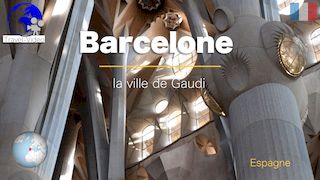
This video focuses on two emblematic sites: the Sagrada Família and Park Güell. It also presents the basilica at different moments in time, offering a rare perspective on the evolution of a monument still under construction.
Sagrada Família, a Monument in Progress
The Sagrada Família is one of Spain’s most recognizable landmarks. Begun in the late nineteenth century, it was profoundly reimagined by Gaudí, who devoted much of his life to the project. Its architecture combines religious symbolism, forms inspired by nature, structural innovation and a highly personal artistic language.
The sequences showing the construction site in 1995 and then in 2011 reveal the remarkable progress of the works. Rising towers, expanded façades, growing volumes and changing surroundings demonstrate the scale of a project exceptional for both duration and ambition.
The video therefore presents not only a monument, but also the continuing process of architecture itself, which adds strong documentary value.
Park Güell, Between City and Imagination
The second major site featured is Park Güell, which represents a different aspect of Gaudí’s creativity. Originally conceived as a residential development, it later became a public park where architecture and landscape interact closely.
Monumental stairways, the famous mosaic bench, inclined columns, paths integrated into the hillside and panoramic views over Barcelona form an ensemble where the boundary between built form and nature seems intentionally blurred.
The park expresses an original urban vision in which public space becomes an aesthetic experience. It also highlights the importance of craftsmanship, colourful ceramics and the creative use of topography.
Historical Context and Barcelona’s Identity
Gaudí’s work belongs to the era of Catalan Modernisme, a movement linked to Barcelona’s economic and cultural expansion in the late nineteenth and early twentieth centuries. Industrial patrons, religious institutions and urban elites commissioned many innovative projects during this period.
Within that environment, Gaudí developed a style immediately recognizable worldwide. His buildings helped distinguish Barcelona from other European cities. Today they remain central to the city’s image and international appeal.
The presence in the video of both a monumental basilica and an experimental park illustrates the diversity of his legacy.
What the Video Makes Especially Clear
Videos built from carefully selected and animated photographs are especially suited to Gaudí’s architecture. They allow viewers to observe sculpted details, textures, flowing curves and transitions between monumental masses and decorative elements.
The comparison between images from different years also makes the progress of the Sagrada Família easier to understand. Viewers can clearly perceive changes in towers, façades and the overall silhouette.
For Park Güell, this format helps explain the relationship between terraces, stairways, columns and the wider urban panorama.
A City Linked to a Unique Architectural Vision
Barcelona cannot be reduced to Gaudí alone, yet few creators have shaped the identity of a major city so strongly. Between monumental spirituality and urban imagination, the Sagrada Família and Park Güell represent two essential dimensions of his work. The video offers a clear introduction, while the related detailed pages allow deeper exploration of their history and architecture.
Links to related pages




Audio Commentary Transcript
Barcelona, an important Spanish metropolis, has a long and turbulent history, but it was an architect born during the second half of the 19th century who largely gave it its letters of nobility. This film shows you the most important and famous works of Antoni Gaudi.
The impressive construction site began in 1882 and the scale of the task as well as the slowness of the financing presaged an interminable construction of this ambitious basilica. Gaudi understood this well, he would never see the end of the Sagrada Familia construction site. To be sure that his project would not be amputated after his death from the 18 towers planned, he decided to build these first, at least to raise them high enough so that it would be impossible not to complete them. Gaudi died in 1926, and at present, in 2022, the set is not finished, even if the work is very advanced.
Can you guess the number behind the pigeon? This magic square is called Gaudi's magic square, although it was not invented by him. The sum of each row, vertical, horizontal or diagonal, is 33, the age of Christ at his death on the cross.
Park Güell in Barcelona bears the name of its sponsor, a wealthy patron of Gaudi. Güell wanted to build a large garden city on one of the hills of Barcelona, with a public park, a chapel and 60 houses. Gaudi accepted the challenge and drew the plans for a garden respecting the natural relief of the place and decided to integrate the whole into the existing nature. Columns symbolize trees, and houses have a mushroom shape. At least those that were built, because the final project was limited to 4 instead of the 60 planned, in view of budgetary difficulties that one can easily imagine when one sees the realization of this unique place.

Music:
- - YouTube video library - Clouds
- - YouTube video library - From Russia with love
- - YouTube video library - Nemesis
- - YouTube video library - The Curious Kitten
Disclaimer: Despite its appropriateness, copyright issues prevent the use of spanish traditional music in "Barcelona, the city of Gaudi • Spain", hence the use of royalty-free music. Despite our careful selection, some might regret this decision, which is necessary to avoid potential lawsuits. Although difficult, this decision is the only viable solution.


