

 Français (France)
  Nederlands (nl-NL)
 00:00 • intro | 00:30 • entrance to the temple complex | 01:45 • intertwined stones and roots | 04:48 • inside a temple
Personal creation from visual material collected during my trip Vietnam & Cambodia (2014)
Map of places or practices in Angkor on this site
• Use the markers to explore the content •
Preah Khan of Angkor, a Temple Between Royal Memory and Living Forest
A major monument of ancient Cambodia
Within the vast archaeological region of Angkor in Cambodia, Preah Khan stands among the most compelling monuments of the former Khmer Empire. Although sometimes overshadowed by more famous temples nearby, this immense complex offers an especially rich experience through its scale, intricate layout, and the striking atmosphere created by stone structures slowly embraced by tropical vegetation.
The video introduces the site through a gradual visual journey: monumental entrances, interior galleries, and the memorable scenes where roots and masonry seem to grow into one another. These sequences reveal a monument that is more than a historical ruin. Preah Khan is also a landscape shaped by centuries of use, abandonment, rediscovery, and conservation.
It allows visitors to understand the grandeur of Angkor while presenting a quieter and more labyrinthine face of Khmer architecture, where movement, shadow, and layered space matter as much as monumental façades.
The main spaces and themes visible in the video
The entrance to the complex is one of the key moments of any visit. As in many Khmer temples, access is carefully staged through gateways, axial paths, and successive enclosures. At Preah Khan this process is particularly powerful because of the size of the site and the sense of entering a monumental city rather than a single sanctuary.
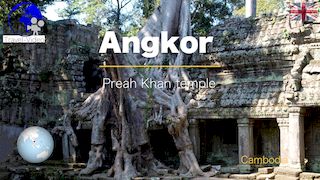
The scenes showing intertwined stones and roots are among the most evocative images of the monument. Over time, large trees have sent roots through joints, over walls, and around fallen blocks. These natural forms do not simply surround the temple; they interact with it, creating one of the most recognizable visual identities of Angkor.
Interior views reveal galleries, courtyards, narrow passages, doorframes aligned in perspective, and alternating zones of light and shade. Unlike temples centred on one dominant chamber, Preah Khan unfolds through movement. One space leads into another, creating a continuous sense of discovery.
The appeal of the site therefore lies not only in sculpture or architecture, but also in atmosphere: weathered stone, filtered light, controlled silence, and the constant presence of the surrounding forest.
Historical, architectural and cultural context
Preah Khan was built in the late twelfth century during the reign of Jayavarman VII, one of the most significant rulers in Khmer history. His reign was marked by an ambitious building programme that reshaped Angkor through temples, roads, hospitals, reservoirs, and civic foundations. Preah Khan formed part of this wider political and religious vision.
The complex is generally understood as both a temple and an institutional centre. It also carried commemorative significance linked to the royal family. Its name is often translated as “Sacred Sword,” but the monument’s historical role was far broader than that of an isolated shrine.
Architecturally, Preah Khan follows principles common in major Khmer sacred architecture: concentric enclosures, axial circulation, galleries, courtyards, and a hierarchical progression toward inner sacred zones. Yet its scale and internal complexity make it especially distinctive. It combines ceremonial planning with the feeling of an inhabited urban compound.
The site also reflects the religious transformations of Cambodia at the time. Jayavarman VII strongly promoted Mahayana Buddhism, while earlier Hindu traditions remained influential. As at several Angkor monuments, later changes introduced additional layers of meaning and adaptation.
After Angkor gradually lost its political centrality, Preah Khan entered a long period of partial abandonment. Vegetation expanded across the site until modern archaeological work and conservation campaigns stabilised and reopened major sections of the complex.
What the videos on this site make especially clear
Videos built from carefully selected and animated photographs are particularly effective for a monument such as Preah Khan. On site, the richness of corridors, courtyards, and details can sometimes overwhelm first impressions. A structured visual sequence helps clarify the organisation of the temple.
Views of the entrances show how scale and perspective were used to prepare movement inward. The visitor better understands that Khmer architecture often works through progression rather than immediate revelation.
Close views of roots and masonry make subtle details easier to read: textures of sandstone, displacement of blocks, tree growth patterns, and the delicate balance between preservation and natural force. These relationships are often missed during a quick visit.
Inside the temple, changing camera angles reveal the depth of galleries and the repeated alignment of openings. This helps explain why Preah Khan feels vast even when individual spaces are modest in size. The monument is experienced through sequence and rhythm rather than through one dominant viewpoint.
Light also plays an important role. Alternating brightness in open courtyards and shadow in covered corridors creates mood and depth. Carefully edited still imagery often captures these contrasts better than hurried movement through the site.
Finally, this approach shows that Preah Khan should not be understood as architecture separated from nature. It is a monument transformed by time, climate, roots, and restoration, where human design and natural processes now coexist.
A distinctive temple within Angkor
Preah Khan brings together imperial ambition, architectural complexity, and the powerful visual poetry of forest and stone. Less direct in its impact than some of Cambodia’s iconic temples, it rewards attention through layered spaces, changing perspectives, and a sense of history embedded in every wall.
The detailed pages linked to this video offer a deeper exploration of Preah Khan, its Khmer origins, and the architectural features that make it one of the great monuments of Angkor.


Audio Commentary Transcript
The complex of Buddhist temples of Preah Khan in Angkor was built at the end of the 12th century, to celebrate the victory of the Khmer emperor Jayavarman VII over the Chams, a competing kingdom of the Khmer empire. The temple was actually a real city where some 15,000 inhabitants lived. Preah Khan also housed the imperial court while waiting for the end of the construction of Angkor Thom, the place chosen by Jayavarman VII to become his new capital.

Music:
- - YouTube video library - Grass
- - YouTube video library - Zombie March
Disclaimer: Despite its appropriateness, copyright issues prevent the use of cambodian traditional music in "Angkor, the Preah Khan temple • Cambodia", hence the use of royalty-free music. Despite our careful selection, some might regret this decision, which is necessary to avoid potential lawsuits. Although difficult, this decision is the only viable solution.
Due to Vimeo's copyright control system, which does not correctly filter content, and their rigid policy, we have decided to transfer all our videos to YouTube. While we have appreciated our collaboration with Vimeo for many years, this decision is necessary to ensure the continuous and uninterrupted availability of our content. Thank you for your understanding and continued support.


