Français (France)
  Nederlands (nl-NL)
 00:00 • intro | 00:33 • Colors and flavors of vegetables | 03:07 • The essential chili of Assam | 04:07 • Everyday Spices | 05:00 • Local Flavors and Traditions | 06:22 • Meat on display | 06:49 • Fish from river and drying racks | 08:03 • Craftsmen serving the harvest | 08:29 • A Place Apart for Women
Personal creation from visual material collected during my trip India • Amazing East India: Assam, Odisha, West Bengal (2023)
Map of places or practices in Maloibari Pathar on this site
• Use the markers to explore the content •
Maloibari Pathar, Assam • Market Life in Everyday Scenes
A Rural Market at the Center of Local Life
In the Indian state of Assam, rural markets remain essential spaces where economy, social life and regional culture meet. They are places to buy and sell, but also places where communities gather, information circulates and seasonal production becomes visible. The market of Maloibari Pathar belongs to this long-standing tradition. Farmers, fishermen, small traders, artisans and local residents come together in an environment shaped by practical exchange and daily routines.
This video offers a close look at that living world. Through produce stalls, spice sellers, fish displays, meat counters and handmade tools, it presents a market not as a tourist attraction but as a functioning part of rural society. It also highlights the important role of women in local commerce, a significant feature in many markets of eastern and northeastern India.
Vegetables, Spices and Regional Food Culture
The first impression is often one of colour and abundance. Vegetables are displayed in baskets, on mats or in compact piles arranged for easy sale. Gourds, leafy greens, roots, beans and eggplants reflect the agricultural richness of Assam, a region supported by fertile soils, rainfall and river systems. Freshness is central, and much of the produce may come from nearby villages or small family farms.
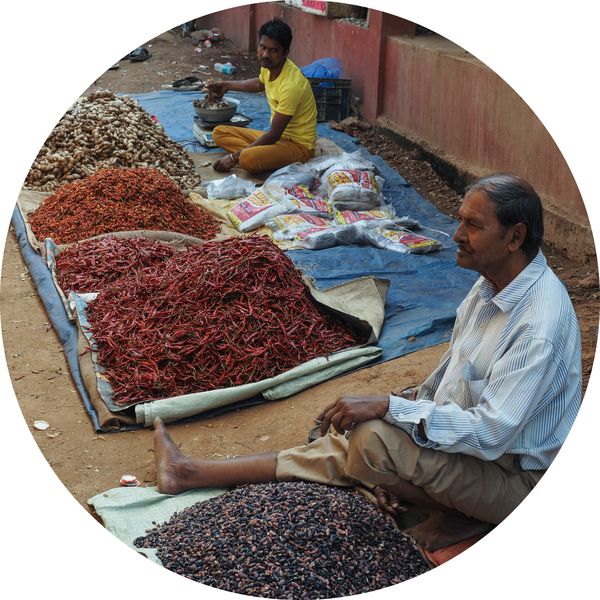
Assam’s well-known chillies occupy a special place. Several local varieties are appreciated for strength, aroma or distinctive flavour. In regional cuisine, chilli is more than seasoning: it helps define everyday taste preferences and culinary identity. Its prominent presence on the market stalls immediately signals its cultural importance.
Spices used in ordinary cooking add another layer to the sensory landscape. Sold whole, dried or in simple mixtures, they support household cooking traditions and sometimes older medicinal practices. Their value lies not only in flavour, but also in preservation methods and inherited food knowledge.
The market’s meat stalls reveal the diversity of diets found in Assam, where food customs vary among communities. Nearby, fish displays remind visitors of the importance of rivers, ponds and wetlands in regional life. Fresh fish, dried fish and preserved varieties reflect both environmental resources and practical methods of storage suited to humid climates.
Tools, Crafts and Working Life
The market is not limited to food. Artisans selling tools and practical objects show how closely trade is linked to agriculture. Baskets, cutting implements, storage containers and work accessories connect the market directly to farming cycles and household needs.
Such objects may appear ordinary, yet they represent technical knowledge adapted to local crops and daily tasks. A rural market often functions as both food center and supply center, supporting harvests, transport, maintenance and domestic labour.
This mixture of products helps explain why traditional markets remain relevant even where modern retail systems are expanding. They answer immediate practical needs while preserving face-to-face exchange.
Historical and Cultural Context of Markets in Assam
Assam has long developed around the Brahmaputra River system and surrounding fertile plains. Agriculture, fishing and trade routes created the conditions for regular market exchange over many centuries. Local markets allowed village producers to distribute goods while connecting rural zones with larger settlements.
The region is also marked by ethnic, linguistic and religious diversity. Assamese communities, tribal groups, migrants and long-established trading populations all contributed to a varied food culture. Markets often reveal this diversity more clearly than formal institutions, because they display what people actually grow, cook, buy and use.
In many towns and villages, the market remains one of the most important public spaces. Prices are discussed, relationships are maintained and the health of the local economy becomes immediately visible.
A Distinct Role for Women
The video draws attention to the presence of women among vendors and customers. In many parts of eastern India, women play a visible role in selling vegetables, spices, prepared foods and small household goods. They often help transform family production into cash income.
This participation reflects broader economic realities. Rural households frequently depend on shared responsibilities, where cultivation, food preparation and market exchange are interconnected. Markets can therefore serve as places of economic agency, social contact and intergenerational knowledge transfer.
What the Videos on This Site Make Especially Clear
Videos built largely from carefully selected and animated photographs are especially effective for market subjects. They allow viewers to study the arrangement of stalls, the textures of vegetables, the drying surfaces of fish or the detail of handmade tools. A slow visual movement across a spice display can reveal far more than a rapid moving shot.
This format also helps explain spatial organisation. Viewers can understand how fresh produce, meat, fish and craft items occupy different zones while still belonging to one coherent marketplace. Gradual transitions make circulation patterns and visual rhythms easier to read.
Close framing highlights expressions, gestures and practical routines that are often missed during a quick visit. The market becomes understandable not simply as a busy place, but as a carefully functioning system.
A Clear Portrait of Rural Assam
The market of Maloibari Pathar offers a direct insight into everyday life in Assam. It brings together agriculture, food traditions, craftsmanship and social exchange within one active setting. This video provides a valuable introduction to that world, while the related detailed pages invite deeper exploration of regional markets, culinary customs and living traditions in northeastern India.
Links to related pages


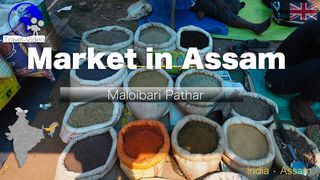
Audio Commentary Transcript
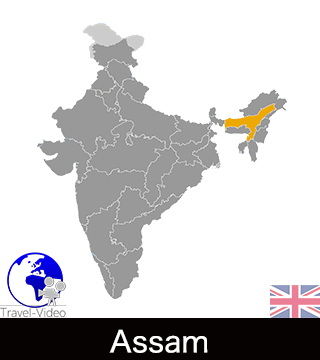
Assam, in Northeast India, is an agricultural region known for its rice fields and tea plantations. Village markets here are central to everyday life. In Maloibari Pathar, along the roadside, farmers and fishermen sell vegetables, fruits, and fish. This market embodies a living tradition of local exchange, essential to the economy and the social fabric of rural communities.
Vegetables on the market
Vegetables occupy a large part of the market. Cabbages, tomatoes, potatoes and gourds are piled up in sacks or arranged in small heaps directly on the ground. These products, grown in the surrounding fields, reflect the agricultural vitality of the region. Here, each family sells its harvest, ensuring a fresh and daily supply for the inhabitants of the nearby villages.
Alongside the staple vegetables, garlic and onions hold an essential place. Their aroma already hints at the chilies and spices that are inseparable from Assamese cuisine.
Chillies
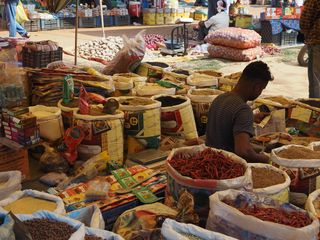
Chilies are among the most visible products on the market. They are found almost everywhere, mixed with vegetables and condiments, but often displayed in large piles spread directly on a tarpaulin on the ground. Whether red or green, fresh or dried, their abundance underlines the importance of this ingredient, essential for spicing up everyday cuisine in Assam.
Spices
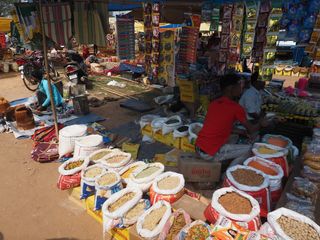
Spices have a more discreet presence in the market. Unlike vegetables and chilies from nearby fields, many of them come from other regions of India. Green pepper is found first, followed by the most common spices of Indian cooking: curry, mustard seeds and various aromatic powders.
Local flavors
Alongside jalebi and other popular local sweets, there are also everyday products: noodles, jaggery, as well as tobacco or betel leaves, all firmly rooted in tradition.
In Assam, in the northeast of India, the essential place in the diet is given to plant-based foods: a variety of vegetables, aromatic condiments, spices and sweets, complemented by some seasonal fruits. This predominance reflects the importance of vegetarianism in the local culture. Yet other resources also come to complete this foundation…
Meat and fish
In Assam, meat holds only a limited place in the diet: these few chickens and pieces of mutton, offered on the rudimentary stalls of Maloibari market, are enough to underline its secondary role.
By contrast, fish plays an essential role. Abundant in Assam thanks to rivers and ponds, it is sold here freshly caught, ensuring its freshness. This profusion not only supplies the markets on a daily basis, but also makes it possible to use preservation methods such as salting and drying, so that fish remains available throughout the year.
Craftsmen and snall traders
The market also hosts craftsmen who forge small agricultural tools on site, intended for everyday farm work.
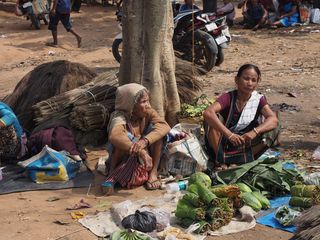
While most of the stalls are run by men, some women sit slightly apart with a modest harvest from their village. On the ground, they offer a few leaves, vegetables, fruits or handmade brooms to earn a small additional income. Their quiet presence on the margins of the market speaks volumes and makes it all the more touching.
Music:
- - YouTube video library - Bhairavi - Sitarkhani - Aditya Verma, Subir Dev
- - YouTube video library - Dhun (Sarangi, Tabla) - Sandeep Das, Aneesh Mishr
- - YouTube video library - Kirwani - Teental - Aditya Verma, Subir Dev
- - YouTube video library - Manj Khammaj - Teental - Aditya Verma, Subir Dev
Disclaimer: Despite its appropriateness, copyright issues prevent the use of indian traditional music in "Assam • Maloibari Pathar • Daily life at the market", hence the use of royalty-free music. Despite our careful selection, some might regret this decision, which is necessary to avoid potential lawsuits. Although difficult, this decision is the only viable solution.