

 Français (France)
  Nederlands (nl-NL)
 The Maa Kamakhya Temple, located in Guwahati, Assam, India, is one of the most revered temples in the Indian subcontinent. Dedicated to the goddess Kamakhya, it holds a significant place in Hindu religious traditions, particularly in the Shakti worship. This sacred site attracts thousands of pilgrims each year, especially during major festivals such as the Ambubachi Mela, which celebrates fertility. The spiritual significance of the temple makes it an important destination for both devotees and visitors, cementing its role in the religious landscape of the region.


Monument profile
Maa Kamakhya temple
Monument category: Hindu Temple
Monument family: Temple
Monument genre: Religious
Cultural heritage: Hindu
Geographic location: Guwahati • Assam • India
Construction period: 7th century AD
• Links to •
• Dynasties that contributed to the construction of the monument •

• List of videos about Guwahati on this site •
Guwahati • Maa Kamakhya Temple: Sacred Site of Assam
The Political and Social Motivations Behind the Construction of the Maa Kamakhya Temple and its Evolution Over Time
The Maa Kamakhya Temple, located in Guwahati, Assam, India, is one of the most sacred and historically significant temples in the country. Its construction is believed to have begun in the 7th century, during the reign of the Mlechchha dynasty, and the temple has since been a focal point for religious, political, and cultural developments in the region. This article explores the political and social motivations behind its construction, its historical evolution, and the challenges it faces today.
Political and Social Motivations for Construction
The construction of the Maa Kamakhya Temple in the 7th century had both political and social implications. At the time, Assam was a politically contested region, and the Mlechchha rulers sought to consolidate their authority by associating themselves with a powerful deity. Kamakhya, a manifestation of Shakti, the feminine divine energy, was venerated as a goddess of fertility and creation. The temple was built as a center of worship for this deity, reinforcing the political legitimacy of the ruling class by connecting their reign to the spiritual well-being of the kingdom.
On a social level, the temple served as a unifying force for the diverse ethnic and cultural groups in Assam. By establishing a central place of worship, the rulers sought to foster cohesion among the local population. The temple's importance in tantric practices and Shaktism added a unique dimension, as it became a hub for religious practitioners from across India. Its association with fertility rites and rituals of regeneration tied the spiritual realm to the daily life and agricultural cycles of the people.
Historical Events and Regional Development
Over the centuries, the Maa Kamakhya Temple has been shaped by several key historical events. One of the most significant was its destruction by Muslim invaders in the 16th century. This period of political upheaval in Assam, marked by the incursions of outside forces, significantly impacted the temple. The temple was later rebuilt in the 17th century under King Naranarayan of the Koch dynasty, who sought to restore the region’s religious and political identity.
The reconstruction of the temple was not merely an act of religious devotion but also a statement of political defiance and resilience. By rebuilding the temple, the Koch rulers reaffirmed their sovereignty and spiritual authority in the face of external threats. The revival of the temple as a religious center played a crucial role in the political stability of the region, as it helped maintain cultural continuity and strengthened the social fabric.
Global Context and Comparison
The period during which the Maa Kamakhya Temple was constructed and later rebuilt coincides with major global developments. In the 7th century, the world witnessed the rise of Islam in the Middle East, the Tang Dynasty in China, and the spread of Christianity in Europe. In India, the political landscape was similarly dynamic, with various kingdoms and dynasties competing for power.
Comparing the construction of Kamakhya to global religious structures, parallels can be drawn to religious monuments like the Great Mosque of Kairouan in Tunisia, constructed in the 7th century, and monastic Christian structures in Europe that symbolized both religious authority and political dominance. Like these structures, the Maa Kamakhya Temple was not only a religious site but also a political symbol, representing the rulers' connection to divine power and their control over the region.
Architectural Transformations and Cultural Influences
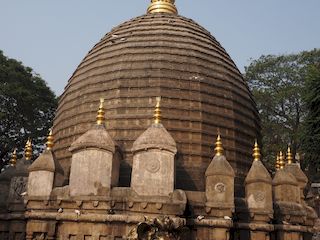
Over time, the Maa Kamakhya Temple has undergone several architectural transformations, reflecting the changes in power and the influence of various cultural forces. The most notable transformation occurred in the 17th century, when the temple was rebuilt. This reconstruction incorporated Islamic architectural elements, such as domes and floral motifs, which were a result of the interactions with Mughal and other Islamic influences in the region. The blending of Hindu and Islamic styles in the temple’s architecture is a testament to the cultural exchanges that took place in Assam during this period.
The structure of the temple is unique in its combination of a shikhara-style tower (common in North Indian temples) with a circular chamber for the sanctum, which houses a symbolic representation of the goddess Kamakhya in the form of a yoni (female genitalia). This architectural design reflects both local traditions and broader South Asian temple-building practices.
Cultural Significance and International Recognition
The Maa Kamakhya Temple is a major center for the Ambubachi Mela, an annual festival that celebrates the menstruation of the goddess, symbolizing fertility and the regenerative forces of nature. This festival draws thousands of pilgrims from across India, highlighting the temple’s enduring cultural and religious importance.
While the temple is not yet listed as a UNESCO World Heritage Site, its potential inclusion would greatly enhance its international recognition and bolster efforts for its preservation. Such recognition could also elevate the temple’s status globally, drawing more attention to its unique blend of religious practices, architectural styles, and cultural significance.
State of Conservation and Modern Challenges
The temple’s state of conservation is a matter of ongoing concern. Due to the heavy influx of pilgrims, particularly during festivals like Ambubachi Mela, the temple faces significant wear and tear. The surrounding urbanization of Guwahati has also impacted the temple's environment, with pollution and uncontrolled development posing threats to its integrity.
Efforts to preserve the temple are complicated by these modern pressures. While restoration work has been undertaken in recent decades, there is a delicate balance to be struck between maintaining the temple’s historical authenticity and accommodating the needs of its large number of visitors. Protecting the temple from environmental degradation, water damage, and human-induced wear remains a key challenge for conservationists.
Conclusion
The Maa Kamakhya Temple stands as a testament to the political, social, and religious forces that have shaped the region of Assam over the centuries. From its initial construction in the 7th century to its reconstruction and ongoing evolution, the temple reflects the resilience of the local culture and its ability to adapt to external influences while maintaining its spiritual core. As the temple continues to attract pilgrims and tourists alike, ensuring its preservation in the face of modern challenges is essential for safeguarding its historical and cultural legacy.
Technological Innovations and Architectural Brilliance of the Maa Kamakhya Temple: A Testament to Mlechchha Ingenuity
The Maa Kamakhya Temple, located in Guwahati, Assam, is not only a spiritual epicenter but also an architectural marvel that reflects the technological advancements and artistic innovations of the Mlechchha dynasty. Built during the 7th century, the temple showcases the grandeur of its era through its use of materials, unique construction techniques, and a blend of regional and foreign artistic influences. The temple has undergone numerous transformations throughout its history, yet it continues to stand as a testament to the architectural prowess of its time.
Materials and Construction Techniques: A Symbol of Grandeur
The original temple, built during the Mlechchha period, utilized local stone as the primary material, reflecting the region's natural resources. The stones were expertly cut and fitted together, often without visible mortar, a technique that required precision and expertise. This method not only provided structural stability but also gave the temple a timeless quality, withstanding centuries of natural wear and external threats.
The use of granite, a durable and challenging material to work with, demonstrated the advanced technological capabilities of the time. The temple's foundation and main structure were constructed using large blocks of this stone, and artisans employed advanced stone carving techniques to create intricate details and motifs. The absence of mortar in some sections is particularly noteworthy, as it shows the Mlechchha dynasty’s mastery in dry masonry, a sophisticated construction method that involved interlocking stones to create a seamless and resilient structure.
Architectural Features and Design: A Unique Fusion of Traditions
The architectural design of the Maa Kamakhya Temple stands out for its blend of regional and foreign influences. The temple features a shikhara-style tower, a characteristic of North Indian temple architecture, combined with a circular sanctum, an uncommon feature that sets it apart from other temples in the region. The circular inner sanctum houses the yoni, a symbol of the goddess Kamakhya, representing fertility and creation. This design reflects the temple’s deep-rooted connections to Shaktism and Tantric practices, which were prevalent in Assam during the Mlechchha period.
The motifs and decorative elements on the temple’s exterior also highlight a mixture of influences. The carvings depict various Hindu deities, mythological creatures, and geometric patterns, showing the influence of Indian traditions. However, the later renovations, particularly during the Koch dynasty in the 17th century, introduced Islamic artistic elements such as floral designs and domes. These modifications were likely a result of the cultural exchanges between Assam and the Mughal Empire, reflecting a synthesis of Hindu and Islamic architectural styles that was unique to this region.
Noteworthy Structure and Layout
One of the most remarkable aspects of the Maa Kamakhya Temple is its layout. The temple is designed around a sanctum sanctorum, which is partially underground and requires visitors to descend into a cave-like chamber to offer their prayers. This feature emphasizes the temple’s connection to the earth and the symbolism of the yoni, making it a spiritual site unlike any other. The circular plan of the sanctum contrasts with the more linear layouts of typical Indian temples, marking it as an architectural innovation of its time.
The temple’s height of approximately 20 meters and its octagonal base are also noteworthy. These elements not only serve an aesthetic purpose but also demonstrate the advanced understanding of geometry and structural stability that was prevalent during the Mlechchha era. The shikhara or tower rises gracefully from the octagonal base, creating a visual spectacle that is both grand and harmonious.
Historical Anecdotes and Architectural Statistics
The Maa Kamakhya Temple has a rich history filled with anecdotes that underline its importance as a religious and cultural hub. One such story recounts how the temple was destroyed during Muslim invasions in the 16th century but was later rebuilt by King Naranarayan of the Koch dynasty in the 17th century. The reconstruction was carried out with such speed and efficiency that it is said to have been completed in less than a year, using the expertise of skilled artisans from across India. This rapid restoration allowed the temple to regain its status as a major pilgrimage site, drawing devotees from far and wide.
In terms of scale, the temple complex spans several thousand square meters and includes multiple subsidiary shrines and sanctums. The main temple itself covers hundreds of square meters and is one of the largest in Assam, making it a focal point for both religious and architectural significance.
Contribution to International Recognition and UNESCO Impact
Although the Maa Kamakhya Temple has yet to be included on the UNESCO World Heritage list, its international recognition is steadily growing due to its unique architectural features and its importance in Shaktism. The temple’s annual Ambubachi Mela, which celebrates the goddess's menstruation and symbolizes fertility, attracts thousands of pilgrims from around the world, further cementing its global significance.
If the temple were to be listed as a UNESCO World Heritage Site, it would likely benefit from increased resources for conservation and restoration efforts. Such recognition would not only protect the temple’s historical and architectural integrity but also enhance its standing as a globally significant cultural monument. This would help preserve the temple's unique blend of Hindu and Islamic influences, ensuring that future generations can appreciate its architectural innovation and spiritual importance.
Conservation Challenges and Modern Threats
In the modern era, the Maa Kamakhya Temple faces several challenges in preserving its historical integrity. The influx of pilgrims, particularly during the Ambubachi Mela, places significant stress on the temple’s infrastructure. The environmental impact of tourism, combined with the urbanization of Guwahati, threatens the temple’s surroundings, potentially leading to damage from pollution, overcrowding, and unchecked development.
Additionally, the weathering of stone and natural erosion over centuries has affected parts of the temple’s structure. While efforts have been made to restore and maintain the temple, there is a delicate balance between preserving the original elements and introducing modern restoration techniques that may alter the temple’s historical authenticity.
Conclusion
The Maa Kamakhya Temple is a masterpiece of Mlechchha-era architecture, showcasing the technological advancements and cultural synthesis of its time. Its unique use of materials, innovative construction techniques, and fusion of regional and foreign artistic influences have made it a landmark of both spiritual and architectural significance. Despite the challenges of modern conservation, the temple continues to be a symbol of Assam’s rich cultural heritage, drawing international attention and admiration. Its potential UNESCO World Heritage recognition would further highlight its importance, ensuring its preservation for future generations.