

 Français (France)
  Nederlands (nl-NL)
 The Hoysaleswara Temple, located in Halebid in the Indian state of Karnataka, is one of the most significant monuments associated with Hoysala architecture. Dedicated to Shiva, the temple complex is especially known for its elaborate sculptural decoration and highly detailed stone carvings. Its exterior walls display numerous religious, mythological, and ornamental scenes carved with remarkable precision. Halebid, once an important Hoysala capital, preserves several major remains linked to the medieval history of southern India. Today, the site remains an important cultural and religious landmark and attracts visitors interested in Indian art, temple architecture, and regional history.
Halebid • Hoysaleswara Temple
Halebid • Hoysaleswara Temple
Halebid • Hoysaleswara Temple
Hoysaleswara Temple

The Hoysaleswara Temple and the Political History of Halebid
Foundation of the Temple and Royal Patronage
The Hoysaleswara Temple was constructed in Halebid, the medieval capital of the Hoysala dynasty in present-day Karnataka. Building activity began during the twelfth century, mainly under the reign of King Vishnuvardhana, one of the most influential Hoysala rulers. The monument was dedicated to Shiva and received the name “Hoysaleswara,” directly associating the temple with the ruling dynasty and its political authority.
An inscription linked to the monument identifies a wealthy officer named Ketamalla as an important patron of the construction. His role demonstrates the close connection between the royal court, administrative elites, and large religious foundations in the Hoysala capital. The temple was not conceived as an isolated sanctuary but as part of a broader program intended to reinforce the prestige of Dwarasamudra, the medieval name of Halebid.
The sanctuary occupied a central place within the ceremonial and religious landscape of the capital. Although the Hoysala rulers supported Shaivite, Vaishnavite, and Jain institutions, the Hoysaleswara Temple became one of the most visible expressions of royal Shaivism. The scale of the complex and the extraordinary richness of its sculptural decoration indicate long-term investment and access to substantial economic resources.
Construction appears to have continued over several decades. Some decorative sections display differences in finishing quality, suggesting that parts of the monument may have remained incomplete when political instability began to affect the kingdom.
Religious and Political Role in the Hoysala Capital
During the height of Hoysala power, the temple functioned both as a major religious institution and as a monument associated with dynastic legitimacy. Important Shaivite rituals and ceremonial activities were likely connected to the royal court and to the public representation of authority within the capital.
The complex was organized around two principal sanctuaries dedicated to Shiva. This dual arrangement has often been interpreted as reflecting specific ceremonial or dynastic symbolism connected with royal patronage. Large donations of land, agricultural income, and ritual resources were assigned to the temple through inscriptions, allowing the maintenance of priests, festivals, and daily worship.
The monument also participated in the urban organization of Halebid. It formed part of a larger sacred and administrative environment that included reservoirs, secondary shrines, residential quarters, and courtly structures. The concentration of monumental architecture within the capital reflected the prosperity achieved by the Hoysala state during its territorial expansion across southern India.
The artistic ambition of the temple corresponded to a period when the dynasty sought to distinguish itself from neighboring powers in the Deccan and southern peninsula. The refinement of the monument’s sculptural program contributed to the political image of the Hoysala court as a center of wealth, religious patronage, and artistic sophistication.
Invasions, Decline, and Later Transformations
The history of the Hoysaleswara Temple changed significantly during the early fourteenth century when military campaigns launched by the Delhi Sultanate reached the Hoysala capital. Armies associated with the general Malik Kafur attacked Dwarasamudra in 1311, causing extensive destruction in the city and damaging several religious monuments.
Parts of the temple suffered structural and sculptural damage during these invasions. Numerous carved figures still preserve visible traces of mutilation. The destruction of the superstructures above the sanctuaries probably dates in part from this period. Although the monument remained standing, the decline of Hoysala political power reduced the resources available for maintenance and ceremonial activity.
As Halebid gradually lost its status as a political capital, the temple continued to function as a place of worship on a more limited scale. The surrounding urban environment changed considerably over the following centuries, while portions of the complex experienced progressive deterioration caused by weathering and neglect.
During the nineteenth century, British administrators and early archaeologists began documenting the monument. Surveys, drawings, and historical studies contributed to renewed scholarly interest in Hoysala architecture. Conservation measures were later continued under the Archaeological Survey of India after independence.
The Temple in the Context of the Twelfth Century
The principal phase of construction of the Hoysaleswara Temple took place during the twelfth century. During the same period, Gothic cathedrals were expanding across western Europe, especially in France and England. In the Middle East, Seljuk political influence remained important in several regions. In China, the Song dynasty continued major urban and economic development. In Southeast Asia, large Khmer temple complexes were being constructed around Angkor.
Preservation, UNESCO Recognition, and Current Status
Today the Hoysaleswara Temple is regarded as one of the most important surviving monuments of the Hoysala dynasty and of medieval Karnataka. The site is protected and maintained by the Archaeological Survey of India, which oversees conservation work and visitor management.
The temple remains an active religious site while also functioning as a major historical monument. Its sculptural decoration, architectural scale, and historical importance attract both pilgrims and researchers. Conservation efforts focus primarily on limiting erosion of the chloritic schist used in the monument, as well as controlling damage caused by climate conditions and increasing tourist activity.
In 2023, the temple was inscribed on the UNESCO World Heritage List as part of the serial property titled “Sacred Ensembles of the Hoysalas.” This recognition includes several major Hoysala monuments in Karnataka and acknowledges the historical and artistic significance of their architecture and sculptural programs.
Monumental Layout and Sculptural Architecture of the Hoysaleswara Temple at Halebid
Site Organization and General Plan of the Complex
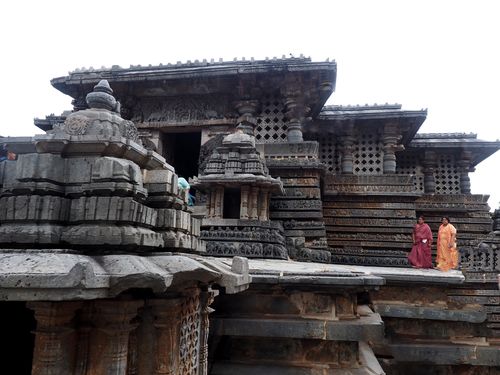
The Hoysaleswara Temple stands at Halebid, the former Hoysala capital in present-day Karnataka. The monument occupies an open setting that still allows a broad perception of its horizontal massing and sculptural surfaces. The entire complex is raised on a large jagati platform with a stellate configuration composed of repeated projections and recesses. This star-shaped plan creates changing perspectives and produces a continuous sequence of sculpted wall surfaces visible from multiple angles.
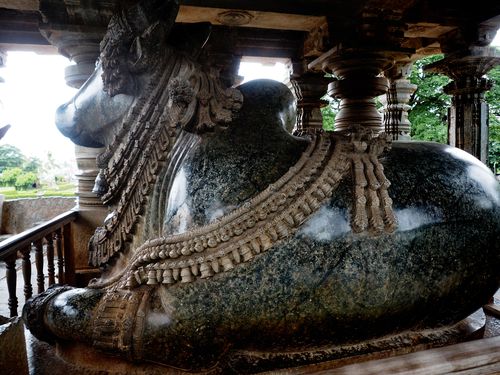
The principal structure follows a dvikuta arrangement with two sanctuaries dedicated to Shiva. These twin shrines are positioned parallel to each other and connected by a shared hall, producing a symmetrical but elongated composition. Each sanctuary is preceded by a pavilion housing a monumental Nandi sculpture aligned with the axis of worship.
The monument emphasizes horizontal extension rather than vertical dominance. Repeated lateral projections and deeply articulated exterior walls multiply shadow lines across the façade and enhance the visual depth of the sculptural decoration. Several subsidiary entrances and open mandapas are integrated into the perimeter of the temple. Circulation paths around the sanctuaries allow ritual circumambulation while guiding movement along the sculpted exterior walls.
The original superstructures above the sanctuaries no longer survive, but remaining foundations indicate that the temple originally combined low horizontal volumes with elevated shikharas. Their disappearance altered the initial visual balance of the monument.
Building Materials and Construction Techniques
The temple was primarily constructed from chloritic schist, commonly known as soapstone. This material remained relatively soft when quarried and hardened gradually after exposure to air, allowing exceptionally precise carving. The quality of the sculptural program is closely linked to the properties of this stone.
The masonry demonstrates careful block assembly with minimal visible mortar. Architectural and decorative elements were carved with remarkable technical precision, especially in narrative friezes, moldings, and figurative panels. Deep undercutting techniques created strong contrasts between light and shadow across the exterior walls.
The interior columns are among the most technically refined architectural elements in the complex. Many appear to have been lathe-turned using rotational carving methods. Their polished surfaces contrast with the dense sculptural textures covering the exterior walls. Several columns incorporate polygonal shafts, circular bands, and highly regular geometric forms.
The structural system combines heavy load-bearing walls with carefully distributed columns supporting stone ceilings. Despite the density of ornamentation, the hypostyle halls maintain strong structural stability. Ceiling slabs are decorated with concentric floral and geometric compositions carved directly into the stone.
Stone brackets and beams connect the various interior spaces while maintaining continuity between halls and sanctuaries. The platform moldings reveal careful proportional planning. Horizontal architectural bands were designed not only for structural articulation but also to accommodate extensive sculptural narratives arranged in a clear visual hierarchy.
Exterior Elevations and Sculptural Programs
The exterior walls form the most distinctive component of the Hoysaleswara Temple. The façades are organized into superimposed horizontal registers extending around nearly the entire monument. This arrangement transforms the outer walls into continuous sculptural surfaces.
The lower registers usually consist of long elephant friezes carved in procession. Above them appear cavalry scenes, vegetal scrolls, mythical animals, lions, and narrative episodes from Hindu epics. Each horizontal band maintains its own decorative rhythm while remaining integrated into the overall composition.
Scenes from the Ramayana, Mahabharata, and Puranas occupy a major place within the sculptural program. The carvings integrate figures, weapons, jewelry, animals, and miniature architectural forms in dense compositions. Some sculptures project dramatically from the wall surface because of the depth achieved in the carving process.
Large sculptural niches contain representations of Shaivite, Vaishnavite, and occasionally Jain deities. Shiva appears in multiple iconographic forms, including Nataraja, Bhairava, and Ardhanarishvara. The variety of religious imagery reflects the broader religious environment associated with the Hoysala court.
The repeated projections of the stellate plan intensify the visual fragmentation of the façades. Each outward angle creates a different viewpoint for observing the sculptural decoration. This configuration produces changing effects of illumination throughout the day, emphasizing relief depth and surface articulation.
Decorative female figures commonly identified as madanikas appear in selected areas, though they are less dominant than in some other Hoysala monuments. Cornices, moldings, and miniature shrine motifs reinforce the layered complexity of the elevations, leaving very little undecorated stone visible on the exterior.
Interior Spatial Organization and Architectural Volumes
The interior spaces are comparatively restrained in relation to the richness of the outer façades, although sculptural decoration remains extensive. The halls are relatively low in height, creating an impression of compact spatial density rather than monumental vertical expansion.
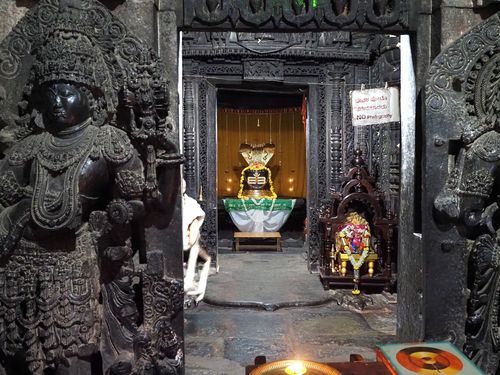
The central mandapa is organized through rows of polished stone columns arranged according to a regular geometric scheme. Openings along the sides admit limited natural light, while several interior zones remain deliberately dim, reinforcing the ritual atmosphere of the sanctuary spaces.
Ceiling panels display carved floral rosettes and geometric patterns positioned within square or circular compositions. The distribution of decorative elements across the ceilings creates strong visual concentration above the circulation spaces.
The sanctum interiors are comparatively austere. The lingams dedicated to Shiva occupy the center of the shrine chambers, while vestibules create transitional zones between public halls and sacred interiors. This gradual progression through increasingly restricted spaces remains clearly legible despite later restoration work.
The Nandi pavilions positioned before the sanctuaries repeat several architectural features of the main temple. Their monumental bull sculptures are carved from large stone masses and aligned directly toward the sanctums according to ritual orientation. The interior organization prioritizes continuity between architectural structure and sculptural ornamentation, with columns, ceilings, beams, and walls forming an integrated decorative system.
Damage, Restoration, and Architectural Preservation
The invasions of the early fourteenth century caused substantial damage to parts of the monument, especially the superstructures and certain sculptural elements. Many reliefs still preserve visible traces of mutilation affecting faces, limbs, and symbolic attributes.
The disappearance of the original towers considerably altered the silhouette of the temple. Nevertheless, the principal halls, sanctuary walls, and structural platform survived largely intact. Later conservation efforts focused mainly on stabilization rather than reconstruction of missing architectural components.
The Archaeological Survey of India currently oversees preservation of the site. Major conservation challenges include erosion of the chloritic schist caused by humidity, climatic variation, and biological growth on exposed surfaces. Visitor circulation also contributes to gradual wear on sculptural details.
The inclusion of the monument on the UNESCO World Heritage List in 2023 as part of the “Sacred Ensembles of the Hoysalas” reinforced preservation efforts around the site. Current interventions emphasize protection of sculptural surfaces, environmental monitoring, and controlled maintenance of the surrounding area to reduce long-term structural deterioration.