

 Français (France)
 Nederlands (nl-NL)
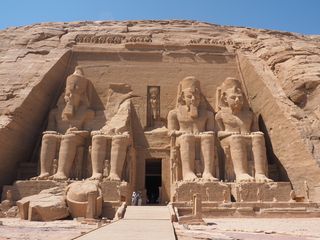
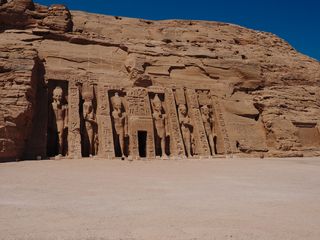
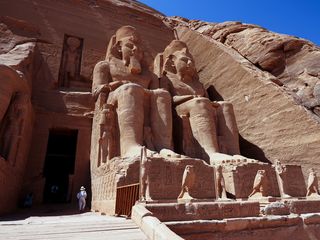
The royal colossi of Abu Simbel, in southern Egypt, are monumental statues arranged across the façades of two rock-cut temples. Four seated figures representing Ramesses II stand before the Great Temple. The façade of the Small Temple displays six standing statues depicting the pharaoh and Queen Nefertari. These groups connect royal imagery with the religious function of the sanctuaries. Smaller representations of royal family members accompany some figures. Relocated with the temples to prevent their submersion during the creation of Lake Nasser, the colossi form part of the Nubian Monuments World Heritage property, inscribed on the UNESCO list in 1979.
Abu Simbel • Royal Colossi
Abu Simbel • Royal Colossi
Abu Simbel • Royal Colossi
Royal Colossi

Sculptures • Giant statues : Colossal figures and sculptural groups
The Royal Colossi of Abu Simbel: Commission, Survival and Relocation
A Royal Commission in Thirteenth-Century BCE Nubia
The royal colossi of Abu Simbel were commissioned by Ramesses II, a ruler of Egypt’s Nineteenth Dynasty, during the thirteenth century BCE. They formed part of the sculptural programmes of two temples cut into the cliffs on the western bank of the Nile in Nubia. The four seated figures outside the Great Temple all represent Ramesses II. The Small Temple displays six standing figures: four of the king and two of Queen Nefertari.
Their creation expressed Egyptian royal authority in territory governed through the pharaoh’s representatives. Facing the river, the principal route through this part of Nubia, the statues made the ruler’s presence visible to those approaching the sanctuaries. Rather than recording a single conquest, they established a permanent royal image within a landscape administered by Egypt. Their association with functioning temples connected that political presence to the worship conducted inside.
Royal Identity and Religious Purpose
The Great Temple’s colossi presented Ramesses II as a sovereign whose authority was supported by the gods. Within the sanctuary, his deified image appeared alongside Amun-Ra, Ra-Horakhty and Ptah. The repeated royal figures on the façade extended this relationship between kingship and divinity into the temple’s exterior setting. They represented the same ruler in a deliberately repeated form, rather than successive kings or different members of the dynasty.
At the Small Temple, dedicated to Hathor and Nefertari, the queen’s two colossi were approximately equal in height to those of her husband. This departure from the usual difference in scale between royal spouses emphasized Nefertari’s position within this particular religious programme. It does not establish that she possessed political authority equivalent to the king’s. Smaller figures of princes and princesses beside the adult statues extended the display to the royal family.
Ancient Damage, Inscriptions and Sand Clearance
One seated colossus at the Great Temple lost its head and upper torso in antiquity. The collapse is generally attributed to an earthquake, although its date remains uncertain. Surviving fragments were left below the façade rather than incorporated into a complete reconstruction. The broken figure consequently records a distinct episode of damage within an otherwise repetitive group of royal images.
The legs of the colossi also preserve inscriptions left by ancient visitors. Greek-speaking soldiers involved in the Nubian expedition of Psamtik II in the early sixth century BCE carved texts into the statues. These inscriptions document the passage of military personnel centuries after Ramesses II and identify participants in an army that included men of different origins.
Accumulating sand subsequently concealed much of the Great Temple’s façade. In 1813, Johann Ludwig Burckhardt reported its visible upper portions to European scholarly audiences. Giovanni Battista Belzoni and his team cleared enough sand to enter the temple in 1817. Drawings, surveys and later photographs progressively documented the colossi, providing records of their appearance before their twentieth-century relocation.
Contemporary Developments Elsewhere
When the colossi were carved, the Hittite Empire controlled much of Anatolia and parts of Syria. Mycenaean palace centres remained active in Greece before the destructions associated with the end of the Late Bronze Age. In China, the Shang dynasty ruled from the Anyang region, where divinatory inscriptions on bones and turtle shells provide written evidence for royal activities.
Relocation and World Heritage Protection
Construction of the Aswan High Dam threatened to submerge the colossi beneath the future Lake Nasser. Their rescue became part of the international safeguarding campaign launched by UNESCO in 1960. The statues and surrounding façades were cut into numbered blocks, transferred to higher ground and reassembled with the temples. The reconstructed complex was inaugurated at its new location in September 1968.
Fragments from the previously collapsed colossus were also transferred, preserving the visible evidence of its ancient destruction. Since 1979, the statues have been included within the UNESCO World Heritage serial property officially named “Nubian Monuments from Abu Simbel to Philae.” Their present setting combines the reassembled ancient sculptures with an artificial cliff and modern supporting structures, allowing the original stone figures to remain on display above the reservoir.
The Royal Colossi of Abu Simbel: Composition, Proportions and Rock-Cut Construction
Two Sculptural Groups Integrated into Temple Fronts
The royal colossi of Abu Simbel form two separate groups incorporated into the façades of the Great and Small Temples. Four seated statues of Ramesses II, approximately twenty metres high, frame the Great Temple’s entrance in two pairs. The Small Temple has six standing figures approximately ten metres high: four representing the king and two Queen Nefertari. Their arrangement establishes the entrances as the central axes of both compositions.
The statues were originally carved directly from the sandstone cliff rather than erected as freestanding objects against an existing wall. Sculptors removed the surrounding rock while retaining connections between the figures and the material behind them. This continuity determined their depth and structural support. Their projecting fronts contrast with their attached backs, producing figures that appear substantially three-dimensional when approached obliquely while remaining inseparable from the façades.
At the Great Temple, seated bodies create broad masses concentrated around torsos, knees and thrones. At the Small Temple, upright figures establish a narrower vertical rhythm, alternating with inscribed strips of rock. On either side of its doorway, a statue of Nefertari stands between two representations of Ramesses II. The difference between these arrangements gives each façade a distinct relationship between sculpted volume, exposed background and entrance opening.
The Seated Colossi of the Great Temple
The seated figures show Ramesses II with an upright torso, hands resting on his thighs and lower legs extending towards feet placed on substantial bases. Their thrones and the stone retained behind their bodies provide broad supporting masses. Arms remain close to the torso, avoiding long unsupported projections. The knees extend prominently towards the forecourt, while the vertical lower legs create deep recesses beside and between them.
The heads combine large facial planes with clearly defined royal attributes. The striped nemes headdress frames the cheeks and descends onto the chest, while the double crown extends the silhouette upwards. A false beard projects beneath the chin, and a cobra ornament marks the forehead. These elements concentrate detail around the face, contrasting with the comparatively uninterrupted surfaces of the chest, shoulders and upper arms.
Smaller royal family figures occupy spaces beside the calves and between the legs. Their reduced scale allows additional bodies to be incorporated without interrupting the dominant outlines of the seated statues. Carved decoration also extends onto the throne sides. Above the doorway, a figure of Ra-Horakhty occupies the central recess, while the baboon frieze runs along the façade’s upper edge, establishing a horizontal termination above the four crowned heads.
The Standing Figures of the Small Temple
The Small Temple’s six colossi occupy tall recesses that distinguish their silhouettes from the surrounding rock. Each figure remains attached to the backing material, with the body facing forwards and one leg advanced. This displacement introduces movement at ground level without rotating the shoulders or pelvis. The arms generally remain close to the sides, maintaining compact outlines and limiting narrow, exposed connections between limbs and torso.
Nefertari’s statues reach approximately the same height as those of Ramesses II, but differences in clothing and bodily contour distinguish the figures. The queen wears a long fitted dress, while the king appears in a short kilt. Crowns and headdresses further differentiate the representations. Narrow waists, elongated legs and relatively close-set feet give this group a more slender appearance than the broad seated masses of the Great Temple.
Smaller figures of royal children accompany the adults near their legs. Between the principal statues, vertical hieroglyphic inscriptions occupy flat strips that separate the recesses. This arrangement places text on the intervening rock rather than across the main bodily surfaces. Recessed backgrounds produce lateral shadows around shoulders, arms and legs, making the depth of the carving visible as daylight changes across the façade.
Sandstone, Fracture and Structural Reassembly
Sandstone forms both the sculpted material and the original supporting mass of the colossi. Its bedding and natural discontinuities affect the survival of projecting parts. One seated figure at the Great Temple lacks its head and upper torso, exposing fracture surfaces above the surviving lower body. The fallen pieces displayed below reveal the scale and thickness of elements normally viewed from far beneath their original positions.
During relocation, the statues and adjacent façades were divided into numbered blocks and reassembled on higher ground. Joints therefore cross surfaces originally carved from continuous rock. The reconstructed fronts now stand against artificial hills incorporating reinforced-concrete supporting structures. Their present construction combines ancient sandstone with modern structural protection, while retaining the original disposition of the figures, the entrance relationships and the visible fragmentation of the damaged colossus.