Français (France)
  Nederlands (nl-NL)
 Of Sikh tradition, (with additional Hindu influence), the Phulkian of Nabha dynasty ruled for approximately 348 years, ± between 1600 and 1948 over all or part of North India, during the Medieval Period, the Colonial Period and the Modern Period.
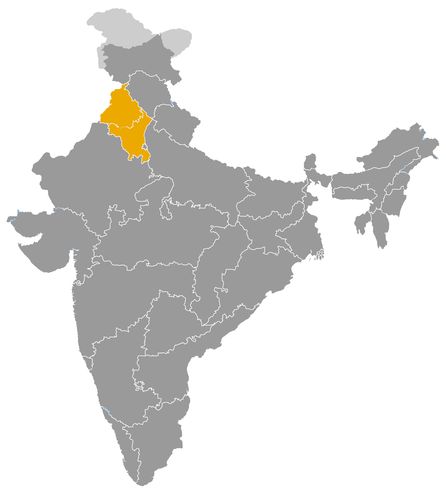
This map illustrates the maximum territory that the Phulkian of Nabha Dynasty had reached at its height, covering the current regions of Haryana and Punjab in India. Its main purpose is to provide a visual aid to understand the geographical extent of this dynasty. However, it's important to note that the contemporary borders of these regions may not necessarily coincide with the historical territories.
The Phulkian Dynasty of Nabha and Its Role in the History of Princely Punjab
A Sikh branch of the wider Phulkian house
The Phulkian dynasty of Nabha belonged to the group of Sikh ruling houses that traced their origin to Chaudhary Phul, the eponymous ancestor of the Phulkian family in the Malwa region of Punjab. Alongside Patiala and Jind, Nabha formed one of the main sovereign branches of this wider dynastic network. Its historical role must therefore be understood through two connected dimensions: its cultural and genealogical place within the Phulkian house, and its political development as a separate princely state.
Nabha was not the most powerful of the Phulkian states. Patiala generally held a more prominent position in the regional hierarchy. Yet Nabha remained historically significant because it preserved a distinct dynastic identity, governed a recognised princely territory, and participated in the political order of the Cis-Sutlej Sikh states. Its history shows how a medium-sized or smaller princely state could maintain relevance through lineage prestige, local administration, strategic diplomacy and adaptation to British paramountcy.
A princely state rooted in the Malwa region of Punjab
The territorial and cultural base of Nabha lay mainly in the Malwa region of Punjab. The town of Nabha, now in the Indian state of Punjab, served as the main centre of the dynasty and gave the state its name. The former princely state, however, was more complex than a single urban centre. It included villages, agricultural lands, revenue areas, local markets and administrative divisions, some of which were connected to areas that now fall outside present-day Punjab.
This geography placed Nabha in close relation with Patiala and Jind. The three states shared Phulkian descent, but each maintained its own ruling house, court, territory and political interests. Their proximity created a landscape in which kinship and rivalry existed side by side. Nabha’s role was therefore shaped not by large-scale expansion, but by its ability to preserve autonomy within a dense regional network of related and competing states.
Political significance among the Cis-Sutlej Sikh states
The Nabha branch emerged as a territorial power in the eighteenth century, during a period of major political change in north-western India. Mughal authority was weakening, Afghan incursions affected Punjab, and Sikh misls and chiefships were expanding their influence. In this setting, Hamir Singh is generally regarded as the effective founder of Nabha State. His successors consolidated local authority while navigating a shifting political environment.
Nabha’s political position depended heavily on its relations with Patiala, Jind and other Sikh powers. The shared Phulkian origin gave the dynasty legitimacy, but it did not create a single political unit. Each branch defended its own territory and rank. This made Nabha part of a broader princely world in which family ties, military alliances, disputes over boundaries and the search for external recognition all mattered.
In the early nineteenth century, Nabha entered the orbit of the Cis-Sutlej states protected by the British. This arrangement restricted its external sovereignty, but it also allowed the dynasty to survive as a distinct princely house. Under British paramountcy, Nabha retained internal authority while diplomacy, military policy and broader regional security were increasingly controlled by colonial power.
Dynastic crises and the limits of princely autonomy
The political history of Nabha was marked by episodes that reveal the limitations of princely sovereignty under British rule. The deposition of Devendra Singh in the nineteenth century and that of Ripudaman Singh in the twentieth century show that dynastic legitimacy alone was not sufficient to secure effective rule. Recognition by the British authorities became essential.
These crises demonstrate the distinction between hereditary status, princely title and actual political power. A ruler could belong to the legitimate dynasty and retain symbolic prestige, while still being removed from government if relations with the colonial administration deteriorated. Nabha therefore offers a clear example of how Indian princely states combined continuity of royal houses with dependence on the imperial framework.
At the same time, such crises did not erase the importance of the dynasty. The ruling house remained a focus of identity, prestige and political memory. Even when authority was restricted, the dynastic structure continued to organise local legitimacy and princely representation.
Agrarian revenue and regional administration
The economy of Nabha was primarily agrarian. The state’s resources came from villages, cultivated lands, rural markets and revenue rights. Land income supported the court, administration, public works, local institutions and the forms of patronage associated with princely rule.
Nabha was not a major port or an international commercial centre. Its economic role was regional. The management of land, taxation, agricultural production and local exchange formed the basis of its political economy. Under British paramountcy, these functions became increasingly formalised through administrative procedures, fiscal regulation and supervision.
This economic structure shaped the role of the rulers. Their authority depended on effective revenue collection, relations with landholding groups, maintenance of order and the administration of a compact but sometimes dispersed territory. Nabha’s economy therefore illustrates the practical foundations of many smaller princely states in northern India.
Sikh identity within a diverse princely society
The Phulkian dynasty of Nabha was a Sikh ruling house. Its legitimacy was connected to Sikh lineage traditions, the history of the Malwa region, the memory of the misls and the martial culture of eighteenth-century Punjab. This Sikh identity linked Nabha to Patiala, Jind and the wider Sikh political world.
The population ruled by Nabha, however, was religiously diverse. Sikhs, Hindus and Muslims lived within its territories, as in many princely states of Punjab. The cultural role of the dynasty therefore cannot be reduced to a single religious community. The rulers had to govern a plural society composed of different religious institutions, rural elites, trading groups and local communities.
Royal patronage supported religious sites, ceremonies, education, public representation and princely prestige. Through such patronage, the dynasty affirmed its status while participating in the broader culture of princely Punjab.
A regional dynasty absorbed into independent India
The effective sovereignty of Nabha ended in 1948, when the state was integrated into the Patiala and East Punjab States Union. This marked the disappearance of Nabha as an autonomous princely state, but not the end of its historical significance.
The Phulkian dynasty of Nabha occupies an important place in the regional history of India. It connects Sikh lineage politics, the Malwa region of Punjab, the Cis-Sutlej states, British princely administration and the territorial reorganisation that followed Indian independence. Its role was less dominant than that of Patiala, but it remains essential for understanding the diversity of Sikh princely power in north-western India.
The Geographical Extension of the Phulkian Dynasty of Nabha in Princely Punjab
A Phulkian state rooted in the Malwa region of Punjab
The Phulkian dynasty of Nabha ruled a princely state located mainly in the Malwa region of Punjab, in north-western India. Like the ruling houses of Patiala and Jind, it belonged to the wider Phulkian family, traditionally descended from Chaudhary Phul. This common origin placed Nabha within a shared dynastic network, but the state itself had its own territory, rulers, administration and political interests.
The geographical history of Nabha must be treated with caution, because the former princely state does not correspond exactly to present-day administrative borders. Its core lay in what is now the Indian state of Punjab, around the town of Nabha, today situated in the Patiala district. However, some dependencies or administrative divisions connected with the former state extended toward areas that now belong to Haryana. Nabha was therefore primarily a Punjabi princely state, but its territorial history was broader and more complex than the modern town alone suggests.
Nabha as the dynastic and administrative centre
The town of Nabha formed the principal centre of the dynasty. It gave its name to the state and served as the main focus of royal authority. The court, princely institutions, residences, markets and local networks were connected with this urban centre. Nabha’s importance was not only administrative, but also symbolic, because it represented the independent identity of this branch of the Phulkian house.
The state controlled a territory made up of villages, agricultural lands, revenue rights, local routes and secondary centres. It was not a large continuous kingdom of the kind associated with major regional powers. Its cohesion depended on administration, land revenue, dynastic recognition and relations with neighbouring states. In this sense, Nabha was typical of several smaller princely states in north-western India, where political authority was based on a network of rural and semi-urban holdings rather than on a vast imperial territory.
Amloh and the Punjabi territorial framework
Amloh was one of the important localities associated with the Nabha State. Located today in Punjab, it helps illustrate the extent of the state beyond its capital. Its inclusion in the Nabha sphere shows that the dynasty did not rule only the town of Nabha, but also controlled or administered a wider group of Punjabi territories.
These areas were economically important because they provided agricultural revenue. Villages, cultivated fields and rural markets formed the material base of the state. The rulers of Nabha depended on these resources to maintain the court, administration, public works and local authority. The geographical extension of the dynasty was therefore closely linked to agrarian control. Its power was expressed through the management of land, revenue and local institutions rather than through maritime trade or large-scale conquest.
Bawal and the complexity of peripheral possessions
The former Nabha State also had connections with areas outside its main Punjabi core, including the Bawal region, now in Haryana. This feature shows the complexity of princely territories in northern India. They were not always compact or geographically continuous. Some included separated or peripheral zones shaped by dynastic, territorial or administrative processes specific to each state.
Such dispersed possessions influenced the way Nabha had to govern. The rulers needed officials, revenue systems, local intermediaries and relations with landed elites in order to maintain authority over areas that were not always close to the capital. This made administrative coordination important. Nabha’s territorial structure encouraged cautious management rather than aggressive expansion.
Relations with Patiala and Jind in the Phulkian zone
Nabha’s geography was strongly shaped by the proximity of Patiala and Jind. These three states were related branches of the Phulkian house, but they were not a single political entity. Each had its own rulers, territory and interests. Their closeness created a political landscape in which kinship, rivalry and diplomacy existed together.
Patiala was usually the most powerful of the Phulkian states and had greater political weight. Jind, whose territory connected present-day Haryana and Punjab, formed another neighbouring branch. Nabha therefore had to protect its autonomy within a region dominated by related but competing houses. Shared ancestry gave the dynasty legitimacy, yet it did not remove disputes over boundaries, rank, influence or relations with stronger powers.
Position among the Cis-Sutlej Sikh states
The territorial development of Nabha belonged to the wider history of the Cis-Sutlej Sikh states. These states emerged during the eighteenth century, when Mughal authority weakened, Afghan interventions disrupted Punjab, and Sikh chiefs consolidated regional power. Nabha’s rulers sought less to build a large kingdom than to secure a recognised and durable princely domain.
The location of Nabha placed it in contact with Sikh principalities, local landholding groups and wider north Indian political forces. Its survival depended on maintaining a balance between neighbouring powers. The state’s modest size made diplomacy essential. It could not rely on territorial depth or overwhelming military strength, so recognition, alliances and careful administration became central to its political geography.
British protection and territorial stabilisation
In the early nineteenth century, Nabha came under British protection as part of the Cis-Sutlej political order. This changed the meaning of its territory. The state retained internal administration, but its external sovereignty was restricted. Its borders and status became more stable, but this stability was linked to British paramountcy.
British protection reduced the danger of absorption by stronger neighbours, including related princely houses. At the same time, it limited Nabha’s freedom to expand or conduct independent diplomacy. The state became a recognised princely territory within a colonial framework, where internal governance mattered more than military expansion.
A modest territory with durable regional significance
The Phulkian dynasty of Nabha controlled a relatively limited territory, centred on Nabha and linked to other Punjabi localities such as Amloh, with some peripheral connections toward present-day Haryana. Its geography placed it between Patiala, Jind, other Sikh states and British power.
Nabha was not a major territorial empire, but its geographical position allowed it to preserve a distinct identity within princely Punjab. Its history shows how a smaller Sikh princely state could maintain authority through land control, dynastic legitimacy, administrative cohesion and diplomatic adaptation. Its integration into the Patiala and East Punjab States Union in 1948 ended its effective sovereignty, but its territorial history remains important for understanding the political geography of north-western India.
This chronology distinguishes the cultural origin of the Phulkian house, traditionally linked to Chaudhary Phul in the seventeenth century, from the effective sovereignty of the Nabha branch, established in the eighteenth century. The earliest figures belong to the dynastic and lineage trunk; the rulers of Nabha later bore the titles of raja and then maharaja within the Cis-Sutlej Sikh states and the British princely system.
Common dynastic origin of the Phulkian house, c. 1600–1763
- Chaudhary Phul (first half of the seventeenth century, traditional lineage chief) • The eponymous ancestor of the Phulkian house, he is associated with the common origin of the Patiala, Nabha and Jind branches.
- Tiloka Singh (second half of the seventeenth century, genealogical tradition) • A son of Phul, he is generally linked to the lines from which the Nabha and Jind branches descended.
- Gurdit Singh (late seventeenth–early eighteenth century, genealogical tradition) • A descendant of Tiloka Singh, he belongs to the lineage transmission before the formation of Nabha State.
Rulers of Nabha, 1763–1948
- Hamir Singh (1763–1783) • Effective founder of Nabha State, he established one of the principal Phulkian branches in the Malwa region of Punjab.
- Jaswant Singh (1783–1840) • Raja of Nabha, he ruled during the consolidation of the Cis-Sutlej Sikh states and closer relations with British power.
- Devendra Singh (1840–1846) • Raja of Nabha, he was deposed by the British after political and administrative tensions.
- Bharpur Singh (1846–1863) • Raja of Nabha, he ruled under British paramountcy and stabilised dynastic continuity after his predecessor’s deposition.
- Bhagwan Singh (1863–1871) • Raja of Nabha, his reign was brief and took place within the British princely system.
- Hira Singh (1871–1911) • Maharaja of Nabha, he developed the administration and prestige of the state in the late nineteenth century.
- Ripudaman Singh (1911–1923) • Maharaja of Nabha, he was deposed after a conflict with the British administration, although his dynastic title retained symbolic significance.
- Pratap Singh (1923–1948, reign under regency then effective ruler) • The last maharaja of Nabha, he ruled until the state was integrated into the Patiala and East Punjab States Union.
 Links to the main sections of the site