Français (France)
  Nederlands (nl-NL)
 Of Sikh tradition, (with additional Hindu influence), the Phulkian of Jind dynasty ruled for approximately 348 years, ± between 1600 and 1948 over all or part of North India, during the Medieval Period, the Colonial Period and the Modern Period.
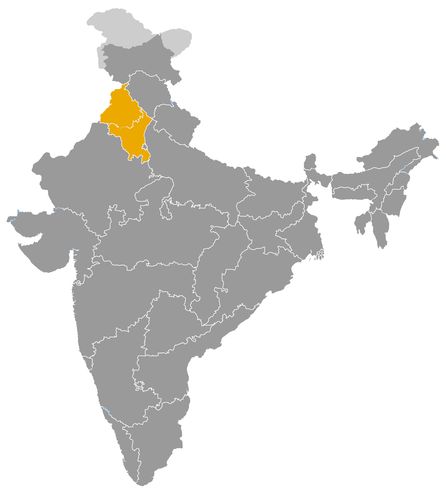
This map illustrates the maximum territory that the Phulkian of Jind Dynasty had reached at its height, covering the current regions of Haryana and Punjab in India. Its main purpose is to provide a visual aid to understand the geographical extent of this dynasty. However, it's important to note that the contemporary borders of these regions may not necessarily coincide with the historical territories.
The Phulkian Dynasty of Jind and Its Role in the History of Princely Punjab
A Sikh branch of the wider Phulkian house
The Phulkian dynasty of Jind belonged to the group of Sikh ruling houses that traced their origin to Chaudhary Phul, the eponymous ancestor of the Phulkian family in the Malwa region of Punjab. Alongside Patiala and Nabha, Jind formed one of the main sovereign branches of this wider dynastic network. Its historical importance must therefore be understood on two levels: as part of a shared Phulkian cultural and genealogical tradition, and as a distinct princely state that emerged as an effective territorial power in the eighteenth century.
Jind was not the largest or most influential of the Phulkian states. Patiala generally held a more prominent position. Yet Jind played a meaningful role in the political history of the Cis-Sutlej Sikh states, in relations between Sikh chiefs and British authorities, and in the regional order that developed before and during British paramountcy. Its history shows how a relatively small dynasty could preserve political identity, local authority and princely legitimacy until its integration into the Patiala and East Punjab States Union in 1948.
A princely state between present-day Haryana and Punjab
The territory of Jind did not correspond neatly to present-day administrative borders. The town of Jind is now in Haryana, while Sangrur, which became an important administrative centre of the former princely state, is now in Indian Punjab. This territorial distribution explains why the dynasty is linked both to the history of princely Punjab and to areas now associated with Haryana.
This geography gave Jind an intermediate position between the Malwa region of Punjab, the plains of northern India and neighbouring Sikh-ruled territories. The state did not possess the extensive and continuous territory of a major regional kingdom. Its power rested instead on towns, agricultural lands, villages, revenue rights, local fortifications and administrative centres. This made Jind a compact but strategically placed princely state within a fragmented political landscape.
Political significance among the Cis-Sutlej Sikh states
The Jind branch developed during the eighteenth century, when Mughal authority was weakening, Afghan interventions affected north-western India, and Sikh confederacies and chiefships were expanding. Gajpat Singh is generally regarded as the effective founder of Jind State. Under his successors, the dynasty sought to maintain autonomy in a region where power relations were fluid and often unstable.
Jind’s political situation was shaped by its proximity to Patiala and Nabha. These states shared a common Phulkian origin, but they remained politically separate. Their relations could involve kinship solidarity, territorial rivalry, diplomatic negotiation and shared responses to stronger external powers. The existence of several Phulkian branches in the same broad region helped shape the political geography of the Malwa area of Punjab.
In the early nineteenth century, Jind became part of the group of Cis-Sutlej states protected by the British. This arrangement restricted its external sovereignty, but it also helped the dynasty survive in a competitive regional environment. Later rulers of Jind supported the British, notably during the uprising of 1857, which strengthened their position within the princely order of British India.
An economy based on agriculture and regional administration
The economic foundations of Jind were primarily agrarian. The state’s territory included villages, cultivated lands, local markets and routes connecting its different possessions. Land revenue formed the principal material basis of princely administration, supporting the court, local forces, public expenditure and administrative institutions.
Jind was not a major maritime or international commercial centre. Its economic importance was regional rather than global. Agricultural production, rural exchange, land assessment, revenue collection and the management of dependent territories shaped its political economy. Under British paramountcy, these structures became increasingly formalised through administrative supervision, fiscal regulation and the wider framework of princely-state governance.
Sangrur played an important role in this development. As an administrative centre, it gave the state a more visible and organised institutional focus. The development of such centres helped strengthen the cohesion of a territory that was not always geographically simple or continuous.
Sikh dynastic identity within a mixed society
The Phulkian dynasty of Jind was a Sikh ruling house. Its identity belonged to the wider history of Sikh elites in Punjab, including the memory of the misls, martial lineages, regional clan traditions and the social networks of the Malwa countryside. This Sikh identity was central to dynastic legitimacy and connected Jind with other Sikh princely states.
However, the population of Jind was religiously diverse, as was the case in many princely states of Punjab. Sikhs, Hindus and Muslims lived within its territories in varying proportions. The cultural role of the dynasty should therefore not be reduced to a single confessional identity. The rulers had to govern a plural society composed of different communities, local institutions, landholding groups and religious traditions.
Royal patronage could support places of worship, public ceremonies, local institutions and forms of princely prestige. Through these practices, the dynasty affirmed its authority while participating in the broader culture of princely Punjab, where political legitimacy was expressed through ritual, genealogy, military memory and public administration.
A regional dynasty absorbed into independent India
The effective sovereignty of the Jind branch ended in 1948, when the state was integrated into the Patiala and East Punjab States Union. This marked the disappearance of Jind as an autonomous princely entity, but not the end of its historical significance. The dynasty remains representative of the smaller Sikh princely states that contributed to the political organisation of Punjab before its incorporation into the Indian Union.
Jind’s role was less prominent than that of Patiala, but it was still historically important. The dynasty linked the Phulkian heritage, the Sikh political world of Malwa, the history of the Cis-Sutlej states, British princely administration and the territorial reorganisation of India after independence. Its history illustrates how a modest princely state could maintain identity, authority and regional relevance across a period of major political transformation.
The Geographical Extension of the Phulkian Dynasty of Jind in Princely Punjab
A Phulkian territory between present-day Haryana and Punjab
The Phulkian dynasty of Jind ruled a princely state situated in the historical region of the Cis-Sutlej Sikh states. Its territory cannot be understood only through present-day administrative borders. The town of Jind is now in the Indian state of Haryana, while Sangrur, one of the most important centres of the former princely state, is now in Punjab. This dual geographical identity explains why the history of Jind belongs both to the political world of princely Punjab and to regions later incorporated into Haryana.
The Jind branch formed part of the wider Phulkian house, which traced its origin to Chaudhary Phul in the Malwa region of Punjab. Like Patiala and Nabha, Jind shared a common dynastic background but developed as a separate territorial power in the eighteenth century. Its state was not a large continuous kingdom with simple borders. It was a compact and sometimes fragmented princely territory, shaped by agricultural lands, towns, revenue rights, routes and administrative centres.
Jind as an early dynastic and territorial centre
The town of Jind gave its name to the princely state and remained an important symbol of the dynasty’s authority. Located in present-day Haryana, it historically belonged to the wider political landscape of eastern Punjab and the Cis-Sutlej region. Its position gave the rulers access to routes linking the Malwa country, the plains of northern India and neighbouring Sikh-ruled territories.
Control of Jind provided the dynasty with a recognisable territorial nucleus. However, the princely state was not limited to the town and its immediate surroundings. As in many north-western Indian states, authority was built through control over villages, agricultural revenue, fortified sites and administrative points distributed across different areas. The geographical structure of Jind was therefore composite, rather than a single uninterrupted block of land.
Sangrur as a major centre in the Punjab part of the state
Sangrur became one of the most significant centres of the Jind State. Although it is now located in Indian Punjab, it played a major role in the administration and political visibility of the princely state. Its importance shows that the dynasty of Jind should not be viewed only through the modern district of Jind in Haryana.
The development of Sangrur as an administrative centre strengthened the state’s presence in the Malwa region of Punjab. It also placed the Jind branch in direct contact with the other Phulkian houses, especially Patiala and Nabha. Through Sangrur, the dynasty maintained a clear Punjab connection, even though the name of the state is today more immediately associated with Haryana.
Relations with Patiala and Nabha in the Phulkian zone
The geographical extension of Jind was strongly shaped by its proximity to Patiala and Nabha. These three states were linked by common descent from the Phulkian house, but they were politically separate. Their territories lay close to one another in the wider Malwa and Cis-Sutlej region, producing a landscape of kinship, rivalry and negotiation.
Patiala was usually the strongest of the Phulkian states and exercised greater political influence. Nabha, like Jind, was more limited in size but retained its own dynastic identity. The closeness of these states meant that Jind could not pursue expansion without considering the interests of related but competing branches. The result was a regional order in which family ties did not eliminate political competition. Territorial adjustments, alliances and disputes had to be managed within a shared dynastic environment.
Frontier pressures and the wider Sikh political landscape
The rise of Jind occurred during a period of political fragmentation in north-western India. Mughal authority had weakened, Afghan interventions affected Punjab, and Sikh chiefships and confederacies were gaining ground. In this setting, Gajpat Singh and his successors established Jind as one of the smaller but durable Sikh princely states.
The state’s territory was influenced by its position among larger or more ambitious powers. Jind had to interact with other Sikh chiefs, local landholding groups, Afghan interests and later British authorities. Its geography did not allow the creation of a large military state on the scale of greater regional powers. Instead, the dynasty concentrated on securing its existing possessions, maintaining routes, collecting revenue and preserving autonomy through careful diplomacy.
British protection and territorial stabilisation
In the early nineteenth century, Jind became one of the Cis-Sutlej states under British protection. This changed the meaning of its geographical extension. Before British paramountcy, the state’s position depended heavily on military strength, alliances and the shifting balance among Sikh and regional powers. Under British protection, its territorial identity became more stable, but its external sovereignty was restricted.
This arrangement helped Jind survive as a princely state, but it also limited independent expansion. The rulers retained internal authority over administration, revenue and local governance, while major diplomatic and military questions were increasingly controlled by the British. Territorial security was therefore achieved at the cost of political dependence.
Agricultural territory and administrative cohesion
The economy of Jind was grounded in land rather than maritime or long-distance imperial trade. Its territory contained villages, cultivated fields, local markets and transport routes connecting its different parts. Agricultural revenue supported the court, local administration, public works and the structures of princely rule.
Because the state’s territory was not always geographically simple, administrative centres such as Sangrur were essential. They gave cohesion to the princely state and allowed the rulers to organise taxation, justice, local governance and relations with British officials. The geographical extension of Jind was therefore not only a matter of land area, but also of the ability to administer dispersed possessions effectively.
A modest state with strategic regional importance
The Phulkian dynasty of Jind did not control a vast kingdom, but it ruled a strategically placed princely state linking present-day Haryana and Punjab. Its territory connected the Malwa region, the Cis-Sutlej Sikh states and the wider political geography of north-western India.
This geographical position shaped all its relationships. With Patiala and Nabha, Jind shared dynastic origins but also competed for space and status. With British authorities, it exchanged part of its external autonomy for protection and stability. With local communities, it depended on land revenue, administrative centres and regional legitimacy.
The integration of Jind into the Patiala and East Punjab States Union in 1948 ended the dynasty’s effective sovereignty. Its territorial history nevertheless remains important for understanding the political geography of princely Punjab and the way smaller Sikh states maintained authority in a complex and changing regional landscape.
This chronology distinguishes the cultural origin of the Phulkian house, traditionally linked to Chaudhary Phul in the seventeenth century, from the effective sovereignty of the Jind branch, established in the eighteenth century. The earliest figures belong to the dynastic and lineage trunk; the rulers of Jind later bore the titles of raja and then maharaja within the Cis-Sutlej Sikh states and the British princely system.
Common dynastic origin of the Phulkian house, c. 1600–1763
- Chaudhary Phul (first half of the seventeenth century, traditional lineage chief) • The eponymous ancestor of the Phulkian house, he is associated with the common origin of the Patiala, Nabha and Jind branches.
- Tiloka Singh (second half of the seventeenth century, genealogical tradition) • A son of Phul, he is generally linked to the line from which the Jind branch descended.
- Sukhchain Singh (late seventeenth–early eighteenth century, genealogical tradition) • A descendant of Tiloka Singh, he belongs to the lineage transmission before the formation of Jind State.
Rulers of Jind, 1763–1948
- Gajpat Singh (1763–1789) • Effective founder of Jind State, he received the title of raja and established an independent Phulkian branch.
- Bhag Singh (1789–1819) • Raja of Jind, he developed favourable relations with the British East India Company and strengthened the state’s security.
- Fateh Singh (1819–1822) • Raja of Jind, his brief reign continued the British alliance.
- Sangat Singh (1822–1834) • Raja of Jind, he ruled during a period of relative stability but died without a direct heir.
- Sarup Singh (1837–1864) • Installed after a period of uncertain succession, he supported the British during the uprising of 1857.
- Raghubir Singh (1864–1887) • Maharaja of Jind, he consolidated the princely state and developed Sangrur as an important administrative centre.
- Ranbir Singh (1887–1948, effective ruler) • The last ruling maharaja of Jind, he governed until the state was integrated into the Patiala and East Punjab States Union.
 Links to the main sections of the site