Français (France)
  Nederlands (nl-NL)
 Of Hindu tradition, the Nayak of Kalahasti dynasty ruled for approximately 232 years, ± between 1570 and 1802 over all or part of South India, during the Medieval Period and the Colonial Period.
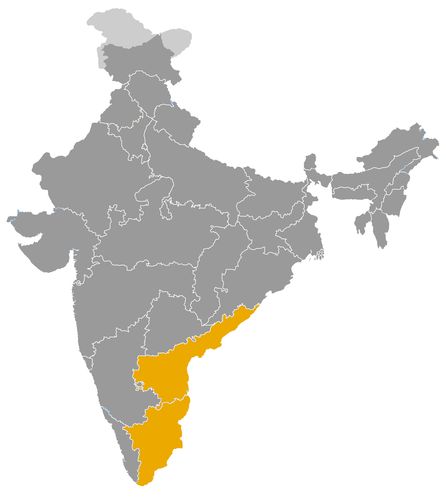
This map illustrates the maximum territory that the Nayak of Kalahasti Dynasty had reached at its height, covering the current regions of Andhra Pradesh and Tamil Nadu in India. Its main purpose is to provide a visual aid to understand the geographical extent of this dynasty. However, it's important to note that the contemporary borders of these regions may not necessarily coincide with the historical territories.
The Nayak Dynasty of Kalahasti and Its Role in the Political and Cultural History of South India
A regional authority formed within the Vijayanagara system
The Nayak dynasty of Kalahasti belonged to the group of regional powers that developed within the military and administrative structure of the Vijayanagara Empire. The Nayaks were not originally independent monarchs in the strict sense, but commanders, governors or local chiefs entrusted with the defence and administration of strategic territories. Their authority was based on military service, revenue collection, local order and loyalty to the imperial centre.
Kalahasti, in present day Andhra Pradesh, occupied an important position between the Telugu speaking regions, northern Tamil Nadu and the routes leading toward the Coromandel Coast. This location gave the Nayaks of Kalahasti a role that was both local and regional. They acted as intermediaries between the imperial world of Vijayanagara, neighbouring Nayak houses, religious institutions and the commercial networks of the eastern coast.
The Damarla family and the political networks of the Telugu country
The Nayaks of Kalahasti are closely associated with the Damarla family, a lineage of military and administrative chiefs active during the later Vijayanagara period. Figures such as Damarla Chennappa Nayaka, Damarla Venkatappa Nayaka and Damarla Ayyappa Nayaka show the importance of this family in a region that extended beyond Kalahasti itself. Their influence was connected with Kalahasti, Vandavasi, Poonamallee and the hinterland of the future city of Madras.
The titles used for these leaders vary according to period and context. Nayaka, Nayak, Naidu and Nayudu indicate command, status and regional authority rather than a uniform royal title. In later contexts, especially under zamindari arrangements, the title Raja became more visible. This variation shows that the Kalahasti line should not be understood only as a conventional hereditary monarchy. It was also a military household, a territorial authority and a family network embedded in the political landscape of South India.
A political role during the weakening of Vijayanagara
The political significance of the Nayaks of Kalahasti became clearer during the decline of Vijayanagara authority. While the empire remained strong, the chiefs of Kalahasti functioned as servants of the imperial order. As central authority weakened, especially from the late sixteenth century onward, they acquired greater room for negotiation and regional action.
Their position was sensitive because their territories lay between several competing powers. To the south were the Nayak states of Gingee, Thanjavur and Madurai. To the north and west were the later Vijayanagara rulers of the Aravidu line and the expanding influence of the Deccan sultanates. Along the coast, European trading companies increasingly sought access to markets, ports and local privileges.
The Damarla chiefs are especially remembered in connection with the early history of Madras. Their role in the circumstances that led to the English acquisition of the Madras site in the seventeenth century illustrates their political importance. They were not merely local landholders, but regional actors whose decisions affected the relationship between Indian authorities and European commercial powers.
Cultural patronage linked with Kalahasti and temple traditions
The cultural importance of the Nayaks of Kalahasti was closely tied to the sacred status of Kalahasti itself. The town was known for the Srikalahasti temple, a major Shaiva centre in southern India. Control over such a religious site strengthened the legitimacy of regional rulers and connected them with established networks of pilgrimage, ritual and temple economy.
Like other Nayak powers, the chiefs of Kalahasti supported religious institutions and participated in a culture in which political authority was expressed through temple patronage. Protection of temples, support for Brahmanical institutions and association with sacred landscapes helped rulers present themselves as guardians of social and religious order.
The dynasty also belonged to a wider literary and courtly environment. Several members of the Damarla family are remembered as Telugu patrons or poets. This literary dimension indicates that their role was not limited to warfare or fiscal administration. They formed part of a cultivated elite in which language, learning, devotion and political prestige were closely connected.
Economic authority based on agriculture and regional routes
The economy of the Nayaks of Kalahasti rested primarily on land revenue. Control over villages, cultivated fields, irrigation resources and taxation gave them the material means to maintain soldiers, support temples and administer their territories. As in many premodern South Indian polities, agrarian income was the foundation of political power.
Their geographic position also gave them access to important routes between the interior and the Coromandel Coast. Kalahasti and its associated territories lay within a wider network through which agricultural goods, textiles, metals, horses and other commodities circulated. The Nayaks of Kalahasti were not maritime rulers, but they governed part of the inland zone that connected local production with coastal trade.
This economic setting increased their strategic value. Control over inland routes meant influence over movement, supply and revenue. It also explains why the Kalahasti chiefs became relevant to European trading interests along the coast. Their authority linked the agrarian interior with the commercial world of the eastern seaboard.
A regional dynasty that reflects South Indian transition
The Nayak dynasty of Kalahasti was not one of the great imperial dynasties of Indian history, but its significance lies in the way it reflects regional transformation. It shows how military families within the Vijayanagara system could become semi autonomous authorities, combining defence, taxation, temple patronage and diplomatic negotiation.
The dynasty’s role was therefore transitional and connective. It stood between empire and local principality, between Telugu and Tamil regions, between inland administration and coastal commerce. Its history reveals the complexity of South India after the weakening of Vijayanagara, when power was distributed among forts, temples, military households, regional dynasties and commercial intermediaries.
The Nayaks of Kalahasti occupy an important place in this regional history because they demonstrate how a relatively limited territorial power could influence political relations, cultural continuity and economic exchange. Their legacy is best understood not through imperial expansion, but through their position in the networks that shaped southern India during a period of fragmentation and adaptation.
The Geographic Reach of the Nayak Dynasty of Kalahasti between Andhra, Tamil Nadu and the Coromandel Coast
A regional domain shaped by the Vijayanagara frontier
The Nayak dynasty of Kalahasti controlled a regional sphere of power in South India, centred on Kalahasti in present day Andhra Pradesh. Its territory developed within the political and military framework of the Vijayanagara Empire, where Nayak chiefs were entrusted with the defence, administration and revenue management of strategic zones. The Kalahasti line, often associated with the Damarla family, emerged in this environment as a military and territorial authority rather than as a large imperial dynasty.
The geographic reach of the dynasty cannot be described as a state with fixed modern borders. Its power was based on forts, villages, fiscal rights, temple connections, military obligations and family networks. This made its territorial structure flexible and sometimes difficult to define precisely. Nevertheless, its core area and main zones of influence can be identified around Kalahasti, Vandavasi, Poonamallee and the inland routes leading toward the Coromandel Coast.
Kalahasti as the religious and territorial centre
Kalahasti formed the principal centre of the dynasty’s authority. The town was important not only for its location in southern Andhra, but also for the religious prestige of the Srikalahasti temple, one of the major Shaiva centres of the region. Control over such a sacred site gave the Nayaks political legitimacy and access to temple based networks of landholding, ritual authority and local patronage.
The area around Kalahasti included rural settlements, agricultural lands, temple estates and routes linking the Telugu speaking interior with the Tamil plains. This core territory provided the material base of the dynasty. Agricultural revenue supported military forces, local administration and religious patronage. The Nayaks’ authority therefore depended on their ability to protect villages, maintain order and control the movement of resources through the region.
Southern connections with Vandavasi and northern Tamil Nadu
One of the most important features of the Kalahasti Nayaks’ geographic extension was their connection with Vandavasi, in present day northern Tamil Nadu. Members of the Damarla family are associated with both Kalahasti and Vandavasi, indicating that their authority extended across a zone linking southern Andhra with the northern Tamil country. This corridor was politically valuable because it connected inland routes with the wider Tamil region and the approaches to the coast.
Vandavasi occupied a strategic position in an area where several powers competed for influence. It stood near the sphere of the Gingee Nayaks and within the broader post Vijayanagara world of Tamil Nayak states. The control of Vandavasi or influence over it allowed the Kalahasti chiefs to participate in the political life of northern Tamil Nadu, where forts, revenue lands and local chiefs were central to regional power.
Poonamallee and the hinterland of Madras
The Damarla family was also connected with Poonamallee, near present day Chennai. This area became important because it lay in the inland zone behind the Coromandel Coast. Poonamallee served as a link between the agrarian interior and the coastal markets where Indian merchants and European trading companies were becoming increasingly active.
This connection explains the role of the Kalahasti Nayaks in the early history of Madras. The Damarla chiefs were involved in the circumstances that led to the English acquisition of the site where Fort St George and the city of Madras later developed. Their influence over the coastal hinterland made them important intermediaries between local Indian political structures and European commercial interests.
The Kalahasti Nayaks were not maritime rulers, and they did not control a naval empire. Their importance came from their inland authority over routes, villages and permissions that affected access to the coast. This made their territory economically and diplomatically significant beyond its apparent size.
Fluid boundaries in a system of delegated authority
The territories of the Nayaks of Kalahasti were not defined by rigid borders. Their authority depended on the changing balance between Vijayanagara, its later Aravidu rulers, neighbouring Nayak states and expanding Deccan powers. In some cases, members of the same family governed different localities or administered lands on behalf of relatives. This means that their territorial reach should be understood as a network of authority rather than a compact kingdom.
Such fluidity was typical of South India after the weakening of Vijayanagara. Military households controlled forts, villages, tax rights and temple networks, while larger powers claimed suzerainty over them. Kalahasti, Vandavasi and Poonamallee formed a connected but flexible zone, shaped by appointments, alliances, family claims and military necessity.
Relations with neighbouring dynasties and regional powers
The geography of Kalahasti strongly influenced its relations with neighbouring dynasties. To the south, the Gingee Nayaks occupied another strategic position in northern Tamil Nadu. The proximity between Kalahasti and Gingee created possibilities for cooperation, but also for rivalry over routes, forts and fiscal resources. Both powers shared roots in the Vijayanagara system and operated in the borderland between Telugu and Tamil regions.
The Kalahasti Nayaks also had to deal with the later Vijayanagara rulers of the Aravidu line, who continued to claim authority over parts of southern Andhra and the Tamil region. This relationship was complex, combining loyalty, dependence and local autonomy. As the imperial centre weakened, regional chiefs had more freedom, but they also became more exposed to pressure from stronger military powers.
The Deccan sultanates, especially Bijapur and Golconda, also influenced the political environment. Their southward expansion placed pressure on Nayak territories and altered the balance of power across Andhra and Tamil Nadu. The coastal presence of European companies added another layer of negotiation, especially in areas linked to Madras and the Coromandel trade.
A limited territory with regional strategic importance
The geographic extension of the Nayak dynasty of Kalahasti was limited compared with the major empires of India, but its position gave it considerable importance. Its authority connected southern Andhra, northern Tamil Nadu and the inland approaches to the Coromandel Coast. Through Kalahasti, Vandavasi and Poonamallee, the dynasty controlled or influenced zones where religious prestige, agricultural revenue, military movement and coastal commerce intersected.
This geography explains the historical role of the Kalahasti Nayaks. They were not builders of a vast empire, but regional intermediaries in a changing South Indian world. Their territory linked the legacy of Vijayanagara with the rise of Nayak principalities, the ambitions of Deccan sultanates and the growing presence of European trade on the eastern coast.
The Nayaks of Kalahasti, also connected with Vandavasi, were mainly Nayak chiefs or poligars who emerged within the Vijayanagara framework and later held more autonomous regional authority. The titulature varies between Nayaka, Nayak, Nayudu, Naidu and, later, Raja in the zamindari context; the dates below are indicative, since the succession was not always a linear monarchy and several family members held parallel offices.
- Damarla Venkatapathi Naidu (second half of the 16th century) • Chief of the Damarla family mentioned before the rise of Chennappa Nayaka. His authority belonged to the administrative sphere of Vijayanagara.
- Damarla Chennappa Nayaka (c. 1585–1614) • Nayaka of Kalahasti and Vandavasi under Vijayanagara suzerainty. He is chiefly known as the dynastic figure associated with the old name of Chennai, Chennapatnam.
- Damarla Venkatappa Nayaka (early 17th century) • Son of Chennappa Nayaka, he administered Kalahasti and exercised authority over the region as far as Vandavasi. With his brother, he took part in the negotiations that led to the grant of the Madras site to the English.
- Damarla Ayyappa Nayaka (first half of the 17th century) • Brother of Venkatappa Nayaka, he resided at Poonamallee and administered the Kalahasti territory for his brother. His role was more one of delegated administration than of a clearly attested separate reign.
- Damarla Ankabhupala Nayaka (first half of the 17th century) • Son of Chennappa Nayaka, he is mentioned as chief of Kalahasti. He is also known as a Telugu poet.
- Damarla Timmappa Nayaka (first half of the 17th century) • Son of Chennappa Nayaka, he is cited as chief of Kalahasti. The details of his political authority remain limited.
- Damarla Chenna Venkata (17th century) • Son of Chennappa Nayaka, he is chiefly known as a poet. His place as an effective ruler remains uncertain.
- Zamindari Rajas of Kalahasti (18th century–1947, mainly zamindari title) • After the Nayak period proper, the family retained a local position under successive political frameworks and later under colonial control. This phase no longer represented independent Nayak sovereignty.
 Links to the main sections of the site