Français (France)
  Nederlands (nl-NL)
 Of Hindu tradition, (with additional Jain influence), the Aravidu dynasty ruled for approximately 76 years, ± between 1570 and 1646 over all or part of East India, South India and West India, during the Medieval Period.
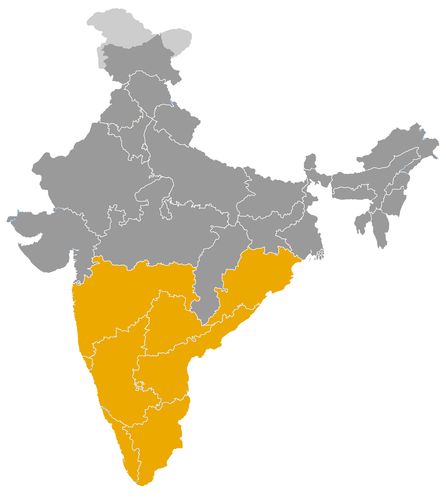
This map illustrates the maximum territory that the Aravidu Dynasty had reached at its height, covering the current regions of Andhra Pradesh, Goa, Karnataka, Kerala, Maharashtra, Odisha, Tamil Nadu and Telangana in India. Its main purpose is to provide a visual aid to understand the geographical extent of this dynasty. However, it's important to note that the contemporary borders of these regions may not necessarily coincide with the historical territories.
The Aravidu Dynasty and the Survival of the Vijayanagara Legacy
A ruling house formed after the crisis of Talikota
The Aravidu dynasty occupies a distinctive place in the history of South India because it represents the final phase of the Vijayanagara Empire. It emerged after the Battle of Talikota in 1565, when the imperial capital at Hampi was devastated by a coalition of Deccan sultanates. Unlike the Tuluva dynasty, which is associated with the height of Vijayanagara power, the Aravidu period was marked by political recovery, territorial contraction and the preservation of imperial legitimacy under difficult conditions.
Tirumala Deva Raya, the effective founder of the dynasty, reorganised what remained of the imperial state after the collapse of Hampi as a functioning capital. The centre of power shifted first to Penukonda, then to Chandragiri and later to Vellore. This movement shows the transformation of Vijayanagara from a vast empire centred on Hampi into a more fragmented political structure rooted in the southern and south eastern regions of the peninsula.
The preservation of imperial legitimacy after Hampi
The main political role of the Aravidu dynasty was to maintain the continuity of the Vijayanagara imperial tradition. Its rulers continued to use royal and imperial titles, especially raya and maharaya, and presented themselves as the legitimate successors of the earlier Sangama, Saluva and Tuluva dynasties. This continuity was important because political authority in South India was closely linked to dynastic prestige, military memory, religious patronage and ceremonial kingship.
However, the real power of the Aravidu rulers was more limited than that of their predecessors. Many former imperial governors and military commanders became increasingly autonomous. The Nayakas of Madurai, Thanjavur, Gingee and other regions gradually transformed themselves into independent or semi independent rulers. The Aravidu dynasty therefore maintained an imperial framework, but it no longer controlled the whole Vijayanagara world with the same strength as the earlier dynasties.
A political geography shaped by new capitals
The movement of the capital was one of the defining features of Aravidu rule. Penukonda became the first major centre after the fall of Hampi. It offered a more secure position in the southern Deccan and allowed the dynasty to maintain links with Karnataka, Andhra and the Tamil regions. Chandragiri later gained importance, especially because of its location in southern Andhra and its proximity to important religious and commercial networks.
Vellore then became a major centre of late Aravidu power. Its position in the northern Tamil region reflected the southward shift of imperial authority. These new capitals show that the Aravidu dynasty did not simply continue the old empire unchanged. It adapted to a new political geography in which survival depended on mobility, regional alliances and the ability to preserve authority across a reduced and unstable territory.
Cultural continuity in a period of political decline
The cultural impact of the Aravidu dynasty should not be reduced to the idea of decline. Although Hampi lost its role as the main imperial capital, many cultural forms associated with Vijayanagara continued under Aravidu rule and through the successor states that emerged from the former imperial structure. Courtly culture, temple patronage, literary production and ceremonial practices remained important.
The dynasty continued to support Hindu religious institutions. Temples, Brahmanical establishments and sacred centres played a central role in legitimising royal authority. Tirupati became especially important in this later Vijayanagara context. Jain communities remained present in parts of Karnataka and elsewhere, but Jainism occupied a more secondary place in the political culture of the period.
The Aravidu age also preserved the multilingual character of Vijayanagara. Telugu, Kannada, Tamil and Sanskrit continued to be used in inscriptions, administration, religious institutions and literary settings. This linguistic diversity reflected the regional composition of the old empire and helped transmit Vijayanagara traditions into the political culture of later South Indian courts.
Economic resources under reduced central control
The economy of the Aravidu period continued to rely on agriculture, land revenue, temple institutions, craft production and regional trade. However, the fiscal capacity of the dynasty was weaker than that of the Tuluvas at their height. The loss of direct control over several provinces reduced the flow of revenue to the central court.
The eastern and southern regions remained economically important. Routes linking Andhra, Tamil Nadu and the Coromandel coast supported trade in textiles, agricultural goods, metals, precious stones and luxury items. Contacts with Portuguese and other maritime traders also influenced the commercial environment of the period. Yet much of this wealth was increasingly controlled by regional powers, port authorities, merchant groups and Nayaka rulers.
The economic role of the Aravidu dynasty was therefore one of adaptation rather than expansion. It sought to preserve revenue networks and religious endowments while operating within a more decentralised political economy.
The transition from empire to regional states
The Aravidu dynasty played a major role in the transition from the Vijayanagara Empire to a new regional order in South India. It did not restore the empire to its former strength, but it prevented the immediate disappearance of the Vijayanagara political tradition after Talikota. By maintaining titles, rituals, courtly practices and religious patronage, it preserved an imperial memory that remained influential long after central power had weakened.
Its relationship with neighbouring powers was shaped by this reduced position. The Deccan sultanates exerted pressure from the north, while Nayaka states grew stronger in the south. The Aravidu rulers had to negotiate, defend, retreat and adapt rather than dominate as the Tuluvas had done.
The historical role of the Aravidu dynasty lies in this process of survival and transmission. It marks the end of Vijayanagara as a dominant imperial state, but also the continuation of its cultural, religious and political legacy within the successor kingdoms of South India.
The Geographical Reach of the Aravidu Dynasty in South India
A reduced imperial space after the fall of Hampi
The Aravidu dynasty ruled the final phase of the Vijayanagara Empire after the Battle of Talikota in 1565. Its geographical extent must be understood in relation to the collapse of the former imperial centre at Hampi. Under the earlier Tuluva dynasty, Vijayanagara had dominated large parts of South India. Under the Aravidus, the empire survived, but its territorial structure became smaller, more fragmented and more dependent on regional alliances.
The Aravidu rulers did not inherit a compact and stable empire. They inherited a damaged political order, in which former provincial governors, military commanders and regional chiefs were gaining autonomy. Their control varied from direct authority in some areas to nominal overlordship in others. The dynasty therefore represents not a phase of territorial expansion, but a period of geographical adaptation and political survival.
The decline of Hampi and the movement of political centres
The devastation of Hampi changed the geography of Vijayanagara power. The old capital, located in present day Karnataka, had been the symbolic and administrative heart of the empire. After Talikota, it could no longer function as the main centre of government. The Aravidu dynasty therefore shifted its authority southward and south eastward.
Penukonda became the first major centre of Aravidu power. Later, Chandragiri and Vellore became increasingly important. This movement shows the transformation of Vijayanagara from a Deccan based imperial state into a more southern and regionalised power. The shift was not merely administrative. It reflected the loss of secure control over northern frontier regions and the need to rely on territories that remained more loyal or strategically defensible.
Penukonda and southern Andhra as a restored base of authority
Penukonda, in present day Andhra Pradesh, played a central role during the early Aravidu period. Its location allowed the dynasty to maintain links with Karnataka, Rayalaseema, southern Andhra and the Tamil regions. It offered a safer political base after the collapse of Hampi and helped preserve continuity with the older imperial system.
Southern Andhra became one of the most important zones of Aravidu authority. Chandragiri, Tirupati, Chittoor and neighbouring areas formed a strategic region because they connected the interior with the eastern coast and with important religious institutions. Chandragiri later developed into one of the principal centres of late Vijayanagara rule. From this region, the Aravidu rulers could maintain contact with Telugu speaking elites, temple networks and commercial routes.
Tamil regions and the growing importance of Vellore
The Tamil regions became increasingly significant under the Aravidu dynasty. Vellore emerged as an important political centre in the later phase of the dynasty, especially because of its position in northern Tamil Nadu. It allowed the rulers to maintain influence over routes linking southern Andhra, the Tamil interior and the Coromandel coast.
Aravidu authority in the Tamil country was often indirect. The Nayakas of Madurai, Thanjavur and Gingee had originally functioned within the Vijayanagara imperial system as governors or military authorities. During the Aravidu period, they became increasingly autonomous. They might still recognise the prestige of the Vijayanagara ruler at certain moments, but in practice they controlled their own armies, revenues and regional courts.
This development deeply affected relations between the Aravidus and their former provincial elites. Instead of ruling the Tamil regions as a strongly centralised imperial power, the dynasty had to negotiate with increasingly independent Nayaka states. The political geography of South India thus shifted from imperial hierarchy to regional pluralism.
Karnataka and the weakened northern frontier
Karnataka remained historically important to the Aravidu dynasty because it contained the old imperial centre of Vijayanagara. However, Aravidu control over the region was weaker than under the Tuluvas. Hampi did not recover its former role, and the northern frontier of the old empire was increasingly vulnerable.
The zones around the Tungabhadra and Krishna rivers, including the Raichur Doab, had long been contested between Vijayanagara and the Deccan sultanates. After Talikota, the balance of power changed sharply. The Aravidus were no longer able to impose the same level of military pressure on the sultanates of Bijapur, Golconda and their neighbours. The northern frontier became a zone of retreat and defence rather than expansion.
Coastal routes and the limits of economic control
The Aravidu dynasty continued to depend on access to trade routes, especially through Andhra and the Tamil regions. The eastern coast and the Coromandel trade networks were important for textiles, agricultural goods, metals, luxury products and maritime commerce. Contacts with Portuguese and other foreign merchants shaped the economic environment of the period.
However, the dynasty no longer controlled coastal wealth as directly as Vijayanagara had done during its strongest phases. Merchant groups, port towns, Nayaka rulers and local intermediaries gained greater influence over commercial revenues. The Aravidu court still benefited from regional trade, but its ability to centralise resources was reduced.
Relations with neighbouring powers in a fragmented landscape
The reduced geography of the Aravidu dynasty shaped its relations with surrounding states. To the north, the Deccan sultanates became stronger rivals and gradually absorbed or contested former Vijayanagara territories. To the south, the Nayaka polities became powerful successors within the old imperial sphere. To the east, control over Andhra and the routes toward the coast remained essential for dynastic survival.
The Aravidu rulers therefore governed through defence, negotiation, relocation and compromise. Their territorial history marks the passage from a large imperial system to a more fragmented regional order. They preserved the name and memory of Vijayanagara, but their geographical authority was narrower, more unstable and increasingly dependent on the cooperation or rivalry of neighbouring powers.
The Aravidu dynasty ruled the final phase of the Vijayanagara Empire after the Battle of Talikota and the decline of Hampi as an effective capital. The rulers continued to bear imperial titles, generally raya or maharaya, but their real authority was gradually reduced and was exercised from Penukonda, Chandragiri and later Vellore. The reign dates are indicative and may vary according to historical chronologies.
- Tirumala Deva Raya (1570–1572) • The effective founder of the Aravidu dynasty, he reorganised imperial power after the crisis of Talikota.
- Sriranga I (1572–1586) • He tried to maintain Vijayanagara authority from Penukonda in a context of strong military and regional pressure.
- Venkata II (1586–1614) • He temporarily strengthened imperial power and made Chandragiri and later Vellore important centres of rule.
- Sriranga II (1614) • His reign was very brief and marked by a violent succession crisis within the dynasty.
- Ramadeva Raya (1617–1632) • He preserved dynastic authority after a period of internal conflict and ruled from the southern centres of the empire.
- Venkata III (1632–1642) • He ruled over a greatly reduced empire, while the Nayakas and regional powers gained increasing autonomy.
- Sriranga III (1642–1646) • The last significant ruler of the dynasty, he was unable to prevent the final collapse of Vijayanagara’s imperial authority.
 Links to the main sections of the site