

 Français (France)
  Nederlands (nl-NL)
 The Bayon Temple is a prominent religious site located in Angkor, Cambodia. Erected in the late 12th century by King Jayavarman VII, it is renowned for its stone towers adorned with smiling faces, which likely represent the bodhisattva Avalokiteshvara or the king himself. Positioned at the center of the ancient city of Angkor Thom, the Bayon is distinguished by its detailed bas-reliefs depicting everyday life and historical battles. Today, the temple is noted for its blend of Buddhist and Hindu elements, mirroring the religious shifts of the period.
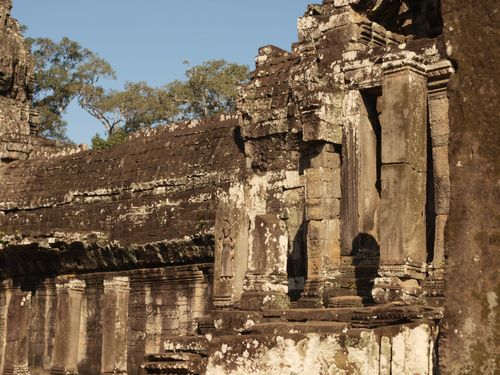
Angkor • Bayon Temple
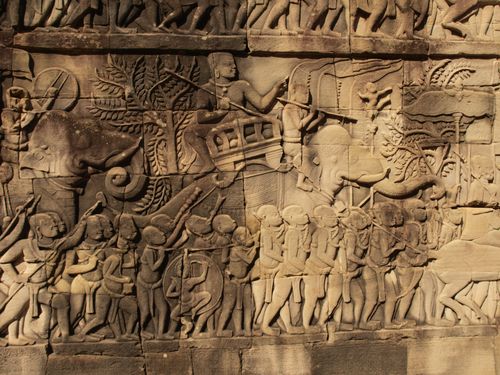
Angkor • Bayon Temple
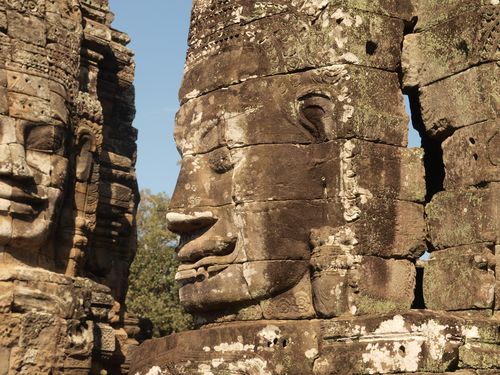
Angkor • Bayon Temple
Monument profile
Bayon Temple
Monument categories: Hindu Temple, Monastery, Buddhist temple
Monument families: Temple • Monastery
Monument genres: Religious
Cultural heritages: Hindu, Buddhist
Geographic location: Angkor • Cambodia
Construction period: 12th century AD
This monument in Angkor is inscribed on the UNESCO World Heritage List since 1992 and is part of the serial property "Angkor".See the UNESCO monuments featured on this site
• Links to •
• Dynasties that contributed to the construction of the monument •

• List of videos about Angkor on this site •
Angkor, the Preah Khan temple • Cambodia
Angkor, Ta Prohm temple • Cambodia
Angkor Thom, the Great City • Cambodia
Angkor Wat, masterpiece of Khmer architecture • Cambodia
• References •
Wikipedia FR: Bayon (Angkor)
Britannica: Bayon, the
UNESCO: Angkor
The Bayon Temple: Political Vision, Cultural Transformation, and Modern Conservation Challenges
The Bayon Temple, a monumental structure at the heart of Angkor Thom in Cambodia, stands as a testament to the political ambitions, social cohesion, and spiritual devotion that shaped the Khmer Empire. Built at the end of the 12th century by King Jayavarman VII, the temple reflects a period of consolidation, technological prowess, and cultural openness that would define the region for centuries. Beyond its architectural grandeur, the Bayon embodies the shifting cultural and political tides of its era, which have influenced its transformation and preservation to this day.
Political and Social Motivations Behind Its Construction
The Bayon Temple’s construction around 1181 marked the resurgence of the Khmer Empire following invasions from the Champa kingdom. Jayavarman VII sought to restore stability and unity to the kingdom, and his vision for the Bayon extended beyond religious devotion. Strategically located at the center of Angkor Thom, the Bayon symbolized the king’s authority and his role as the protector of his people under the guise of the compassionate bodhisattva Avalokiteshvara. This architectural expression not only solidified Jayavarman VII’s political position but also provided a unifying spiritual identity to the empire through the embrace of Mahayana Buddhism.
The temple’s iconic stone faces, which many believe represent either Avalokiteshvara or the king himself, radiate a sense of benevolence and vigilance. This motif was intended to convey the omnipresence of the king’s protection over the empire, reinforcing the social and political order of the time.
Key Historical Events and Their Regional Influence
Over the centuries, the Bayon has witnessed various political upheavals and cultural shifts. Notably, the conversion from Mahayana Buddhism to Theravada Buddhism and the subsequent political incursions by Siamese forces greatly impacted the temple’s role and symbolism. The temple was gradually adapted to reflect Theravada practices, marking a shift in both the religious and social identity of the region. These changes echo the larger forces at play within the Khmer Empire, as it experienced a decline in power and faced increasing influence from neighboring regions like Siam and Thailand.
The regional and political dynamics not only influenced the Bayon’s religious orientation but also underscored Angkor as a crucial political and cultural center. Through its bas-reliefs, which depict scenes of everyday life and military achievements, the Bayon became a visual record of the Khmer Empire’s cultural and historical landscape.
Global Context and Cultural Comparisons
Globally, the Bayon’s construction aligns with other remarkable architectural achievements around the world. In Europe, Gothic architecture was on the rise, while China’s Song Dynasty enjoyed a golden age of trade and technology. Similarly, in the Islamic world, the Almohad Caliphate was expanding its influence in North Africa and Spain. In these distant regions, monumental architecture served as an assertion of power and cultural identity, akin to the Bayon’s role within the Khmer Empire.
The Bayon’s architectural uniqueness, with its combination of concentric towers and colossal stone faces, sets it apart from contemporary structures globally. This blending of indigenous styles with external Buddhist iconography created an architectural style that resonated with the empire’s political objectives, making the Bayon a cultural icon for the Khmer Empire.
Major Transformations Reflecting Cultural and Political Changes
The Bayon Temple underwent significant modifications over the centuries. Originally conceived as a Mahayana Buddhist sanctuary, it was later adapted to accommodate Hindu and then Theravada Buddhist elements. Each religious shift brought changes to the temple’s architectural layout and decorative elements, illustrating the influence of external powers and internal reforms on Cambodian society.
These transformations reflect the broader cultural exchanges and political interactions within the region, especially through trade and diplomatic relations with India, Thailand, and other Southeast Asian civilizations. This cultural synthesis is visually apparent in the temple’s intricate carvings and the interplay of religious motifs that span multiple traditions.
Conservation Status and Contemporary Challenges
As a UNESCO World Heritage Site since 1992, the Bayon has garnered international attention for its historical and cultural value. However, preserving its structural integrity is an ongoing challenge. The Bayon faces threats from natural erosion, invasive vegetation, and the pressures of high tourism. While international conservation efforts aim to stabilize and restore its architecture, balancing the site’s accessibility with preservation is essential to its sustainability.
Conservation teams from around the world work to maintain the integrity of the temple, using advanced preservation techniques to protect the site from environmental degradation and visitor impact. This requires rigorous management, as the temple’s unique features and delicate bas-reliefs are especially susceptible to damage.
Cultural Significance and Legacy
The Bayon Temple remains a symbol of Cambodia’s heritage and resilience. Its historical and architectural significance extends beyond its physical structure, embodying the spirit and grandeur of the Khmer Empire. The international recognition brought by UNESCO status has not only contributed to its conservation but also to its role as a cultural emblem for Cambodia, drawing millions of visitors and scholars alike. The Bayon’s preservation continues to be an important endeavor, serving as a reminder of the Khmer Empire’s remarkable legacy and the enduring importance of protecting global heritage sites.
The Architectural Brilliance of the Bayon Temple: Technological Innovation, Cultural Synthesis, and Global Recognition
The Bayon Temple, located in Angkor, Cambodia, is a remarkable testament to the technological advances and artistic innovation of the Khmer Empire under King Jayavarman VII. Built around the late 12th century, the Bayon stands as a unique architectural marvel, reflecting the grandeur and sophistication of its era. The temple’s design, materials, and artistic motifs reveal a fusion of regional traditions and foreign influences, making it one of the most iconic monuments of Southeast Asia.
Technological and Construction Innovations
The construction of the Bayon illustrates the advanced engineering skills of Khmer builders. The temple was primarily constructed using sandstone, a durable material widely available in the region. Sandstone blocks were meticulously shaped and placed without mortar, a technique that required precise stone-cutting skills to ensure stability. This technique also allowed the blocks to withstand the humid, tropical climate over centuries, highlighting the Khmer Empire's technical mastery.
Another notable material used was laterite, employed in foundational areas and covered by sandstone to enhance durability. The combination of these materials and the sheer scale of the construction—estimated to have involved hundreds of thousands of sandstone blocks—demonstrates the immense logistical and engineering capabilities of the Khmer Empire.
The Unique Architectural Plan of the Bayon
The Bayon is distinct from other temples of Angkor for its concentric, circular layout, diverging from the traditional rectangular layouts of the time. Its central tower, surrounded by 54 towers each adorned with four serene faces, represents a revolutionary approach to temple design. The central tower is symbolic of Mount Meru, the mythical center of the universe in Hindu and Buddhist cosmology, positioning the Bayon as a spiritual and cosmic center.
This temple’s plan not only demonstrates spiritual symbolism but also reflects the unity of the empire. The 216 stone faces, often believed to represent either the bodhisattva Avalokiteshvara or Jayavarman VII himself, symbolize the king’s omnipresence across his realm, reinforcing the political power of the Khmer monarchy.
Cultural Synthesis in Decorative Motifs
The Bayon’s architectural design and decorative elements embody a distinctive synthesis of Mahayana Buddhist influences and indigenous Khmer styles. The bas-reliefs that adorn the walls of the Bayon provide a vivid glimpse into Khmer society, depicting everyday scenes, battles, and ceremonial events. These carvings, covering nearly 1.2 kilometers of the temple walls, represent more than 11,000 figures and scenes, illustrating the empire’s values, culture, and interactions with neighboring regions.
The influences of Hindu deities and Buddhist iconography further reveal the cultural diversity of the Khmer Empire, which was open to foreign ideas and religious practices. Jayavarman VII's promotion of Mahayana Buddhism while retaining elements of Hinduism symbolizes an inclusive religious policy, enriching the artistic style of the Bayon with a fusion of beliefs.
Anecdotes and Notable Facts
Several remarkable statistics and anecdotes underscore the Bayon’s significance. With its 216 enigmatic faces, the Bayon Temple has become one of the most recognized architectural landmarks in Cambodia and Southeast Asia. According to some estimates, the construction may have involved thousands of skilled laborers and artisans, who worked in organized guilds to complete the intricate carvings and sculptures within a relatively short time frame. The temple’s size and artistry highlight the immense resources and workforce that Jayavarman VII could mobilize, underscoring the power of the Khmer Empire.
UNESCO World Heritage and International Recognition
In 1992, the Bayon Temple, as part of the Angkor complex, was designated a UNESCO World Heritage Site. This recognition has significantly boosted international awareness of the temple’s historical and cultural importance. The UNESCO status has also attracted global attention to the conservation challenges facing the Bayon. Due to its popularity among visitors and exposure to natural elements, preservation efforts are ongoing to protect the structure from erosion and damage.
International conservation teams are focused on stabilizing the faces, restoring weakened structures, and maintaining the bas-reliefs, which are particularly vulnerable to deterioration. This global effort has helped to preserve the Bayon, ensuring its survival for future generations and allowing it to continue as a source of inspiration and cultural pride for Cambodia.
Conclusion
The Bayon Temple remains a symbol of the Khmer Empire’s architectural innovation, religious inclusivity, and cultural prowess. Its distinctive architectural plan, advanced construction techniques, and rich decorative art reflect both the technological mastery and cultural synthesis that defined its time. As a UNESCO World Heritage Site, the Bayon has gained worldwide recognition and support, furthering its legacy as a monumental achievement in Southeast Asian history. The ongoing conservation of the Bayon ensures that it will continue to captivate and educate visitors, preserving its status as a masterpiece of human creativity and resilience.