

 Français (France)
  Nederlands (nl-NL)
 00:00 • intro | 00:35 • Landscapes and people on the banks of the Mekong
Personal creation from visual material collected during my trip Vietnam & Cambodia (2014)
Map of places or practices in Mekong de Chau Doc à Phnom Penh on this site
• Use the markers to explore the content •
The Mekong in Cambodia, River Landscapes and Daily Life
A great waterway at the heart of the country
The Mekong is one of the defining geographical and historical features of Cambodia. Flowing from the uplands of continental Asia before crossing several countries, it enters Cambodia as a broad and powerful river that has long shaped settlement, agriculture, trade and mobility. More than a natural boundary or transport route, it has functioned for centuries as a living corridor connecting rural communities, market towns and regional centres.
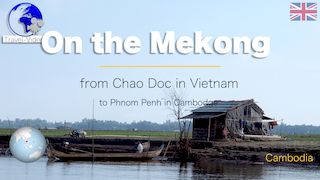
This video focuses on landscapes and people along the Cambodian banks of the river. The Mekong appears here as an inhabited environment rather than an abstract line on a map. Its shores combine tropical vegetation, village life, boats of many sizes, modest landing places, riverside houses and scenes of everyday activity. Together, these elements reveal a country where the relationship between water and society remains especially visible.
Riverbanks, villages and human activity
The banks of the Mekong are never entirely fixed. Seasonal rhythms transform the scenery throughout the year. During the rainy season, water levels may rise dramatically, altering access paths, cultivated land and the outline of the shore. In the dry season, exposed banks and sandbars can reappear, changing the scale and use of riverside spaces.
Human presence is constant. Boats still play an important role in local transport, fishing remains central in many communities, and riverside commerce continues traditions that are centuries old. Housing often reflects adaptation to the environment, whether through raised structures, open façades for ventilation, or positions chosen in relation to water access.
The video also suggests the coexistence of different tempos of life. Slow-moving wooden boats, people working near the shore, children at play, passing engines and moments of calm all belong to the same landscape. This balance between continuity and change is one of the most distinctive aspects of the Cambodian Mekong.
A river linked to Khmer history
The Mekong has played a major role in the development of Cambodian civilisation. Ancient Khmer kingdoms benefited from river networks that connected inland territories with maritime trade routes. Even when political capitals were located elsewhere, especially in the wider Angkor region, waterways remained essential for communication, transport and economic exchange.
In later centuries, including the modern and colonial periods, the river retained strategic importance. It supported administration, commerce and links between provinces. Today it still connects large parts of the country and remains significant for agriculture, fisheries and internal movement.
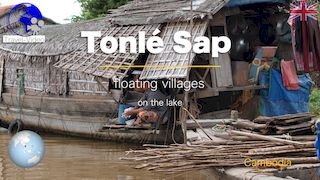
The Mekong is also closely tied to Cambodia’s broader hydraulic system, particularly through its relationship with the Tonlé Sap. Seasonal water reversals and flood cycles influence fisheries, soil fertility and ecological balance. To understand Cambodia fully, one must understand the central role of this river and the natural systems associated with it.
Space, light and the character of the landscape
Watching the Mekong is also a way of reading space itself. Wide horizons, shifting shorelines, trees leaning toward the water, reflective surfaces and silhouettes of boats create a landscape whose monumentality comes from scale rather than built architecture. Here, grandeur belongs to the river and the open sky.
Riverside settlements add a more intimate dimension. A few houses, a landing place, nets drying in the sun or a path descending toward the water can express daily life with remarkable clarity. Such details transform a panoramic scene into a human landscape shaped by routine, labour and memory.
Light is another essential element. Depending on the hour and season, the water may appear silver, brown, opaque or luminous. Tropical skies, sometimes heavy with clouds and sometimes intensely clear, constantly alter the mood of the scene. The Mekong is therefore not a static place, but a changing visual world.
What this site’s videos make especially clear
Videos created from carefully selected and animated photographs offer particular advantages for a subject like this. They allow the viewer to observe textures, river surfaces, boat construction, village layouts and subtle relationships between human activity and natural setting. Details that might be missed in a brief moving shot can become easier to understand through slower visual transitions.
This format also helps explain spatial continuity. The viewer can gradually perceive the distance between homes and the water, the structure of the riverbank, the breadth of the channel and the way vegetation frames inhabited areas. Step by step, the logic of the landscape becomes more readable.
Such an approach is especially effective for the Mekong, where meaning often lies not in a single monument but in atmosphere, scale, recurring gestures and the long connection between communities and the river.
An essential face of Cambodia
To follow the Mekong through Cambodia is to encounter one of the country’s foundations: its bond with water, movement and inhabited landscapes. This video offers a clear and engaging introduction to that world, and viewers wishing to explore further can continue with the site’s detailed pages devoted to the river and other Cambodian heritage themes.
Links to related pages

Audio Commentary Transcript
There are much more romantic trips on the Mekong, but to choose between a bus, a plane or the Mekong to pass from South Vietnam to the capital of Cambodia, the solution of a fast boat seems by far the best. Firstly because 140 kilometers in these regions are covered more quickly on water than on the road and then for the beauty of the surrounding landscapes.
Music:
- - YouTube video library - BTS Prologue, (© BTS Prolog by Kevin MacLeod is licensed under a Creative Commons Attribution 4.0 license. https://creativecommons.org/licenses/by/4.0/
- Source: http://freepd.com/Unclassified/BTS%20Prolog
- Artist: http://incompetech.com/)
- - YouTube video library - Vacation Casual
Disclaimer: Despite its appropriateness, copyright issues prevent the use of cambodian traditional music in "Cambodia • On the Mekong", hence the use of royalty-free music. Despite our careful selection, some might regret this decision, which is necessary to avoid potential lawsuits. Although difficult, this decision is the only viable solution.


