

 Français (France)
  Nederlands (nl-NL)
 The Madan Mohan Temple is a Hindu temple located in Kolkata, in the Indian state of West Bengal. Dedicated to Madan Mohan, a form of the deity Krishna venerated within the Vaishnavite tradition, the temple forms part of the historical religious landscape of the city. It reflects the role of urban shrines established by Bengali merchant and elite families during the development of colonial Calcutta. The sanctuary remains associated with local devotional practices and religious celebrations linked to Krishna. As such, it illustrates the presence of neighborhood temples that contribute to the religious and social life of the historic districts of Kolkata.
Monument profile
Madan Mohan temple
Monument category: Hindu Temple
Monument family: Temple
Monument genre: Religious
Cultural heritage: Hindu
Geographic location: Kolkata • West Bengal •
Construction period: 18th century AD
• Links to •
• List of videos about Kolkata on this site •
Kolkata • Urban Life and Trading Traditions
Kolkata • Colonial Heritage and Legacy of the Raj
Kolkata • Religious Diversity and Urban Traditions
History of the Madan Mohan Temple in Kolkata
Political and social context of the construction
The Madan Mohan Temple located in the Baghbazar area of Kolkata emerged within a complex political and social environment that shaped the development of the city during the eighteenth and nineteenth centuries. At that time, Calcutta, as the city was then known, was rapidly transforming from a trading settlement into the administrative and economic center of British power in eastern India. This transformation created new opportunities for wealthy Bengali families who were closely connected to commercial networks, landholding systems, and colonial administration.
Within this context, prominent urban elites began to construct religious complexes that served not only devotional purposes but also expressed social status and cultural identity. The establishment of a temple dedicated to Madan Mohan, a revered form of Krishna in the Vaishnavite tradition, must be understood within this broader phenomenon. Devotion to Krishna had long been influential in Bengal, particularly following the spread of Vaishnavism inspired by the teachings of Chaitanya in the sixteenth century. Urban temples dedicated to Krishna often became centers of religious gatherings, devotional music, and communal rituals.
The families responsible for founding such temples sought to reinforce both their religious legitimacy and their social prestige. By financing and maintaining a temple complex, wealthy patrons demonstrated piety while also consolidating their influence within the local community. The temple therefore functioned as both a sacred space and a symbol of patronage, reflecting the intersection of religion, social hierarchy, and urban life.
The development of the Madan Mohan Temple also coincided with the consolidation of British authority in Bengal following the Battle of Plassey in 1757 and the establishment of British administrative structures in the region. As local elites adapted to the new political order, they invested in religious institutions that preserved cultural continuity while simultaneously integrating aspects of colonial urban culture. The temple thus emerged during a period in which traditional religious practices coexisted with new forms of urban organization and political authority.
Major historical events affecting the site
Although the Madan Mohan Temple was not directly involved in military conflicts, the broader historical events that shaped Kolkata inevitably influenced its evolution. The city experienced rapid demographic growth throughout the eighteenth and nineteenth centuries as it became the capital of British India. This expansion transformed the surrounding neighborhoods, including Baghbazar, which developed into a densely populated district characterized by residential compounds, temples, and commercial activity.
During the colonial period, religious institutions such as the Madan Mohan Temple continued to operate within a complex social environment in which Indian traditions persisted alongside British governance. Unlike many older temples that had been associated with royal patronage, urban temples in Kolkata were typically maintained by private families or community trusts. This pattern allowed the temple to remain active even as political authority shifted from regional rulers to colonial administration.
The late nineteenth and early twentieth centuries brought further changes to the urban landscape of Kolkata. As the city expanded and infrastructure developed, many historic neighborhoods experienced increased density and architectural modification. Religious sites were gradually surrounded by residential buildings, commercial establishments, and public roads. Despite these transformations, the Madan Mohan Temple continued to function as a center of devotional activity, preserving its role within the local community.
In the decades following Indian independence in 1947, Kolkata underwent significant political and economic changes that affected many historic structures. Urban growth, environmental pressures, and evolving patterns of religious practice contributed to the gradual transformation of temple complexes across the city. Nevertheless, the Madan Mohan Temple maintained its religious importance and continued to host rituals and festivals associated with Krishna worship.
Global context during the period of construction
The construction of the Madan Mohan Temple occurred during a period of significant global transformation. The eighteenth and nineteenth centuries were marked by the expansion of European colonial empires, the development of international trade networks, and the emergence of new urban centers across Asia. Kolkata became one of the principal nodes in these global exchanges, linking the Indian subcontinent with Europe, Southeast Asia, and the broader Indian Ocean world.
During this same period, monumental religious and civic architecture was being constructed in many parts of the world. In Europe, neoclassical architecture was spreading through public institutions and urban planning projects. In South and Southeast Asia, traditional architectural forms were often adapted to incorporate new materials and stylistic influences introduced through colonial contact.
The Madan Mohan Temple can therefore be understood as part of a broader global phenomenon in which religious architecture responded to shifting political and cultural conditions. While maintaining its Vaishnavite devotional function, the temple reflects the urban and cultural environment of colonial-era Kolkata, where local traditions intersected with international architectural influences and evolving social structures.
Transformations and adaptations over time
Like many historic religious complexes in South Asia, the Madan Mohan Temple has undergone a series of transformations over the course of its existence. These changes were often gradual and responded to practical needs rather than deliberate architectural redesign.
Alterations to the surrounding structures, galleries, and courtyards were introduced as the urban environment around the temple evolved. Additional partitions, railings, and structural reinforcements were added to accommodate growing numbers of visitors and to manage the movement of worshippers during religious festivals. Such modifications illustrate how the temple adapted to changing patterns of use while preserving its essential layout.
Periods of maintenance and repair were necessary to address the effects of climate, humidity, and urban pollution on the building materials. The traditional lime plaster used in the construction required periodic renewal, and sections of the complex were repaired to ensure structural stability. These interventions, while sometimes altering the original appearance of certain surfaces, allowed the temple to remain in active use.
The surrounding neighborhood also changed significantly during the twentieth century. What had once been part of a spacious residential compound gradually became embedded within a dense urban district. Streets, houses, and commercial establishments now surround the temple, integrating it into the everyday life of the city.
Cultural significance and contemporary role
Today the Madan Mohan Temple continues to function as a place of worship and as a cultural landmark within the Baghbazar area of Kolkata. Devotees gather regularly to participate in rituals dedicated to Krishna, including devotional singing and religious celebrations associated with Vaishnavite traditions.
The temple plays a role not only in religious practice but also in the preservation of local identity. In a rapidly changing metropolis, historic temples serve as points of continuity that connect contemporary urban life with older cultural traditions. Festivals and religious gatherings held at the site attract both local residents and visitors, reinforcing the temple’s position within the social fabric of the neighborhood.
The presence of the temple also reflects the enduring influence of Vaishnavism in Bengal. Although the city of Kolkata contains many religious traditions and communities, Krishna devotion remains an important aspect of the region’s spiritual heritage.
Conservation and modern preservation challenges
The preservation of the Madan Mohan Temple presents several challenges typical of historic buildings located in dense urban environments. Environmental factors such as humidity, monsoon rains, and air pollution gradually affect the condition of brick masonry and plaster surfaces. These processes require continuous maintenance to prevent structural deterioration.
Urban development in the surrounding area has also altered the original spatial context of the temple. Increased traffic, construction activity, and population density place additional pressure on historic sites. Managing visitor access while protecting the architectural integrity of the complex has become an important concern for caretakers and local authorities.
Although the temple is not part of an international heritage listing, its cultural and historical significance is widely recognized within the local community. Preservation efforts often rely on a combination of community support, religious stewardship, and periodic restoration work carried out using traditional materials.
Through these ongoing efforts, the Madan Mohan Temple remains a living historical monument within Kolkata. Its continued use as a religious center ensures that the traditions associated with the site are transmitted to future generations while maintaining the architectural and cultural heritage of one of the city’s historic neighborhoods.
Architecture of the Madan Mohan Temple in Kolkata
Technological and architectural context
The Madan Mohan Temple in Baghbazar represents a distinctive form of urban religious architecture that developed in Kolkata during the late eighteenth and nineteenth centuries. Rather than following the canonical typologies of Bengali temple architecture such as the chala or ratna forms, the complex belongs to the category of thakur bari, a temple integrated within a residential and ceremonial compound associated with elite Bengali families.
This architectural model reflects a period of transition in which traditional construction techniques were combined with new spatial and formal influences introduced through colonial contact. The temple does not emphasize vertical elevation or sculptural superstructures, but instead focuses on horizontal expansion around a central courtyard. This approach allowed for a controlled internal environment, suited to ritual practices while responding effectively to climatic conditions.
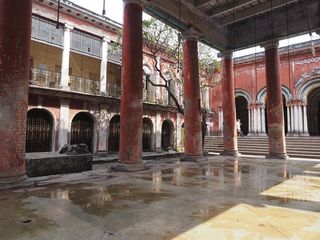
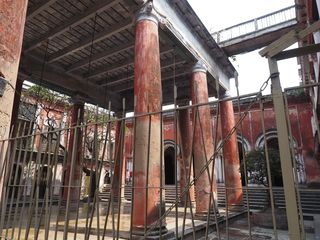
One of the most striking architectural features is the large ceremonial pavilion supported by massive cylindrical columns. These columns create an intermediate space that is neither fully enclosed nor entirely open, ensuring structural stability while promoting natural ventilation. This design reflects a pragmatic understanding of airflow, shade, and spatial organization in a humid tropical environment.
The integration of circulation, ritual space, and climatic adaptation demonstrates a mature architectural response to the constraints of dense urban fabric. The open courtyard acts as a thermal regulator, while the surrounding galleries provide shaded transitional zones between interior and exterior spaces.
Materials and construction methods
The primary construction material used in the Madan Mohan Temple is fired brick, a standard material in the Bengal region due to the scarcity of durable stone. The structural walls are built using thick brick masonry bonded with lime mortar, a technique that offers both strength and flexibility under varying climatic conditions.
The monumental columns that dominate the central pavilion are constructed in masonry and finished with lime plaster. Their red pigmentation, applied as a surface coating, serves both aesthetic and protective functions. The thickness of these columns ensures load-bearing capacity while allowing them to support large roof spans without the need for complex internal frameworks.
Floors and upper galleries are typically supported by timber beams or later metal reinforcements integrated into the masonry structure. These hybrid construction methods reflect the gradual incorporation of new materials and techniques during the colonial period.
The exterior and interior surfaces are coated with protective plaster layers, designed to shield the brickwork from moisture infiltration. Over time, the degradation of these coatings exposes the underlying structure, revealing the layered construction techniques characteristic of the period.
Architectural and artistic influences
The architectural language of the Madan Mohan Temple demonstrates a clear synthesis of regional Bengali traditions and European classical influences. The most prominent expression of this hybridization is found in the use of large cylindrical columns with simplified classical capitals. These elements recall the porticoes of colonial administrative buildings and urban mansions constructed in Kolkata during the same period.
Unlike traditional Hindu temples, where sculptural ornamentation and symbolic iconography dominate, this complex adopts a restrained decorative approach. The emphasis lies on proportion, rhythm, and spatial hierarchy rather than on elaborate surface detailing.
At the same time, several features remain rooted in Bengali architectural practice. The use of arcaded galleries, internal courtyards, and open circulation spaces reflects long-standing regional traditions adapted to urban conditions. The overall composition resembles elite residential complexes as much as religious structures, illustrating the dual function of the site as both a devotional and social space.
The combination of these influences produces an architectural form that is neither purely indigenous nor fully colonial, but instead represents a localized reinterpretation of multiple traditions within a specific historical context.
Spatial organization and structural layout
The spatial organization of the Madan Mohan Temple is defined by a large rectangular courtyard that forms the central axis of the complex. This courtyard serves as the primary gathering space for religious activities and communal events.
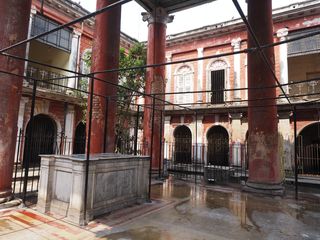
Surrounding the courtyard are two levels of arcaded galleries. The ground floor consists of a sequence of arched openings providing access to interior rooms and ritual spaces, while the upper level features balconies overlooking the courtyard. These galleries create a continuous circulation system that connects different parts of the complex.
At the center of the courtyard stands the natmandir, a ceremonial pavilion supported by tall cylindrical columns. This structure functions as a transitional space between the outer courtyard and the inner sanctum. It accommodates devotional singing, ritual performances, and public gatherings.
Beyond the pavilion lies the sanctum housing the image of Madan Mohan. The alignment of entrance, pavilion, and sanctum establishes a clear processional axis, guiding movement through the complex in accordance with ritual practice.
The structural clarity of the layout distinguishes the temple from more compact or vertically oriented religious buildings. The emphasis on horizontal expansion, open space, and layered circulation reflects both functional and symbolic considerations.
Notable features and architectural particularities
One of the most remarkable aspects of the temple is the scale of its columns. Their height and diameter are significantly larger than those typically found in Bengali temple architecture, giving the central pavilion a monumental character that contrasts with the otherwise modest scale of the surrounding structures.
The red coloration of the columns and walls constitutes a defining visual feature. This chromatic choice enhances the perception of mass and continuity across the complex, while also aligning with regional aesthetic conventions associated with religious and aristocratic architecture.
The presence of metal frameworks and protective railings within the courtyard represents later additions, introduced to manage access and support temporary installations during religious festivals. These elements illustrate the ongoing adaptation of the site to contemporary uses.
Another notable characteristic is the integration of residential and ritual functions within a single architectural ensemble. The galleries and upper floors suggest that parts of the complex were used for habitation or administrative purposes, reinforcing the connection between family, temple, and community.
Conservation and contemporary challenges
The architectural condition of the Madan Mohan Temple reflects the broader challenges faced by historic structures in Kolkata. Exposure to humidity, pollution, and urban density contributes to the gradual deterioration of plaster surfaces and masonry elements.
The maintenance of lime-based materials requires specialized knowledge, and inappropriate restoration techniques can compromise the structural integrity of the building. At the same time, the continued use of the temple for religious purposes ensures a degree of ongoing care, even if systematic conservation efforts remain limited.
The absence of formal international recognition does not diminish the architectural significance of the site. The temple represents a valuable example of urban religious architecture shaped by the interaction between local traditions and global influences during the colonial period.
Its preservation depends largely on local initiatives and the continued engagement of the community. As Kolkata continues to evolve, the Madan Mohan Temple stands as a testimony to a specific phase in the city’s architectural history, where religious function, residential form, and cross-cultural design converged within a single coherent structure.