

 Français (France)
  Nederlands (nl-NL)
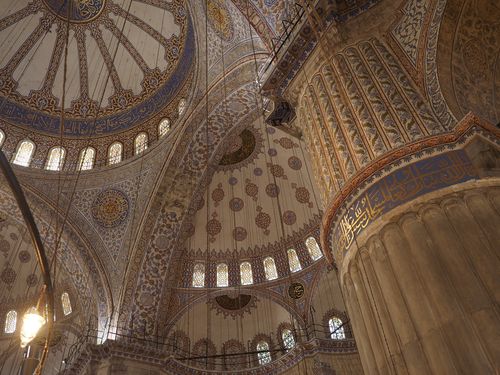
 The Sultanahmet Mosque, located in Istanbul, Turkey, is one of the city's most iconic landmarks. Renowned for its six minarets and grand central dome, it exemplifies Ottoman architectural brilliance. Often referred to as the "Blue Mosque" due to the blue ceramic tiles that adorn its interior, it serves both as a functioning place of worship and a prominent attraction. Built in the early 17th century during the reign of Sultan Ahmed I, it is celebrated for its harmonious design and expansive courtyards. The Sultanahmet Mosque remains a must-see destination for those exploring Istanbul's cultural and spiritual heritage.

Monument profile
Sultanahmet Mosque
Monument category: Mosque
Monument family: Mosque, Minaret or Madrasa
Monument genre: Religious
Cultural heritage: Islamic
Geographic location: Istanbul • Turkey
Construction period: 17th century AD
This monument in Istanbul is inscribed on the UNESCO World Heritage List since 1985 eand is part of the serial property "Historic Areas of Istanbul". See the UNESCO monuments featured on this site
• Links to •
• List of videos about Istanbul on this site •
Istanbul • Sultanahmet, the blue mosque, Turkey
Istanbul • Hagia Sofia, Turkey
Istanbul • Hagia Irene, Turkey
Istanbul • Cistern Basilica, Turkey
Istanbul • Topkapi palace, Turkey
Istanbul • Grand Bazaar, Galata Bridge, Bosphorus Treasures
• References •
UNESCO: Historic Areas of Istanbul
The Sultanahmet Mosque: A Political, Social, and Cultural Icon Through the Ages
The Sultanahmet Mosque, widely known as the "Blue Mosque," stands as a testament to the political aspirations and social ambitions of the Ottoman Empire. Constructed between 1609 and 1616 under Sultan Ahmed I, the mosque reflects the era's drive for cultural dominance and spiritual affirmation. Over the centuries, it has borne witness to historical transformations that have shaped its cultural significance and its role in the modern world.
Political and Social Motivations Behind Its Construction
At the dawn of the 17th century, the Ottoman Empire faced growing internal and external pressures. Defeats in military campaigns, such as those against the Habsburgs and Safavids, highlighted vulnerabilities in the empire's reach. Sultan Ahmed I, ascending the throne at a young age, sought to reaffirm his legitimacy and restore the empire’s prestige. The mosque, strategically placed near the Hagia Sophia and the Hippodrome of Constantinople, was intended to rival the grandeur of Byzantine monuments while emphasizing Islamic supremacy.
Socially, the mosque served as a unifying force for the diverse population of Istanbul. Its construction, involving artisans and materials from across the empire, symbolized cohesion and reinforced the centrality of Islam in the lives of Ottoman subjects.
Historical Events and Their Regional Impact
The Sultanahmet Mosque has witnessed pivotal moments in Istanbul’s history. During the decline of the Ottoman Empire in the 19th century, the mosque continued to function as a central place of worship, maintaining its role in the daily life of the city. The transformation of the Ottoman Empire into the Republic of Turkey in the early 20th century marked a significant shift, as the mosque became a symbol of the nation’s rich cultural heritage amidst the secularization policies of Mustafa Kemal Atatürk.
Its designation as a landmark in Istanbul's historical peninsula attracted international attention, solidifying its role as both a religious site and a cultural beacon.
Global Context and Regional Comparisons
The early 17th century marked a time of significant transformation across the globe. In Europe, the Thirty Years’ War reshaped political and religious boundaries, while the Mughal Empire in India erected architectural marvels like the Taj Mahal. In the Americas, European colonial powers were establishing dominance, fundamentally altering indigenous cultures. The construction of the Sultanahmet Mosque paralleled these events, reflecting the Ottoman Empire’s ambition to project power and cultural sophistication in a competitive global arena.
Architectural Transformations Over the Centuries
Throughout its history, the Sultanahmet Mosque has undergone multiple restorations. The most notable changes include the reinforcement of its structure following earthquakes and the meticulous preservation of its iconic İznik tiles. These tiles, renowned for their vibrant blue patterns, are among the mosque’s most celebrated features. The addition of modern lighting and sound systems for tourists demonstrates the mosque’s adaptation to contemporary needs while striving to preserve its authenticity.
Cultural Significance and Modern Preservation Challenges
The mosque’s inclusion in the "Historic Areas of Istanbul," a UNESCO World Heritage Site, has elevated its global recognition and bolstered conservation efforts. However, challenges persist. Urban pollution, high visitor foot traffic, and environmental factors pose threats to its structural integrity and decorative elements. Balancing its role as a living place of worship with its status as a tourist attraction requires ongoing attention and resources.
A Legacy of Resilience and Global Admiration
The Sultanahmet Mosque remains a symbol of Ottoman ingenuity and cultural dialogue, bridging the past and present. It exemplifies the empire’s architectural and artistic achievements, while its resilience mirrors the enduring legacy of Istanbul as a crossroads of civilizations. Preserving this iconic structure not only safeguards a piece of history but also ensures its continued inspiration for future generations.
Architectural Mastery of the Sultanahmet Mosque: A Testament to Ottoman Innovation and Artistic Synthesis
The Sultanahmet Mosque, also known as the Blue Mosque, stands as a remarkable example of Ottoman architectural ingenuity and artistic sophistication. Constructed between 1609 and 1616 under Sultan Ahmed I, its design by architect Sedefkâr Mehmed Ağa reflects both technological advancements and a harmonious blend of cultural influences. This masterpiece continues to captivate the world with its unique architectural features and historical significance.
Technological Advancements and Materials Used
The construction of the mosque demonstrated cutting-edge architectural techniques for its time. The central dome, measuring 23.5 meters in diameter and rising 43 meters above the ground, is supported by four colossal pillars known as "elephant feet." This innovative design ensured stability while allowing for an expansive and uninterrupted interior space.
High-quality materials, including finely cut stones and marbles, were sourced from across the Ottoman Empire. The interior is adorned with more than 20,000 İznik tiles, celebrated for their intricate floral and geometric patterns in shades of blue, turquoise, and green. These tiles, produced with advanced glazing and firing techniques, contributed to the mosque’s radiant and serene atmosphere. Imported granite and porphyry were used for structural elements, emphasizing durability and grandeur.
Architectural Design and Its Significance
The mosque’s layout is a marvel of symmetry and balance. Its design integrates a vast central prayer hall beneath the dome, surrounded by semi-domes that distribute the weight evenly. This structural ingenuity draws from both Byzantine influences, particularly the Hagia Sophia, and Ottoman refinements.
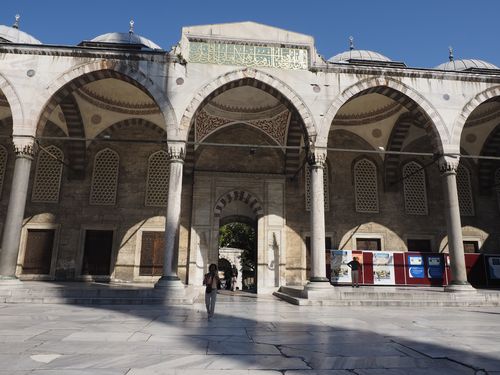
The exterior features six slender minarets, an unprecedented number for a mosque at the time, symbolizing the sultan’s ambition and the empire’s prestige. The spacious courtyard, surrounded by arcades, mirrors the interior’s grandeur and provides a serene transition between the mosque and the bustling city.
A Blend of Regional Traditions and Foreign Influences
The Sultanahmet Mosque embodies a fusion of artistic traditions. Its calligraphic inscriptions, created by master artist Seyyid Kasim Gubari, showcase Ottoman mastery of Islamic art. Meanwhile, the İznik tiles reflect Persian influences in their floral motifs, and the mosque’s monumental scale echoes Byzantine architectural principles.
The use of natural light, enhanced by more than 200 stained-glass windows, creates an ethereal atmosphere, blending functionality with aesthetic beauty. This interplay of regional and foreign elements highlights the cosmopolitan nature of Ottoman Istanbul, a crossroads of cultures.
Notable Anecdotes and Statistics
An intriguing anecdote about the mosque involves its six minarets. According to legend, Sultan Ahmed I originally requested "altın minare" (gold minarets), but the architect misinterpreted this as "altı minare" (six minarets). While controversial at the time, as the Grand Mosque of Mecca also had six minarets, the issue was resolved by adding a seventh minaret to the mosque in Mecca.
The construction employed thousands of workers over seven years, and Sultan Ahmed I himself is said to have participated in laying the first stone, emphasizing his personal dedication to the project.
Global Recognition and UNESCO Impact
Part of Istanbul's Historic Areas, a UNESCO World Heritage Site since 1985, the Sultanahmet Mosque enjoys global recognition as a symbol of Ottoman cultural and architectural achievement. This designation has brought international attention to its preservation, ensuring that restoration projects adhere to the highest standards.
Efforts to conserve its İznik tiles, calligraphy, and structural integrity have been vital in maintaining its historical and aesthetic value. UNESCO’s recognition also highlights the mosque’s role in fostering intercultural dialogue and appreciation for shared heritage.
Challenges and Contemporary Relevance
Modern challenges to the mosque’s preservation include environmental threats such as urban pollution and seismic activity, as well as the wear and tear caused by millions of annual visitors. Balancing its function as an active place of worship with its role as a tourist attraction requires ongoing commitment and innovation.
A Timeless Symbol of Artistic and Spiritual Grandeur
The Sultanahmet Mosque continues to inspire awe and admiration, not only as an architectural masterpiece but also as a living testament to the Ottoman Empire's legacy. Its seamless integration of technological innovation, cultural synthesis, and artistic excellence ensures its place among the world’s most celebrated monuments, embodying both historical grandeur and timeless spiritual significance.