

 Français (France)
  Nederlands (nl-NL)
 The Kyaung Daw Gyi Monastery in Pa Khan Gyi, Myanmar, is a significant Buddhist religious site, known for its wooden architecture and traditional ornamentation. It stands as a testament to Burmese craftsmanship, particularly in the intricate wood carvings that adorn the structure. With its impressive scale and refined decorations, it represents a notable example of the country’s historic monasteries. The monastery continues to serve its religious and spiritual function, providing a place for monks and devotees to practice Theravāda Buddhism. As a center for worship and Buddhist teachings, it also attracts visitors interested in the religious art and cultural heritage of the region.
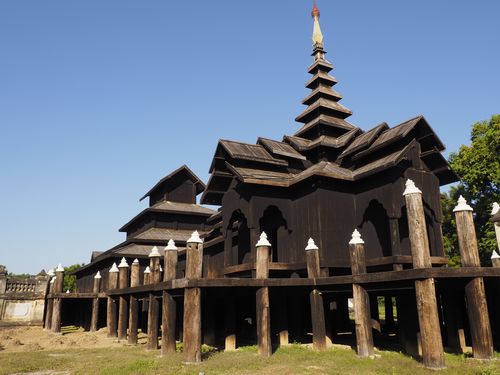
Pa Khan Gyi • Kyaung Daw Gyi Monastery

Pa Khan Gyi • Kyaung Daw Gyi Monastery

Pa Khan Gyi • Kyaung Daw Gyi Monastery
Monument profile
Kyaung Daw Gyi Monastery
Monument category: Monastery
Monument family: Monastery
Monument genre: Religious
Cultural heritage: Buddhist
Geographic location: Pa Khan Gyi • Myanmar
Construction period: 19th century AD
• Links to •
• List of videos about Pa Khan Gyi on this site •
Pa Khan Gyi, the wooden monastery of • Myanmar
The History of Kyaung Daw Gyi Monastery in Pa Khan Gyi, Myanmar
Political and Social Context of Its Construction
The Kyaung Daw Gyi Monastery, located in Pa Khan Gyi, Myanmar, stands as a significant example of Burmese monastic architecture and Buddhist heritage. Built during a time when Myanmar was experiencing significant political and social transformations, its construction was closely tied to the ruling authority's efforts to solidify power, affirm religious legitimacy, and unify the diverse territories under its control.
The monastery was likely constructed during the Konbaung Dynasty (1752–1885), an era marked by territorial expansion, military conflicts, and consolidation of Buddhist influence. At this time, Burmese rulers faced continuous challenges from Siam (modern-day Thailand), British colonial forces, and internal rebellions. The construction of grand monasteries such as Kyaung Daw Gyi was part of a larger strategy to legitimize royal power by linking the monarchy with Theravāda Buddhism, the dominant religion in Myanmar.
The ruling elite sought to reinforce the presence of Buddhism through monumental religious architecture, ensuring the loyalty of the Sangha (monastic community), which played a central role in education, governance, and cultural preservation. In addition to serving as a religious institution, the Kyaung Daw Gyi Monastery functioned as a center of learning, where monks studied Buddhist scriptures and taught young novices, effectively shaping the spiritual and intellectual landscape of the region.
The monastery’s construction may have also been influenced by the political alliances and rivalries of the time. As the Konbaung Dynasty sought to expand its influence, it actively patronized monastic institutions to gain the support of the population and rival noble factions. This period saw increasing interactions with Ayutthaya (Siamese Kingdom), Qing China, and British India, which led to both conflicts and cultural exchanges that influenced Burmese religious architecture.
Major Historical Events That Shaped the Monastery
Throughout its history, Kyaung Daw Gyi has witnessed several major events that have influenced its preservation, transformation, and status as a religious institution.
Wars and Invasions:
- The Burmese-Siamese Wars (16th–18th centuries) resulted in significant destruction of religious sites on both sides. While it is unclear if Kyaung Daw Gyi was directly impacted, similar monasteries in the region suffered damage during these conflicts.
- The Anglo-Burmese Wars (1824–1885) led to the decline of royal patronage for religious structures as British forces gradually took control of Burmese territories. During the Third Anglo-Burmese War (1885), which marked the fall of the Konbaung Dynasty, many monastic institutions faced plundering or neglect.
Colonial Era (1885–1948):
- Under British rule, the importance of monastic institutions declined as Western-style education and governance replaced traditional Buddhist systems. However, monasteries like Kyaung Daw Gyi remained vital in preserving Burmese culture, acting as centers of resistance against colonial policies.
- During this time, the monastery likely underwent minimal restorations, relying on local community donations rather than royal patronage.
World War II and Japanese Occupation (1942–1945):
- Many Burmese religious sites were damaged during Allied bombings and clashes between Japanese and British-led forces. Although there are no detailed records of wartime damage to Kyaung Daw Gyi, its survival amidst widespread destruction highlights its resilience.
Post-Independence Period (1948–Present):
- After Myanmar gained independence in 1948, Buddhist institutions regained state support. However, political instability, military rule, and economic difficulties meant that the restoration of historic monasteries remained sporadic.
- Today, Kyaung Daw Gyi is recognized as a heritage site, with efforts to restore its structure and preserve its historical significance.
Global Context at the Time of Construction
During the likely period of Kyaung Daw Gyi’s construction, similar religious and architectural trends were shaping the world:
- In Southeast Asia, other Theravāda Buddhist nations, including Thailand, Laos, and Cambodia, were constructing elaborate monastic complexes, such as Wat Phra Kaew in Bangkok.
- In China and Japan, Buddhist architecture was evolving with influences from traditional wooden structures, while the Qing Dynasty (1644–1912) was expanding its influence over Tibet and Mongolia, further shaping Buddhist artistic traditions.
- In Europe, the 18th century saw the rise of Baroque and Neoclassical architecture, particularly in religious and governmental buildings. While stylistically different, these projects paralleled Burmese monastic constructions in their use of monumental design to assert political and religious authority.
- In India, the British East India Company was consolidating its rule, impacting Buddhist communities in regions such as Bengal and Sri Lanka. Buddhist revival movements in Sri Lanka also influenced Burmese monastic developments.
These global movements reflect how Kyaung Daw Gyi was part of a broader wave of religious monumentalism, with states using architecture to demonstrate power, cultural identity, and devotion.
Transformations and Modifications Over Time
Over the centuries, Kyaung Daw Gyi has undergone several modifications:
- Architectural Restorations: Due to Myanmar’s humid climate and frequent conflicts, the monastery has likely required extensive repairs, particularly to its wooden structures and roofs.
- Changes in Usage: Originally a royal-sponsored religious and educational institution, the monastery has adapted to modern times, hosting Buddhist ceremonies, meditation retreats, and community gatherings.
- Urbanization Impact: As surrounding areas developed, the monastery’s integration into a modern landscape presented challenges in maintaining its original setting. While still a religious site, it is now also a tourist and cultural attraction.
Modern Role and Cultural Importance
Today, Kyaung Daw Gyi remains a vital part of Myanmar’s religious, cultural, and historical identity.
- Spiritual Center: It continues to function as a monastic and meditation center, drawing monks and laypeople from across the country.
- Tourism and Cultural Symbolism: As interest in Myanmar’s Buddhist heritage grows, the monastery has become an important site for both local and international visitors.
- Festivals and Religious Observances: Annual Buddhist celebrations, such as Thingyan (Burmese New Year) and Kathina (Robe Offering Ceremony), see large gatherings at the monastery.
Current State of Conservation and Challenges
Despite its importance, Kyaung Daw Gyi faces several threats to its preservation:
- Environmental Factors: Humidity, termites, and monsoon rains pose continuous risks to its wooden framework.
- Tourism Pressure: Increased foot traffic can cause wear on the floors and structural damage.
- Limited Funding for Restoration: Unlike temples that receive substantial international recognition, Kyaung Daw Gyi relies primarily on local donations and Myanmar’s limited heritage conservation budget.
Efforts to restore and protect the site have increased, with conservation projects focusing on structural reinforcement, documentation, and community-led initiatives. Future UNESCO recognition could help secure funding and international expertise for long-term preservation.
Conclusion
The Kyaung Daw Gyi Monastery of Pa Khan Gyi is a testament to Myanmar’s rich Buddhist tradition, reflecting centuries of political shifts, religious devotion, and artistic excellence. From its construction during the Konbaung Dynasty to its continued role in modern Myanmar, the monastery stands as both a place of worship and a cultural landmark. However, conservation efforts must be prioritized to ensure that this historical treasure remains preserved for future generations.
The Architecture of Kyaung Daw Gyi Monastery in Pa Khan Gyi, Myanmar
Technological and Architectural Innovations of the Era
The Kyaung Daw Gyi Monastery in Pa Khan Gyi, Myanmar, represents a significant architectural achievement in traditional Burmese monastic construction. Built using sophisticated woodworking techniques, the monastery exemplifies the technological advancements of its time, particularly in structural stability, climate adaptation, and the intricate artistry of its design.
One of the most notable architectural features of the monastery is its elevated structure on wooden stilts, a technique commonly employed in Southeast Asian religious and residential buildings. This method was essential for ensuring stability in Myanmar’s tropical environment, where seasonal monsoons and humidity could otherwise compromise the integrity of wooden buildings. The elevation protected the structure from flooding, pests, and rot, while also allowing for better air circulation beneath the monastery, preventing excess moisture buildup.
Another crucial innovation is the absence of nails or metal fasteners in the construction of Kyaung Daw Gyi. Instead, intricately carved wooden joints, mortise-and-tenon connections, and interlocking beams were used to hold the structure together. This method not only enhanced the flexibility of the building, making it more resistant to earthquakes, but also demonstrated the high level of craftsmanship among Burmese artisans.
The roofing system is another element that reflects technological ingenuity. Designed with multiple tiers and overhanging eaves, the roof effectively channels rainwater away from the main structure, reducing water damage. The tiers also contribute to passive cooling, an essential feature in Myanmar’s hot climate, as they allow heat to escape from the interior of the building while shading the lower sections.
Materials and Construction Methods
The primary material used in the construction of Kyaung Daw Gyi is teak wood, one of Myanmar’s most valuable natural resources. Teak is renowned for its durability, resistance to termites, and ability to withstand high humidity, making it an ideal choice for monastic architecture. The dense grain of the wood allows for intricate carvings, contributing to the monastery’s aesthetic appeal.
The construction process involved seasoning the wood for several years before use, ensuring that it had minimal moisture content, thus reducing the risk of warping or splitting over time. Artisans employed hand tools to carve elaborate details, particularly in pillars, doorways, and ceiling panels, where religious and mythological motifs were often depicted.
Another innovative aspect of Kyaung Daw Gyi’s construction is its layered foundation, which consists of wooden pilings driven deep into the ground. This method distributes the weight of the structure evenly and provides resilience against shifting soil and erosion.
The monastery’s ornamental elements, such as gilded surfaces, lacquered wood panels, and embedded precious stones, further highlight the level of craftsmanship involved. The use of gold leaf decorations and lacquer coatings was not only aesthetic but also served as a protective layer against humidity and insect damage.
Architectural and Artistic Influences
The architectural design of Kyaung Daw Gyi reflects a blend of Burmese, Indian, and Chinese influences, characteristic of religious structures built during the Konbaung Dynasty (1752–1885).
- Burmese Influence: The monastery embodies traditional Burmese wooden monastic design, particularly through its multi-tiered pyatthat roof, an iconic feature of Burmese religious architecture. This tiered roofing system is commonly found in royal palaces and pagodas, symbolizing hierarchy and sacred space.
- Indian Influence: The monastery incorporates floral motifs, geometric patterns, and depictions of Jataka tales (stories of the Buddha’s previous lives), which are common elements in Indian Buddhist art.
- Chinese Influence: The inclusion of curved eaves and dragon motifs suggests an influence from Chinese temple architecture, likely introduced through trade and diplomatic exchanges.
The wooden carvings at Kyaung Daw Gyi are particularly striking, featuring Buddhist deities, celestial beings, and mythological creatures such as naga (serpents) and kinnari (half-bird, half-human figures). These carvings not only serve a decorative purpose but also convey religious teachings and narratives to devotees and monks.
Spatial Organization and Structure
The layout of Kyaung Daw Gyi follows the traditional monastic floor plan found in Burmese Theravāda Buddhist monasteries. The central hall, or thein, serves as the primary area for prayer, meditation, and religious ceremonies. It is supported by massive teak columns, intricately carved and spaced evenly to create a sense of grandeur and symmetry.
The entrance porch is typically adorned with an elaborately carved wooden gateway, symbolizing the transition from the secular world to the spiritual realm. The monastery also includes:
- Living quarters for monks, arranged along the perimeter of the complex.
- A scripture hall, where palm-leaf manuscripts containing Buddhist teachings are stored.
- A communal dining hall, where monks receive alms and conduct ritual meals.
One of the most distinctive features of Kyaung Daw Gyi is its series of elevated walkways and wooden bridges, connecting different sections of the monastery. These not only enhance mobility within the complex but also reinforce the elevated structure’s resilience against floods.
Statistics and Notable Anecdotes
- Dimensions: The monastery spans hundreds of square meters, with its tallest columns reaching over 10 meters in height.
- Carving Details: Some of the wooden panels contain over 50 layers of hand-carved designs, depicting Buddhist cosmology.
- Historical Anecdote: Oral tradition suggests that the teak wood used for construction was personally donated by a royal patron, reinforcing the monastery’s link to the Burmese monarchy.
- Unique Fact: Some carvings allegedly feature hidden symbolic messages related to Buddhist philosophy, only decipherable by monks trained in ancient scripts.
International Recognition and Conservation Challenges
Despite its architectural significance, Kyaung Daw Gyi faces several preservation challenges:
- Environmental Factors: Myanmar’s humid climate accelerates wood decay, termite infestation, and fungal growth.
- Tourism Pressure: Increased foot traffic threatens the integrity of delicate carvings and floors.
- Urbanization: As modern infrastructure develops around the monastery, maintaining its historical ambiance and structural isolation becomes difficult.
- Restoration efforts are primarily community-driven, with local artisans and monks actively participating in conservation projects. While not yet a UNESCO World Heritage Site, discussions regarding its inclusion have highlighted the need for international funding and technical expertise to preserve its intricate wooden architecture.
Conclusion
The Kyaung Daw Gyi Monastery in Pa Khan Gyi stands as an architectural and cultural masterpiece, embodying the finest traditions of Burmese monastic construction. Through its innovative structural solutions, exquisite craftsmanship, and integration of regional artistic influences, the monastery continues to serve as both a spiritual sanctuary and a historical landmark.
As Myanmar navigates the challenges of modernization and heritage conservation, Kyaung Daw Gyi remains a testament to the enduring legacy of Burmese Buddhist architecture, reflecting centuries of devotion, artistic excellence, and architectural ingenuity.