Français (France)
  Nederlands (nl-NL)
 Of Buddhist tradition, (with additional Hindu and Zoroastrian influence), the Kushan dynasty ruled for approximately 345 years, ± between 30 and 375 over all or part of East India, North India and the Himalayan region, during the Ancient Period.
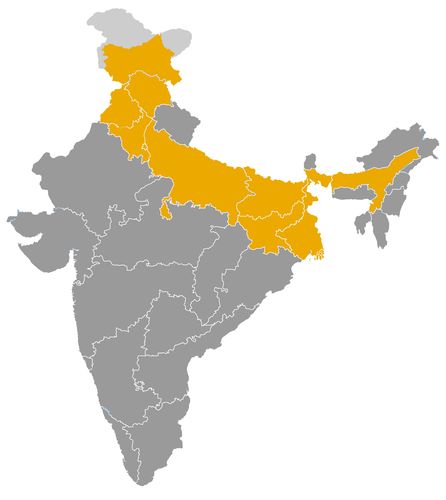
This map illustrates the maximum territory that the Kushan Dynasty had reached at its height, covering the current regions of Assam, Bihar, Delhi (NTC), Haryana, Himachal Pradesh, Jammu & Kashmir, Jharkand, Punjab and Uttar Pradesh in India. Its main purpose is to provide a visual aid to understand the geographical extent of this dynasty. However, it's important to note that the contemporary borders of these regions may not necessarily coincide with the historical territories.
The Kushan Dynasty and Its Role in the History of Ancient India
A Central Asian power incorporated into the Indian world
The Kushan dynasty occupies a major place in the history of ancient India, especially between the first and fourth centuries CE. Its rulers came from the Yuezhi, a people of Central Asian origin who moved into Bactria before expanding toward Afghanistan, Gandhara, the Punjab and the Indo-Gangetic plains. Although their origins lay outside the Indian subcontinent, the Kushans became one of the most influential political powers in northern India.
Their importance lies in the way they connected several cultural and economic zones. The Kushan Empire linked India with Central Asia, Iran, China and the Roman world. This position made the dynasty a bridge between the subcontinent and the wider Eurasian world. Rather than representing a foreign interruption in Indian history, the Kushans became part of the political and cultural fabric of ancient North India.
Imperial authority across a multicultural territory
The Kushan state reached its greatest strength under Kanishka I, one of the most prominent rulers of ancient India. His empire included strategic regions such as Gandhara, Mathura, the Punjab, parts of the Indus basin and territories beyond the Hindu Kush. These areas were linguistically, religiously and culturally diverse, and the Kushans developed a flexible model of kingship suited to this variety.
Their rulers used titles and symbols drawn from several traditions, including Iranian, Greek, Central Asian and Indian sources. Kushan coinage is especially revealing: it presents rulers as universal monarchs and displays deities from different religious worlds. This was not simply decorative. It was a political language designed to legitimise rule over a vast and varied population.
The Kushans also helped stabilise the northwestern regions of the subcontinent after earlier periods of Indo-Greek, Saka and Indo-Parthian rule. Their empire created a stronger political framework for urban life, long-distance trade and religious patronage.
Economic power based on trade and coinage
The economic role of the Kushan dynasty was exceptional. Their empire controlled key sections of the routes linking India with Central Asia and China. These networks carried silk, spices, precious stones, textiles, metals, ivory and luxury goods. The Kushans benefited from these exchanges and contributed to their security by holding the passes, river valleys and commercial centres through which merchants moved.
A major sign of Kushan economic strength was their coinage. From the reign of Vima Kadphises onward, the dynasty issued substantial gold coins, as well as copper and other denominations. These coins indicate access to wealth, a monetised economy and participation in long-distance trade. They also provide valuable evidence for royal titles, political claims and religious imagery.
Commercial centres such as Mathura, Taxila and the cities of Gandhara prospered in this environment. The Kushan period helped integrate the northwest and the Gangetic region into broader commercial systems that extended far beyond India.
Patronage of Buddhism and religious pluralism
The Kushans are strongly associated with the history of Buddhism, especially because of Kanishka I. Buddhist tradition remembers him as a major patron, and his reign is often linked with the expansion of Mahayana Buddhism and the spread of Buddhist ideas toward Central Asia and China. Monasteries, stupas and pilgrimage centres benefited from the stability and resources of the Kushan period.
However, the dynasty should not be described as exclusively Buddhist. Kushan religious policy was notably pluralistic. Their coins show Iranian, Greek, Indian and Buddhist divinities, reflecting the religious diversity of the empire. This pluralism helped the rulers communicate with different communities and reinforced their legitimacy across a broad territory.
The Kushan period was therefore important not only for Buddhist history, but also for the wider religious landscape of ancient India. It encouraged movement between traditions and helped create conditions in which religious ideas, images and institutions could travel across regions.
Gandharan and Mathura art as cultural landmarks
The cultural impact of the Kushans was particularly visible in art. Two major artistic centres flourished under their rule: Gandhara and Mathura. Gandharan art combined Indian, Iranian and Hellenistic elements, producing refined images of the Buddha, bodhisattvas and narrative scenes from Buddhist tradition. Its sculptural style, with naturalistic drapery and classical-looking forms, became one of the most distinctive artistic developments of ancient South Asia.
Mathura developed a different artistic language, more deeply rooted in Indian traditions. It produced Buddhist, Jain and Brahmanical images and played a central role in the formation of early Indian iconography. Under Kushan patronage, Mathura became one of the great religious and artistic centres of northern India.
The Kushan period was especially important for the wider use of anthropomorphic images of the Buddha. Although this development cannot be attributed to a single dynasty alone, Kushan political stability and patronage strongly encouraged the growth of workshops, monasteries and visual religious culture.
A durable legacy in North Indian history
The decline of Kushan power was gradual. From the third century onward, the empire faced pressure from the Sasanians in the west, the rise of local powers and the fragmentation of its former territories. Later Kushan rulers retained authority in reduced regions, but the imperial structure weakened before the emergence of new powers, including the Guptas.
Despite this decline, the Kushan legacy remained significant. They strengthened the role of northwestern India as a zone of contact between the subcontinent and Eurasia. They promoted trade, supported religious institutions, contributed to the spread of Buddhism and encouraged major artistic developments in Gandhara and Mathura.
The Kushan dynasty therefore holds a distinctive place in Indian history. It was not merely a ruling house of foreign origin, nor simply a regional kingdom. It was an imperial power that connected cultures, economies and religions across a vast area. Its importance lies in this ability to organise a transregional world in which India was deeply linked to Central Asia, Iran, China and the wider networks of the ancient world.
The Geographic Reach of the Kushan Dynasty between India and Central Asia
A transregional empire entering India from the northwest
The Kushan dynasty controlled one of the most strategically placed empires of ancient South Asia. Its power did not begin in the Indian heartland, but in the northwestern zones that connected the subcontinent with Central Asia. The Kushans emerged from the Yuezhi confederation, which had settled in Bactria before expanding across Afghanistan, Gandhara and the Indus region. Their geographic extension therefore gave them a distinctive position: they were at once a Central Asian, Iranian and Indian power.
In Indian history, the Kushans are especially important because they brought the northwestern frontier and parts of northern India into a wider Eurasian political system. Their empire linked the Oxus region, the Hindu Kush, the Kabul valley, Gandhara, the Punjab, the Indus basin and eventually Mathura and parts of the Indo-Gangetic plain. Their territory was not only a land empire, but also a network of routes, cities, river valleys and mountain passes.
Bactria and Afghanistan as the first centres of Kushan power
The earliest Kushan expansion developed north of the Hindu Kush, in Bactria, a region corresponding broadly to parts of northern Afghanistan, southern Uzbekistan and Tajikistan. This area had previously been shaped by Achaemenid, Hellenistic and Greco-Bactrian influences. By gaining control there, the Kushans inherited a zone of urban culture, coinage, trade and political contact with Iran and Central Asia.
From Bactria, the Kushans moved southward through Afghanistan. The Kabul valley and the routes across the Hindu Kush were essential to this expansion. Control of these passages allowed the dynasty to connect Central Asia with the Indian subcontinent. It also placed them in direct contact with Iranian powers to the west and with earlier Indo-Parthian and Saka groups established in the northwest.
Gandhara as the gateway to the Indian world
Gandhara became one of the most important territories under Kushan rule. Centred around regions such as Peshawar, Taxila and the valleys of present-day northwestern Pakistan and eastern Afghanistan, Gandhara was both a military corridor and a cultural meeting point. It controlled access between the mountain routes of Central Asia and the plains of northern India.
The Kushan presence in Gandhara had major consequences. Politically, it gave the dynasty a strong base within the Indian cultural sphere. Economically, it allowed the Kushans to supervise routes used by merchants travelling between India, Iran, Central Asia and China. Culturally, Gandhara became one of the great centres of Buddhist art, where Indian, Iranian and Hellenistic elements interacted under Kushan patronage.
Expansion into the Punjab, the Indus basin and Mathura
The Kushans expanded from Gandhara into the Punjab and the Indus basin. These regions were agriculturally productive, commercially active and strategically placed between the northwest and the Indo-Gangetic world. Their control strengthened Kushan authority in areas that had previously been contested by Indo-Greeks, Sakas and Indo-Parthians.
A major stage in their Indian expansion was the incorporation of Mathura. Located in northern India, Mathura was an important religious, artistic and commercial centre. Its inclusion within the Kushan sphere showed that the dynasty was not restricted to frontier regions. It exercised authority over a significant part of northern India and interacted deeply with Indian religious and cultural traditions.
At the height of their power, especially under Kanishka I, the Kushans probably controlled or influenced territories stretching from Bactria and Afghanistan to Gandhara, the Punjab, the Indus region, Mathura and parts of the Gangetic plain. The exact eastern and southern limits remain debated, but their role in northern India was substantial.
Relations with Iranian and Central Asian powers
The western and northern extension of the Kushan Empire shaped its relations with neighbouring powers. To the west, the Kushans interacted with the Parthians and later the Sasanians. These Iranian powers were rivals for influence in Bactria, Afghanistan and the trade corridors linking Iran with India.
During the period of Kushan strength, the dynasty was able to maintain control over these contested regions. However, in the third century, Sasanian expansion placed growing pressure on the western parts of the empire. The Sasanians and the Kushano-Sasanians took control of parts of the former Kushan sphere in Bactria and Afghanistan. This reduced Kushan power and shifted its centre of gravity toward the Indian territories.
Relations with Indian dynasties and regional powers
Within India, the Kushans operated in a politically fragmented environment. Their neighbours included Saka groups, local rulers of Rajasthan and the Punjab, powers in the Gangetic region and, farther south, the Satavahanas. The Kushans did not conquer the whole of northern India, but they controlled key corridors and urban centres that gave them influence beyond their direct territory.
Their possession of Mathura placed them close to the central regions of North Indian religious and political life. It also connected them with trade routes leading toward the Ganges plain, Rajasthan and the Deccan. Their presence affected the balance of power among neighbouring dynasties by controlling access between the northwest and the interior.
As Kushan power declined, regional authorities became more autonomous. The weakening of the empire helped create the political conditions in which later powers, including the Guptas, could expand in northern India.
A geographic legacy based on routes, cities and cultural exchange
The geographic importance of the Kushan dynasty lay less in fixed borders than in the control of strategic connections. Their empire linked Central Asia, Iran, northwestern India and the Gangetic world. Mountain passes, caravan routes, river valleys and cities such as Gandhara and Mathura formed the real structure of their power.
This geography shaped their relations with neighbouring dynasties. The Kushans were commercial intermediaries, military rivals and cultural transmitters. Their control of frontier and inland regions allowed goods, artistic forms, religious ideas and political models to move across Eurasia. In Indian history, their territorial extension made the northwest not a margin, but a central zone of exchange between India and the wider ancient world.
Kushan chronology remains debated, especially for the earliest rulers and for the late period. The dates below are indicative and distinguish the formation of Kushan power, the main Kushan Empire and the late Kushan rulers, whose authority was more limited.
Formation of Kushan power
- Kujula Kadphises (c. 30-80) • A Yuezhi chief who became the founder of Kushan power, he consolidated the authority of his line in Bactria and neighbouring regions.
- Vima Taktu (c. 80-95) • Probably identifiable with the ruler called Soter Megas on coins, he continued Kushan expansion toward Afghanistan and northwestern India.
- Vima Kadphises (c. 95-127) • He strengthened the Kushan state and developed an important gold coinage, reflecting an active imperial economy.
Main Kushan Empire
- Kanishka I (c. 127-150) • A major ruler of the dynasty, he expanded the empire over much of northern India and supported Buddhism, Gandharan art and Eurasian exchange.
- Huvishka (c. 150-190) • He maintained Kushan imperial power and continued a religious and monetary policy marked by strong cultural diversity.
- Vasudeva I (c. 190-230) • The last major ruler of the unified Kushan Empire, he ruled mainly over the Indo-Gangetic regions and northwestern India.
Late Kushans
- Kanishka II (c. 230-247) • His reign belongs to the period of reduced Kushan power after Sasanian advances in Bactria and Afghanistan.
- Vashishka (c. 247-267) • A late Kushan ruler, he probably exercised more limited authority in northwestern India and the Mathura region.
- Kanishka III (c. 267-270) • His brief and poorly documented reign reflects the survival of a reduced Kushan authority after the fragmentation of the empire.
- Vasudeva II (c. 270-310) • He ruled in the Indian part of the former Kushan sphere, in a context of competition with the Kushano-Sasanians and other regional powers.
- Shaka (c. 310-335) • A late Kushan ruler known mainly from coinage, he represents a phase in which dynastic power had become strongly regionalised.
- Kipunadha (c. 335-375) • The last late Kushan ruler generally connected with the dynasty, he ruled before the rise of new powers such as the Kidarites.
 Links to the main sections of the site