Français (France)
  Nederlands (nl-NL)
 Of Hindu tradition, the Khalji dynasty ruled for approximately 30 years, ± between 1290 and 1320 over all or part of Central India, North India, South India and West India, during the Medieval Period.
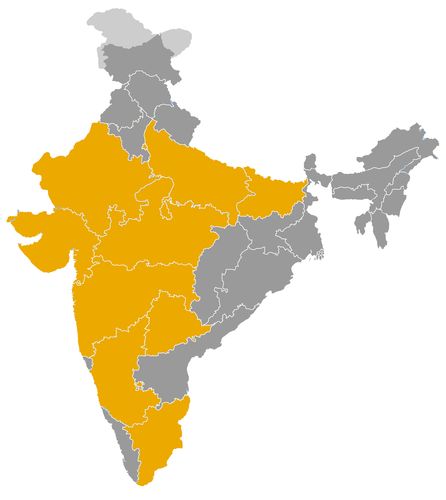
This map illustrates the maximum territory that the Khalji Dynasty had reached at its height, covering the current regions of Bihar, Delhi (NTC), Karnataka, Madhya Pradesh, Maharashtra, Rajasthan, Tamil Nadu and Uttar Pradesh in India. Its main purpose is to provide a visual aid to understand the geographical extent of this dynasty. However, it's important to note that the contemporary borders of these regions may not necessarily coincide with the historical territories.
The Khalji Dynasty and the Imperial Expansion of the Delhi Sultanate
A short-lived dynasty with major historical influence
The Khalji dynasty ruled the Delhi Sultanate from 1290 to 1320, between the Mamluk or Slave dynasty and the Tughlaq dynasty. Although its rule lasted only three decades, its importance in the history of India was considerable. Under the Khaljis, the Delhi Sultanate moved beyond its earlier northern Indian base and became a more aggressive, centralized and expansive power. Its influence reached Gujarat, Rajasthan, Malwa, the Deccan and parts of southern India.
The rise of Jalal al-Din Firuz Khalji marked a change in the ruling elite of Delhi. The Khaljis were connected with Turko-Afghan military circles and had long been associated with frontier regions of the Indo-Islamic world. Their accession ended the dominance of the older Mamluk aristocracy and opened a new phase in the political development of the sultanate. This phase was especially shaped by military expansion, stronger royal authority and more direct state intervention in economic affairs.
The strengthening of royal authority under Ala al-Din Khalji
The most important ruler of the dynasty was Ala al-Din Khalji, who reigned from 1296 to 1316. After seizing power from Jalal al-Din, he established a forceful and highly centralized style of rule. His main political goal was to reduce the power of nobles, governors and military commanders who might challenge the authority of the sultan.
Ala al-Din developed a system of surveillance, tightened control over provincial administration and restricted the independent power of aristocratic factions. He also sought to prevent rebellions by limiting the ability of nobles to accumulate excessive wealth or build private alliances. This policy strengthened the authority of the central state and gave the sultanate a greater capacity for military and administrative action.
His reign was also marked by successful resistance to Mongol incursions. The Mongol threat was one of the greatest military dangers facing northern India in the late thirteenth and early fourteenth centuries. By defending Delhi and the northwestern frontier, Ala al-Din strengthened the prestige of the sultanate and secured the political heartland from which further expansion became possible.
Military expansion across western, central and southern India
The political role of the Khalji dynasty is closely linked to its military expansion. Ala al-Din Khalji extended the influence of Delhi farther than any previous ruler of the sultanate. Gujarat was conquered, bringing the sultanate into contact with wealthy commercial regions and maritime trade networks. Campaigns against Rajasthan targeted powerful Rajput strongholds such as Ranthambore and Chittor, whose capture had both military and symbolic significance.
The Khalji expansion also reached Malwa, an important region between northern India, Gujarat and the Deccan. Its control helped open routes toward central and southern India. The most spectacular campaigns were conducted in the Deccan and beyond, especially under the command of Malik Kafur. The Yadavas of Devagiri, the Kakatiyas of Warangal, the Hoysalas of Dvarasamudra and the Pandyas in the far south were all affected by the military reach of Delhi.
In many of these southern regions, Khalji power did not take the form of permanent direct administration. Instead, defeated rulers were often required to pay tribute, acknowledge the superiority of the sultan and supply wealth to Delhi. This system allowed the sultanate to benefit from distant conquests without fully integrating those territories into its administrative structure.
Economic reforms designed to support a military state
One of the most distinctive aspects of Ala al-Din Khalji’s rule was his intervention in the economy. The sultan needed large resources to maintain a strong army, defend the northwest frontier and support campaigns across the subcontinent. To achieve this, he strengthened revenue collection, especially in the fertile regions close to Delhi.
His administration introduced strict market regulations. Prices of grain, horses, cloth, slaves and other goods important to the army were controlled. These measures were intended to reduce the cost of maintaining soldiers and to prevent merchants and intermediaries from gaining excessive influence. The state also supervised supplies and trade more closely than before.
These reforms should not be understood as economic policy in a modern sense. They were instruments of military government. Their purpose was to support a large standing army and strengthen the fiscal power of the sultan. Even if such controls depended heavily on the ruler’s authority and were difficult to maintain after his death, they show the exceptional reach of the Khalji state.
Cultural development within the Indo-Persian world of Delhi
The Khalji period also contributed to the cultural development of the Delhi Sultanate. Persian remained the language of administration, court life, literature and historical writing. Delhi became an important centre of Indo-Persian culture, attracting poets, scholars, chroniclers and religious figures.
The poet and musician Amir Khusrau is one of the most prominent cultural figures associated with this period. His work reflects the interaction between Persian, Turkic and Indian traditions, and he became an important symbol of the literary and artistic vitality of the Delhi court. The Khalji period therefore strengthened Delhi’s role as a major cultural centre of medieval India.
Architecture also developed under the Khaljis. Monuments associated with Ala al-Din Khalji, especially in the Qutb complex, show a more confident use of arches, domes, inscriptions and monumental forms. These buildings continued earlier Indo-Islamic architectural experiments while preparing the way for later developments under the Tughlaqs and subsequent dynasties.
A powerful legacy despite rapid dynastic collapse
After Ala al-Din Khalji’s death, the dynasty rapidly declined. Court factions, succession struggles, the influence of Malik Kafur, the brief nominal reign of Shihab al-Din Omar and the rule of Qutb al-Din Mubarak Shah weakened political stability. In 1320, Nasir al-Din Khusrau Shah was overthrown by Ghiyas al-Din Tughlaq, who founded a new dynasty.
Despite its short duration, the Khalji dynasty left a lasting mark on Indian history. It strengthened the authority of the sultan, expanded the geographic reach of Delhi, resisted Mongol pressure, developed powerful fiscal instruments and encouraged Indo-Persian cultural life. The Khaljis transformed the Delhi Sultanate from a strong northern Indian kingdom into a power with imperial ambitions across much of the subcontinent.
The Geographic Expansion of the Khalji Dynasty and the Wider Reach of Delhi’s Power
A northern sultanate transformed into an expansive military power
The Khalji dynasty ruled the Delhi Sultanate from 1290 to 1320. Although its period of rule was short, its geographic expansion was one of the most significant developments in medieval Indian history. Before the Khaljis, the Delhi Sultanate was already established as a major power in northern India, with its centre in Delhi and authority over parts of the Punjab, the Doab and the upper Indo-Gangetic plain. Under Ala al-Din Khalji, however, the sultanate became an expansionist power whose armies reached Gujarat, Rajasthan, Malwa, the Deccan and even parts of southern India.
This expansion did not create a uniformly governed empire across the subcontinent. Some regions were directly administered, while others were controlled through tribute, military pressure or political submission. The Khalji state therefore combined central rule in its northern heartland with looser forms of domination over distant territories.
Delhi, the Doab and the Punjab as the strategic core
The political and military centre of Khalji power remained Delhi. The capital was the administrative heart of the sultanate and the symbol of the sultan’s authority. Around it, the Doab between the Ganges and Yamuna rivers formed one of the most important fiscal regions of the state. Its agricultural revenues supported the army, the court and the campaigns that carried Khalji power far beyond northern India.
The Punjab was equally important, but for different reasons. It served as the northwestern frontier of the sultanate and was exposed to Mongol attacks from Central Asia. Ala al-Din Khalji’s ability to repel Mongol incursions strengthened the security of Delhi and gave the sultanate the confidence to pursue expansion elsewhere. The defence of the Punjab was therefore closely connected to the wider geography of Khalji rule.
The stability of this northern core was essential. Without control of Delhi, the Doab and the frontier routes, the military campaigns into western, central and southern India would have been impossible to sustain.
Rajasthan and the confrontation with Rajput strongholds
Rajasthan was one of the first major zones of confrontation between the Khaljis and neighbouring powers. Rajput rulers controlled fortified centres, strategic routes and prestigious warrior lineages. Campaigns against Ranthambore and Chittor had both military and symbolic importance. Their capture demonstrated the power of Delhi against long-established regional elites.
Yet Khalji control over Rajput territories was not always deep or permanent. Fortresses could be taken, chiefs could be defeated and tribute could be imposed, but local resistance remained strong. The rugged geography, political traditions and military organization of Rajput states limited full incorporation into the sultanate.
These campaigns changed relations between Delhi and the Rajput polities. The Rajputs now faced a more aggressive and better-resourced sultanate capable of conducting large sieges and projecting power into their territories. At the same time, their continuing resistance prevented Rajasthan from becoming a fully integrated province of the Khalji state.
Gujarat and access to western trade networks
The conquest of Gujarat was one of the most important achievements of Khalji expansion. Gujarat was a wealthy region with major commercial centres and access to maritime trade through the Arabian Sea. By conquering or subordinating Gujarat, Delhi gained access to commercial circuits linking western India with the Persian Gulf, the Red Sea and the broader Indian Ocean world.
This expansion had major economic consequences. Gujarat offered wealth, tribute, luxury goods, horses and access to merchant networks. Its submission strengthened the financial base of the sultanate and helped support the military ambitions of Ala al-Din Khalji.
The conquest also changed the political balance of western India. Delhi became a direct actor in a region that had previously been outside its stable sphere of control. Neighbouring powers had to respond to a sultanate whose ambitions were no longer confined to the Indo-Gangetic plain.
Malwa and the opening of routes toward central India
Malwa occupied a strategic position between northern India, Gujarat, Rajasthan and the Deccan. Khalji expansion into Malwa gave Delhi a stronger presence in central India and helped open routes toward the southern plateau. Control or influence over this region made it easier to move armies from the north into the Deccan.
Malwa also functioned as a buffer and corridor. It linked several major political zones and allowed Delhi to monitor movements between western and central India. However, as in other regions, Khalji authority depended on military force, appointed commanders and the continuing ability of the centre to impose obedience.
The incorporation of Malwa into the Khalji sphere therefore strengthened Delhi’s geographic reach, but it also increased the difficulty of maintaining control over a more dispersed political space.
The Deccan and southern campaigns under Malik Kafur
The most spectacular phase of Khalji expansion occurred in the Deccan and southern India. Campaigns led by Malik Kafur reached Devagiri, Warangal, Dvarasamudra and the Pandya territories. These campaigns brought the Delhi Sultanate into direct contact with the Yadavas, Kakatiyas, Hoysalas and Pandyas.
In these distant regions, Khalji power usually took the form of tributary dominance rather than direct administration. Defeated rulers could remain on their thrones, but they were required to pay tribute, acknowledge the authority of Delhi and provide wealth to the sultan. This system allowed the Khaljis to benefit from southern resources without the burden of permanent administration.
These campaigns transformed relations between northern and southern India. For the first time, Delhi appeared as a power capable of military intervention on a nearly subcontinental scale. Southern dynasties had to adapt their diplomacy, military planning and political calculations to the presence of an ambitious northern sultanate.
A wide but fragile sphere of domination
The geographic expansion of the Khalji dynasty was remarkable, but it was also fragile. The northern heartland was more securely controlled than Gujarat, Malwa, the Deccan or the far south. Many distant territories were bound to Delhi through tribute rather than direct government. This system depended heavily on the authority of Ala al-Din Khalji and on the effectiveness of his commanders.
After his death, succession struggles weakened the dynasty, and much of this wider influence became difficult to maintain. Nevertheless, the Khalji expansion changed the scale of the Delhi Sultanate. It reshaped relations with Rajput powers, Gujarat, Malwa, the Deccan and the southern kingdoms, and it prepared the way for the even broader imperial ambitions of the Tughlaqs.
The Khalji dynasty was the second dynasty of the Delhi Sultanate. Its rulers bore the title of sultan. The reign dates are generally accepted, but the reign of Shihab al-Din Omar was very brief and largely nominal, under the influence of Malik Kafur and court factions.
- Jalal al-Din Firuz Khalji (1290–1296) • Founder of the Khalji dynasty, he came to power after the fall of the Mamluks of Delhi and initially sought to rule with moderation.
- Ala al-Din Khalji (1296–1316) • He led extensive conquests, repelled Mongol incursions and greatly strengthened the sultanate’s military and fiscal administration.
- Shihab al-Din Omar (1316, nominal reign) • A child sultan, he was placed on the throne after Ala al-Din Khalji’s death, but his real power was very limited.
- Qutb al-Din Mubarak Shah (1316–1320) • He removed the regents, restored his personal authority and ruled until he was overthrown by Khusrau Khan.
- Nasir al-Din Khusrau Shah (1320) • His very short reign ended the Khalji dynasty before Ghiyas al-Din Tughlaq seized power.
 Links to the main sections of the site