Français (France)
  Nederlands (nl-NL)
 Of Hindu tradition, (with additional Jain influence), the Chahamana of Ranastambhapura dynasty ruled for approximately 109 years, ± between 1192 and 1301 over all or part of North India, during the Medieval Period.
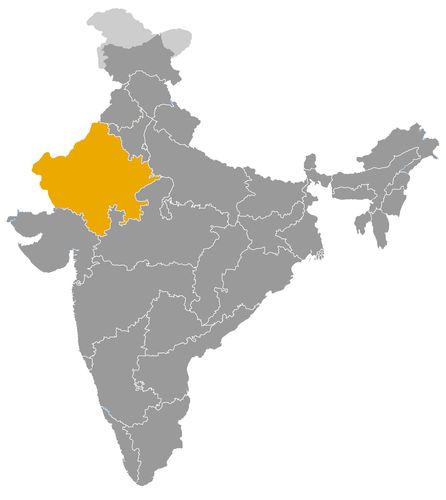
This map illustrates the maximum territory that the Chahamana of Ranastambhapura Dynasty had reached at its height, covering the current regions of Rajasthan in India. Its main purpose is to provide a visual aid to understand the geographical extent of this dynasty. However, it's important to note that the contemporary borders of these regions may not necessarily coincide with the historical territories.
The Chahamanas of Ranastambhapura and Their Role in Medieval Indian History
A Rajput dynasty formed after the decline of Chahamana power at Ajmer
The Chahamanas of Ranastambhapura, more commonly associated with Ranthambore in present day Rajasthan, formed one of the most significant regional Rajput dynasties of northern India between the late twelfth and early fourteenth centuries. They belonged to the wider Chahamana lineage, whose earlier and more powerful branch had ruled from Shakambhari and Ajmer. The emergence of the Ranastambhapura branch was closely linked to the political upheavals that followed the defeat of Prithviraja III by the Ghurids at the end of the twelfth century.
Govindaraja, generally identified as a son of Prithviraja III, is regarded as the founder of this branch. His establishment at Ranastambhapura marked both continuity and adaptation. The old Chahamana power centered on Ajmer had been broken, but the lineage survived by creating a new base in a strongly fortified region. This ability to recover after military defeat is one of the reasons why the dynasty occupies an important place in the history of medieval India.
Ranthambore as a strategic fortress and political center
The political importance of the Chahamanas of Ranastambhapura cannot be separated from the fortress of Ranthambore. Built on a high rocky hill and protected by difficult terrain, the fort became one of the most formidable strongholds of Rajasthan. It controlled access between the Rajput territories of Rajasthan, the plains influenced by Delhi, and routes leading toward Malwa and Gujarat.
In medieval India, a strong fort could compensate for limited territorial size. The Chahamanas of Ranastambhapura did not rule a vast empire, but their control of Ranthambore gave them a political influence greater than the extent of their lands might suggest. The fort served as a royal residence, military refuge, administrative center and symbol of dynastic legitimacy.
The dynasty’s history was therefore shaped by the defense of a strategic position. Its rulers had to balance autonomy with the pressure of larger powers, especially the Delhi Sultanate. Their political role was not merely local. Ranthambore became a key point in the contest between regional Rajput lineages and the expanding military state based at Delhi.
A dynasty between vassalage, autonomy and resistance
The early Chahamanas of Ranastambhapura appear to have operated under the shadow of the new political order created after the Ghurid conquests. Some of their rulers may have accepted a form of subordination to the rulers of Delhi, at least nominally. Such arrangements were common in medieval India, where local dynasties could preserve authority over their territories while recognizing the superiority of a stronger power.
Over time, however, the dynasty asserted greater independence. Rulers such as Vagabhata strengthened Ranastambhapura and resisted attempts by the Delhi Sultanate to impose direct control. This gradual movement from dependency toward autonomy gave the dynasty a central role in the history of Rajput resistance.
The most famous ruler of the line was Hammira Deva, who reigned at the end of the thirteenth century. He pursued an ambitious military policy and sought to expand or defend his influence against neighboring powers. His refusal to accept lasting submission to Delhi brought him into conflict with Sultan Alauddin Khalji. The siege and capture of Ranthambore in 1301 ended the independent rule of the dynasty and marked an important stage in the consolidation of Delhi Sultanate authority over Rajasthan.
Cultural identity shaped by Rajput kingship and heroic memory
The cultural impact of the Chahamanas of Ranastambhapura lies largely in their association with Rajput ideals of sovereignty, martial honor and dynastic continuity. Like other Rajput houses, they cultivated legitimacy through lineage, religious patronage and the defense of sacred and political space. Their rulers presented themselves as protectors of order, tradition and local society.
Ranthambore became more than a military site. It entered regional memory as a place of resistance and royal dignity. Later literary and historical traditions, especially those centered on Hammira Deva, transformed the final phase of the dynasty into a symbol of Rajput courage. These traditions cannot always be read as direct records of events, but they show the powerful cultural memory that the dynasty generated.
The rulers also participated in the broader religious and artistic culture of Rajasthan. Their patronage would have supported temples, inscriptions, religious specialists and local institutions. In this context, culture and politics were closely linked. Supporting sacred spaces and learned communities helped reinforce royal authority and integrate local elites into the dynastic order.
Economic foundations based on land, routes and fort administration
The economic base of the Chahamanas of Ranastambhapura was regional rather than imperial. Their revenues came mainly from agricultural production, village taxation, market activity, pastoral resources and control of routes. The lands surrounding Ranthambore provided the material foundation for the court and army, while the fortress allowed the rulers to supervise movement through a strategically important zone.
Ranthambore’s location gave the dynasty access to routes connecting eastern Rajasthan with Malwa, Delhi and western India. Control over such routes could generate income through duties, protection arrangements and the regulation of trade. Although the dynasty did not command the great maritime commerce of Gujarat or the immense agrarian resources of the Gangetic plain, it benefited from its position between several economic regions.
Warfare strongly affected this economy. During periods of stability, fort based rule could protect villages and encourage exchange. During sieges or campaigns, however, agricultural production, population movement and market networks were disrupted. The dynasty’s economic history was therefore closely tied to its military fortunes.
A regional power with enduring historical significance
The Chahamanas of Ranastambhapura were not among the largest dynasties of medieval India, yet their historical role was substantial. They preserved a branch of Chahamana authority after the fall of Ajmer, turned Ranthambore into a major Rajput stronghold, and resisted the expansion of one of the most powerful states of the period.
Their importance lies in the way they illustrate the political structure of medieval northern India. Power was not held only by empires and sultanates. It was also shaped by fortified regional dynasties, local alliances, military prestige, religious patronage and control of strategic routes. The fall of Ranthambore in 1301 did not erase the memory of the dynasty. Instead, it confirmed the fort’s place as one of the great symbols of Rajput resistance and as a decisive site in the history of Rajasthan and northern India.
The Geographic Expansion of the Chahamanas of Ranastambhapura in Medieval India
A fortified kingdom centered on Ranthambore
The Chahamanas of Ranastambhapura, more commonly associated with Ranthambore in present day Rajasthan, ruled a regional but strategically important territory between the late twelfth and early fourteenth centuries. Their political center was the hill fortress of Ranthambore, known in older sources as Ranastambhapura. This stronghold stood in eastern Rajasthan, near the transition between the Rajput dominated lands of western India and the plains increasingly influenced by the rulers of Delhi.
The dynasty did not create a vast empire. Its geographic expansion was more limited than that of the major powers of the period, such as the Delhi Sultanate, the Chaulukyas of Gujarat or the Paramaras of Malwa. Yet the territory controlled by the Chahamanas of Ranastambhapura was highly significant because of its location. Ranthambore stood near routes linking Rajasthan with the Gangetic plain, Malwa and Gujarat. Control of this fortress gave the dynasty an influence that exceeded the actual size of its dominion.
The formation of a new Chahamana base after the fall of Ajmer
The territorial history of the Ranastambhapura branch began after the decline of the older Chahamana power centered on Shakambhari and Ajmer. Following the defeat of Prithviraja III by the Ghurids at the end of the twelfth century, the old Chahamana kingdom was fragmented. Govindaraja, generally regarded as a son of Prithviraja III, established or was installed at Ranastambhapura, where a new branch of the lineage developed.
The early territory of the dynasty probably consisted of the fortress of Ranthambore and its surrounding lands. These included agricultural villages, pastoral zones, local markets and roads under the protection of the fort. In medieval India, control over a defensible stronghold and its dependent countryside could form the basis of a viable regional state. The boundaries of such a state were not always fixed in the modern sense. Authority was expressed through forts, tribute, military presence, local chiefs and fiscal rights.
At first, the rulers of Ranastambhapura may have accepted the superiority of the new powers based at Delhi. This did not necessarily mean the disappearance of local authority. On the contrary, nominal subordination allowed the Chahamanas to preserve a territorial nucleus in eastern Rajasthan while political conditions remained unstable.
Consolidation of authority in eastern Rajasthan
During the thirteenth century, the Chahamanas of Ranastambhapura consolidated their position around Ranthambore. Their authority extended over parts of eastern Rajasthan, especially the area corresponding broadly to the region around present day Sawai Madhopur. From this fortified center, they controlled nearby villages, levied revenue, maintained armed forces and supervised movement through the surrounding zone.
The dynasty’s expansion was not always a linear process. Its influence fluctuated according to military success, pressure from Delhi, alliances with neighboring rulers and the loyalty of subordinate chiefs. Some lands were probably held directly, while others may have acknowledged Chahamana authority in a looser manner. This form of layered sovereignty was typical of many medieval Indian polities.
Under rulers such as Vagabhata, Ranastambhapura became more independent and more capable of resisting intervention. The fort provided a secure base from which the dynasty could defend its lands and project power into nearby regions. Its strength also made it an attractive target for larger states that wished to control the routes between northern India and western India.
Relations with the Delhi Sultanate shaped by geography
The most important external relationship of the Chahamanas of Ranastambhapura was with the Delhi Sultanate. Geography made this relationship unavoidable. Ranthambore lay close enough to Delhi’s expanding sphere of influence to be considered a strategic threat, but it was strong enough to resist direct conquest for long periods.
This situation produced a complex political pattern. At times, the rulers of Ranastambhapura appear to have accepted vassal status or recognized the supremacy of Delhi. At other times, they asserted independence and defended the fortress militarily. Their territory thus functioned as a frontier zone between Rajput regional power and the expanding sultanate.
Under Hammira Deva, the last ruler of the dynasty, this tension became decisive. Hammira pursued an assertive policy and sought to strengthen Ranthambore’s position among the neighboring powers. His refusal to submit permanently to Alauddin Khalji led to a major confrontation. The fall of Ranthambore in 1301 ended the independent territorial authority of the Chahamanas of Ranastambhapura and marked an important stage in the extension of Delhi’s power into Rajasthan.
Contacts with Rajput lineages, Malwa and Gujarat
The geography of Ranastambhapura also influenced relations with other dynasties of western and central India. To the west and northwest lay other Rajput territories linked to the broader political world of Rajasthan. The memory of the older Chahamana power at Ajmer remained important, while neighboring Rajput houses competed for land, prestige and alliances.
To the south and southwest, routes connected Ranthambore with Malwa and Gujarat. These regions were politically and economically significant, and their rulers could be either rivals or partners depending on the circumstances. The Paramaras of Malwa, the Chaulukyas and later Vaghelas of Gujarat, and the Guhilas of Mewar all belonged to the wider regional environment in which Ranastambhapura operated.
The Chahamanas therefore occupied a position of both separation and connection. Their fortress protected them from direct domination, but their location forced them to interact with surrounding powers. Marriage alliances, military expeditions, border conflicts and diplomatic arrangements were all shaped by the territorial position of Ranthambore.
A limited territory with strategic regional influence
The geographic expansion of the Chahamanas of Ranastambhapura was that of a fortified regional kingdom rather than an imperial state. Their core territory lay around Ranthambore, with influence extending across parts of eastern Rajasthan and, at times, into neighboring zones through alliances or military action.
Their historical importance comes from the strategic value of this territory. Ranthambore stood between Delhi, Rajasthan, Malwa and the routes toward Gujarat. This location shaped the dynasty’s political choices, its conflicts with the Delhi Sultanate and its relations with neighboring Rajput and regional powers. Although their dominion was limited, the Chahamanas of Ranastambhapura controlled one of the key fortresses of medieval northern India. Their fall in 1301 shows both the strength of Delhi’s expansion and the enduring importance of fortified regional states in the history of Rajasthan.
The Chahamanas of Ranastambhapura, descended from the Chahamana line of Shakambhari, ruled around Ranthambore through periods of vassalage, independence and interruption connected with the Delhi Sultanate. The reign dates are indicative, as the chronology of this branch remains partly uncertain.
- Govindaraja (c. 1192-c. 1210) • Son of Prithviraja III, he established the Ranastambhapura branch after the defeat of the Chahamanas of Shakambhari by the Ghurids.
- Balhana-deva (c. 1210-c. 1220) • Son of Govindaraja, he is recorded as a vassal of the Delhi Sultanate before probably asserting a measure of autonomy.
- Prahlada-deva (c. 1220-c. 1223) • Elder son of Balhana, he ruled briefly and his death is traditionally connected with a hunting accident.
- Viranarayana (c. 1223-c. 1226) • Son of Prahlada, he is said to have been summoned to Delhi by Iltutmish and to have died there in hostile circumstances.
- Vagabhata (c. 1226-c. 1260) • Younger son of Balhana, he restored the power of Ranastambhapura and defended the fort against several attacks from the Delhi Sultanate.
- Ruler of uncertain name (c. 1260-c. 1275) • An intermediate reign is noted in some lists, but the ruler’s identity remains uncertain.
- Shakti-deva (c. 1275-c. 1283) • He preceded Hammira-deva and belonged to the final phase of the dynasty before its military height.
- Hammira-deva (c. 1283-1301) • The last ruler of the dynasty, he pursued an expansionist policy before being defeated when Ranthambore fell to Alauddin Khalji.
 Links to the main sections of the site