

 Français (France)
 Nederlands (nl-NL)
Of Hindu tradition, (with additional Islamic influence), the Bhat dynasty ruled for approximately 235 years, ± between 1713 and 1948 over all or part of Central India, North India, South India and West India, during the Modern Period.
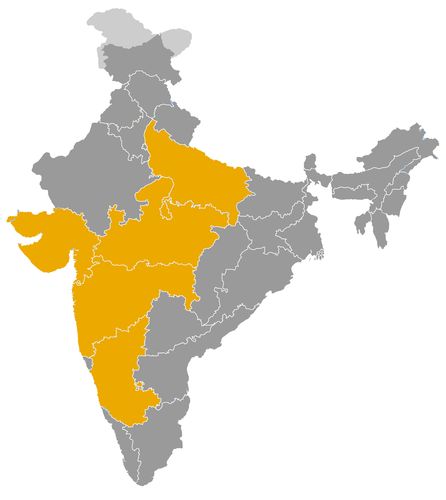
This map illustrates the maximum territory that the Bhat Dynasty had reached at its height, covering the current regions of Gujarat, Karnataka, Madhya Pradesh, Maharashtra and Uttar Pradesh in India. Its main purpose is to provide a visual aid to understand the geographical extent of this dynasty. However, it's important to note that the contemporary borders of these regions may not necessarily coincide with the historical territories.
The Bhat Dynasty: Peshwa Authority and the Transformation of Maratha India
From Royal Ministers to Hereditary Political Leaders
The Bhat dynasty played a central role in Indian history between 1713 and 1818. Its members held the office of peshwa, originally the principal minister of the Maratha sovereign. They gradually became the effective leaders of Maratha power while formally retaining the authority of the Bhonsle monarchy at Satara. Their rise accompanied the weakening of Mughal imperial government and the emergence of competing regional states.
Balaji Vishwanath, a Brahmin from the Konkan region, became peshwa under Shahu in 1713. Through diplomacy and negotiations with influential Maratha chiefs, he helped consolidate the king’s position. Shahu’s appointment of Balaji’s son, Baji Rao I, in 1720 established a family succession that gradually made the office hereditary.
Military Expansion and the Formation of a Confederacy
Under Baji Rao I, who served from 1720 to 1740, Maratha influence expanded beyond Maharashtra into Gujarat, Malwa and Bundelkhand. Rapid campaigns and mobile armies exploited the difficulties of Mughal provincial government. The peshwas helped transform the Marathas into a major force in the struggle to determine India’s political future.
Expansion did not produce a uniformly centralized empire. The Scindia, Holkar, Gaekwad and Nagpur Bhonsle houses developed territorial bases and increasingly independent military establishments. The peshwa’s supremacy depended on alliances and negotiation as well as administrative authority.
The defeat at Panipat in 1761, against Ahmad Shah Durrani and his allies, inflicted devastating losses and disrupted Maratha ambitions in northern India. Nevertheless, Madhavrao I subsequently restored much of their strength. The confederacy remained a major political power rather than disappearing after a single military catastrophe.
Pune as an Administrative and Diplomatic Capital
Bhat government transformed Pune into the political centre of the peshwas. Shaniwar Wada, their principal palace, embodied this concentration of authority. Ministers, military commanders, financiers and representatives of allied houses made the city an important centre of negotiation and decision making.
Government relied on territorial officials, accountants and established village authorities. Marathi administrative writing, particularly in the Modi script, supported extensive correspondence and financial record keeping. These practices helped coordinate revenue collection, expenditure and instructions across dispersed possessions.
Political continuity remained vulnerable to disputed successions and royal minorities. Competition among relatives, ministers and military leaders repeatedly complicated central direction. The influence of figures such as Nana Fadnavis demonstrates that effective authority could extend beyond the reigning peshwa himself.
Agricultural Revenue, Military Finance and Urban Commerce
The economic foundations of peshwa power lay primarily in agriculture and taxation. Territorial revenues were supplemented by tribute and fiscal claims over regions subject to Maratha pressure. Chauth, theoretically a quarter of assessed revenue, was an important instrument of this system, although collection and enforcement varied.
Maintaining armies required substantial resources. Bankers and moneylenders provided advances and facilitated financial transfers, linking government to commercial networks. Credit supported military operations but also created obligations that constrained political choices.
Pune benefited from court expenditure and the consumption of administrative and military elites. Textile production, crafts and markets expanded to meet this demand. Such activity did not imply general prosperity: warfare, requisitions and extraordinary taxation could damage cultivation and disrupt trade. Economic effects differed considerably between regions and periods.
Religious Patronage and Cultural Hierarchies
The Bhat peshwas were Hindu and supported temples, pilgrimage centres and traditional scholarship. Distributions of dakshina to Brahmin scholars strengthened Pune’s reputation as a centre of religious learning. Temple construction and urban improvements also helped express the prestige of the ruling establishment.
Patronage reinforced existing social hierarchies, particularly the privileged position of Brahmin elites. Its educational benefits should therefore not be confused with universal public schooling.
Religious support was not exclusively Hindu. Grants to Muslim institutions were maintained or issued, while occasional assistance to Christian establishments is documented. Such measures reflected local circumstances, inherited administrative arrangements and practical requirements of government.
British Intervention and the End of Peshwa Government
Internal divisions facilitated intervention by the British East India Company. Through the Treaty of Bassein in 1802, Baji Rao II accepted military and diplomatic dependence on the British. His defeat and surrender in 1818 brought the abolition of the peshwa’s office.
The Bhat legacy combines political expansion, administrative development and cultural patronage. Their history also reveals the limitations of a military confederacy sustained by costly campaigns, contested leadership and powerful regional houses whose interests did not always coincide.
The Territorial Expansion of the Bhat Dynasty and Its Place in India’s Political Geography
A Maratha Power Centred on Pune
The Bhat dynasty held the office of peshwa from 1713 to 1818. Originally principal ministers of the Maratha sovereigns, its members gradually became the effective leaders of a political system extending far beyond Maharashtra. Their authority combined directly administered possessions, fiscal claims, subordinate territories and alliances with increasingly autonomous Maratha houses.
Balaji Vishwanath, appointed by Shahu in 1713, established the foundations of this ascendancy. His son Baji Rao I made Pune the principal centre of peshwa government. Their territorial core included parts of the Deccan plateau and the Konkan coast. Satara nevertheless retained its importance as the seat of the Bhonsle monarchy, whose formal authority the peshwas continued to recognize.
Expansion into Gujarat and Malwa
Under Baji Rao I, peshwa from 1720 to 1740, Maratha campaigns extended political influence into Gujarat and Malwa. The weakening of Mughal provincial government created opportunities for conquest, negotiated settlements and revenue collection. Expansion therefore did not always involve permanent occupation or direct administration.
In Gujarat, the peshwa’s interests overlapped with those of the Gaekwad family. Ahmedabad illustrates this complexity: authority and revenues were divided through arrangements that changed over time. Vadodara developed primarily as the centre of Gaekwad power rather than as a city governed directly by the Bhats.
In Malwa, largely within present day Madhya Pradesh, the Scindia and Holkar houses consolidated substantial domains. Ujjain, Indore and Maheshwar belonged to this wider Maratha political landscape. Their inclusion within the confederacy should not be confused with uniform administration from Pune.
Bundelkhand and the Northern Political Frontier
Baji Rao I’s intervention in support of the Bundela ruler Chhatrasal helped establish Maratha rights in Bundelkhand. This region now extends across parts of Madhya Pradesh and Uttar Pradesh.
Sagar, Jhansi, Jalaun and Kalpi became associated with Maratha expansion through differing administrative arrangements. Representatives of the peshwa and local officeholders exercised authority, while some gradually developed hereditary positions and greater independence.
Farther north, the Scindias established predominance over Agra and Delhi. The Mughal emperor remained an important source of political legitimacy despite dependence on outside military support. Maratha influence at Delhi consequently reflected Scindia power within the broader confederacy, rather than straightforward Bhat administration.
Southern Territories and Relations with Mysore
To the south, possessions acknowledging peshwa authority extended into parts of present day Karnataka, including the Dharwad and Hubballi areas. Control depended on military campaigns, negotiated agreements and the activities of regional commanders.
These interests brought the Marathas into repeated conflict with Mysore under Haidar Ali and Tipu Sultan. Territorial possession and financial contributions became central subjects of negotiation after military confrontations. Cooperation with other powers could also serve immediate strategic objectives.
The nizam of Hyderabad was another major neighbour. Relations combined territorial rivalry, fiscal demands and temporary alliances. Maratha victory at Kharda in 1795 strengthened their bargaining position, but did not result in the complete incorporation of Hyderabad.
The Confederacy’s Apex and the Limits of Bhat Authority
Around 1795, the Maratha Confederacy reached an extensive territorial position. Its domains included parts of modern Maharashtra, Gujarat, Karnataka, Madhya Pradesh and Uttar Pradesh. The Nagpur Bhonsle possessions added territories in present day Chhattisgarh and Odisha.
These eastern lands were not directly governed by the Bhat family. Likewise, demands for tribute from Rajput principalities in Rajasthan did not necessarily eliminate their rulers or incorporate their administrations into the peshwa’s domains.
Territorial supremacy must therefore be understood as layered and uneven. The peshwa’s precedence coexisted with the ambitions of powerful partners. This structure helped sustain expansion but made coordinated diplomacy and military action increasingly difficult.
British Conquest and the End of Peshwa Territory
The defeat at Panipat in 1761 demonstrated the vulnerability of northern expansion, although Maratha power subsequently recovered. More lasting territorial losses followed the conflicts with the British East India Company.
The Treaty of Bassein in 1802 placed Baji Rao II in military and diplomatic dependence on the British and intensified tensions with other Maratha chiefs. Subsequent wars produced major territorial cessions and weakened the confederacy.
In 1818, the last peshwa’s surrender ended Bhat government. Much of his territory was annexed, while several other Maratha houses survived as princely states under British supremacy. The dynasty’s geographical legacy was thus a network of territories and relationships rather than a single consistently centralized empire.
The title of peshwa designated the Maratha sovereign’s principal minister, not a maharaja. Becoming hereditary within the Bhat family, the office gradually conferred effective leadership without abolishing the Satara monarchy. The periods below indicate tenure of office or explicitly identified nominal authority. The successions of 1796 and the rival government of 1802–1803 are presented separately; their dating and classification vary between chronologies. The list ends with the abolition of peshwa rule in 1818 and excludes Nana Sahib’s later claims.
- Balaji Vishwanath (1713–1720) • The first peshwa of the Bhat family; consolidated Shahu’s power through diplomacy.
- Baji Rao I (1720–1740) • Extended Maratha power into Gujarat, Malwa and Bundelkhand.
- Balaji Baji Rao (1740–1761) • Presided over Maratha expansion, interrupted by the defeat at Panipat in 1761.
- Madhavrao I (1761–1772) • Restored much of Maratha power after Panipat; initially governed alongside his uncle Raghunathrao.
- Narayanrao (1772–1773) • His brief administration ended with his assassination at the palace in Pune.
- Raghunathrao (1773–1774; contested authority) • Assumed office after Narayanrao’s death, then was displaced in favour of Madhavrao II.
- Madhavrao II (1774–1795) • Installed as an infant; government was long dominated by a ministerial council and Nana Fadnavis.
- Chimaji Appa II (1796; nominal tenure lasting several months) • Briefly installed during the succession crisis, then replaced by his brother Baji Rao II.
- Baji Rao II (1796–1818; displaced from Pune in 1802–1803) • Restored with British support in 1803; his surrender in 1818 ended peshwa rule.
- Amrit Rao (1802–1803; rival government under Holkar protection) • Headed a competing administration in Pune; his classification as peshwa varies between chronologies.
- Vinayak Rao (1802–1803; nominal and contested proclamation) • Amrit Rao’s son, proclaimed peshwa within the Holkar supported government without lasting independent authority.
 Links to the main sections of the site