

 Français (France)
  Nederlands (nl-NL)
 Wat Sensoukharam in Luang Prabang, Laos, is a Buddhist temple that reflects the city’s religious landscape. It serves as an active place of worship and contributes to the spiritual life of the local community. The temple represents traditional monastic presence and is linked with ritual practices rooted in Lao Buddhism. It has become a cultural reference point for residents while drawing interest from visitors who observe its ongoing religious function. Today, Wat Sensoukharam remains part of Luang Prabang’s urban identity, illustrating the continuity of Buddhist institutions in a setting shaped by both heritage appreciation and contemporary tourism.

Luang Prabang • Wat Sensoukharam

Luang Prabang • Wat Sensoukharam
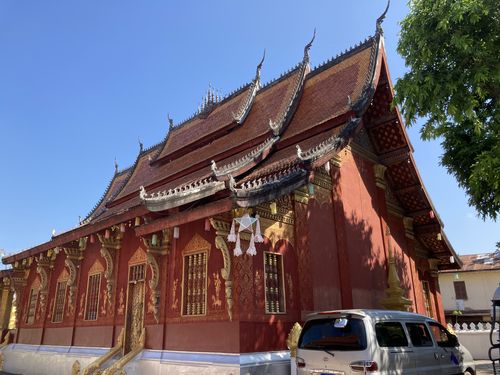
Luang Prabang • Wat Sensoukharam
Monument profile
Wat Sensoukharam
Monument category: Buddhist temple
Monument family: Temple
Monument genre: Religious
Cultural heritage: Buddhist
Geographic location: Luang Prabang • Laos
Construction period: 18th century AD
This monument in Luang Prabang is inscribed on the UNESCO World Heritage List since 1995 and is part of the serial property "Town of Luang Prabang".See the UNESCO monuments featured on this site
• Links to •
• List of videos about Luang Prabang on this site •
Luang Prabang, Royal Palace • Laos
Luang Prabang, the markets • Laos
Luang Prabang, Wat Sensoukharam temple • Laos
Luang Prabang, Sunset on Mount Phou Si • Laos
Luang Prabang, Wat Xieng Thong temple • Laos
Luang Prabang, paper making workshop • Laos
Laos • Fabric Arts
Luang Prabang, a City in the Countryside • Laos
Luang Prabang, some temples • Laos
• References •
UNESCO: Town of Luang Prabang
The History of Wat Sensoukharam in Luang Prabang
Origins, political ambitions and religious context
Wat Sensoukharam, often considered one of the more emblematic monastic complexes of Luang Prabang, emerged within a political framework in which Buddhist institutions were central to the legitimacy of the Lao monarchy. Its construction is commonly attributed to the late eighteenth or early nineteenth century, although precise dates vary due to gaps in monastic chronicles. At that time, Luang Prabang was recovering from episodes of instability following invasions, shifting alliances with Siam and Vietnam, and fluctuating autonomy. Royal patrons, seeking to reassert authority and reinforce religious merit, initiated or financially supported the creation of monasteries as symbolic acts of power, moral guardianship, and urban renewal.
Building a wat was therefore not an isolated act of devotion: it doubled as a political statement. It asserted the ruler’s ability to fund religious infrastructure, unite local communities, and attract learned monks. Wat Sensoukharam formed part of this strategy. Its location in the historic city fabric aligned with a broader attempt to consolidate Luang Prabang’s identity as a religious capital, capable of sustaining ritual life despite external threats.
Social function and community significance
Monasteries in Laos historically fulfilled multiple roles: they were religious centres, educational institutions, administrative intermediaries and social hubs. Wat Sensoukharam reflected this multifunctionality. Beyond providing monastic quarters and space for ceremonies, it served as a venue for moral instruction, manuscript production, and collective gatherings. For neighbourhood residents, the monastery was a space of belonging and protection. Sponsoring ritual maintenance, decorating the viharn, or providing food for monks reinforced local cohesion, further integrating the wat into the civic life of the city.
Wider Southeast Asian context
The period often associated with Wat Sensoukharam’s formation coincided with a broader regional trend of temple-building or renewal after periods of warfare and displacement. In Thailand, the late Ayutthaya and early Rattanakosin eras saw efforts to rebuild or strengthen monasteries as vehicles of state identity. In Myanmar, Konbaung rulers sponsored pagoda refurbishments. Across mainland Southeast Asia, monastic foundations became instruments of moral reform and urban consolidation. Wat Sensoukharam exemplifies how Luang Prabang participated in this transregional pattern, balancing continuity of Theravada Buddhism with local motifs and patronage strategies.
Dynastic changes and their impact
The nineteenth century witnessed significant power shifts that influenced monastic maintenance. Periods of suzerainty under Siam disrupted local autonomy while providing channels for artistic exchange. Rivalries between local noble families affected temple endowments as patronage was tied to shifting loyalties. The colonial transition under French rule introduced new dynamics: while Buddhist institutions maintained doctrinal continuity, monastic estates increasingly interacted with administration systems, urban planning, and heritage regulation.
Throughout these changes, Wat Sensoukharam remained a neighbourhood monastery, sustained by routine donations rather than large endowments. Repairs were periodic and often modest, reflecting financial fluctuations. The monastery’s longevity depended on its continued integration into everyday ritual life rather than monumental royal sponsorship.
Turbulent twentieth century and renewal
The twentieth century brought upheavals—wars, political transitions, ideological reform—and many temples across Laos experienced deterioration or administrative marginalisation. While Luang Prabang retained its ritual status, reduced resources and population movement sometimes weakened maintenance cycles. As elsewhere, wartime scarcity affected roof repairs, fresco retouching, and structural consolidation, resulting in phases of slow decline.
However, the socialist period later re-evaluated Buddhist institutions as cultural heritage rather than competing moral authorities. Gradually, the wat system became recognised as a repository of identity. Wat Sensoukharam benefited from these shifts, receiving incremental restoration as Luang Prabang developed a heritage-driven cultural economy.
World Heritage inscription and changing meanings
The inscription of Luang Prabang on the UNESCO World Heritage List in 1995 reframed Wat Sensoukharam’s status. It was no longer merely a living monastic institution but a tangible manifestation of Lao urban history. The wat formed part of the city’s protected sacred landscape, prompting stricter oversight over repairs, colour schemes, and neighbourhood integration.
International attention elevated expectations: its ornamented façades and stupa became photographic markers of local identity. Yet increased visitation also carried risks—surface wear, pollution, and pressure on ritual privacy. Maintaining authenticity demanded cooperation between monks, municipal authorities, and heritage bodies.
Architectural transformation over time
Like many Lao temples, Wat Sensoukharam has undergone episodic modification rather than drastic redesign. Replacement of roofing materials, renewal of gilded decoration, reinforcement of masonry, and repainting are customary. Such interventions ensure continuity rather than rupture. In some periods, stucco layers concealed earlier paintwork; at others, new motifs replaced faded ones, reflecting the living nature of Buddhist craftsmanship.
The addition of ancillary structures—small stupas, monastic quarters and storage buildings—expanded the compound’s spatial articulation. These developments were functional responses to evolving monastic life and urban constraints. They illustrate how the monastery continuously adapts without abandoning the core typology of viharn, stupa, and esplanade.
Contemporary ritual and community role
Today, Wat Sensoukharam remains a functioning monastery, hosting ordinations, festivals, almsgiving rituals and seasonal celebrations. Its presence reinforces neighbourhood identity, and its monks participate in civic rituals, funerary rites, and educational activities. The wat also acts as a repository for local memory—families may commemorate deceased relatives through merit-making events, while visitors associate it with the aesthetic appeal of Luang Prabang’s temple tradition.
The complex contributes to Luang Prabang’s branding as a heritage city. For residents, it is an embodiment of moral continuity; for tourists, a visual expression of Lao Buddhism; and for the state, a cultural asset supporting nation-building narratives that emphasise ancient traditions and artistic excellence.
Conservation challenges and policy responses
Preservation of Wat Sensoukharam faces practical challenges typical of active monasteries. Climate stress—intense sun, heavy monsoon rains and humidity—accelerates deterioration of wooden elements, stucco layers and gilding. Urban growth increases traffic and pollution, complicating efforts to control environmental impact.
Authorities and monks collaborate on maintenance, often financed locally through donation drives. Heritage management encourages traditional techniques, though modern consolidants are sometimes used to address moisture infiltration or insect damage. The delicate balance lies in sustaining ritual life while protecting the monastery’s authenticity—a tension evident in debates over repainting cycles, replacement of roof tiles, or tourist circulation patterns.
Conclusion: a continuously evolving historical monument
Wat Sensoukharam illustrates how a religious site can accumulate layered meanings across centuries. Its origins reflect monarchic strategies, while its survival attests to community resilience. Political transitions altered its role but did not erase its ritual utility. Today, architectural renewal, World Heritage recognition and tourism have reshaped its visibility without compromising its primary function as a living Buddhist space.
In this sense, Wat Sensoukharam epitomises Lao heritage: grounded in devotion, sustained through adaptation, and embedded in both local practice and global heritage discourse.
The History of Wat Sensoukharam in Luang Prabang
Overall conception and setting
Wat Sensoukharam in Luang Prabang is a representative example of Lao monastic architecture, combining a clear ritual function with a carefully composed presence in the urban landscape. The monastery occupies a relatively open plot within the historic core of the city, allowing the main hall to be perceived at distance and framed by an esplanade used for gatherings and processions. The complex is organised in the classical Lao manner: a dominant viharn (ordination and assembly hall), one or more stupas, ancillary monastic buildings, and smaller structures linked to daily religious life.
The principal visual focus is the viharn, facing an open forecourt that separates the sacred precinct from the street. The building is raised slightly on a masonry platform accessed by a frontal stairway, flanked by guardian figures. This vertical transition marks the passage from secular space to ritual interior and establishes the temple as a distinct architectural object within the surrounding urban fabric.
Structural system and construction techniques
The structural logic of the viharn combines masonry walls with a timber roof frame, a hybrid system characteristic of many temples in Luang Prabang. The perimeter walls are built of brick or stone bound with mortar and coated with plaster. They support the lateral loads and contribute to thermal inertia, keeping the interior relatively stable despite external temperature variations.
Above this solid base, the roof structure is carried by timber posts and beams. The internal columns are aligned to form bays, onto which purlins and rafters are fixed. This framework distributes the weight of the heavily tiled roof while allowing the central space to remain relatively open and unobstructed. Over time, repairs have occasionally introduced concrete or steel elements to reinforce the lower portions of columns or the foundations, but these interventions generally remain hidden behind traditional finishes.
This mixed system reflects both local craftsmanship and adaptive responses to climate and material availability. Timber, abundant and easy to work, lends itself to intricate joinery and carved details, while masonry and cement repairs improve resistance to moisture and ground movement.
Roof design, climate control and stability
The most striking architectural feature of Wat Sensoukharam is its layered, steeply pitched roof. Several tiers of roof planes descend from the ridge, overlapping and extending well beyond the line of the walls. This configuration is visually distinctive and technically efficient.
The steep pitch allows heavy monsoon rains to run off rapidly, reducing the risk of infiltration. The generous overhangs protect the façades from direct sun and rainfall, creating continuous shaded zones along the building perimeter. These shaded areas act as transitional spaces between exterior and interior, moderating temperature and providing shelter for people moving around the hall.
Structurally, the multiple tiers distribute loads across the timber frame and reduce wind uplift. Decorative finials and ridge ornaments are not only symbolic elements but also protect exposed ends of the roof members. The combination of slope, overlapping planes and deep eaves is an example of climatic adaptation refined over generations of temple building in the region.
Materials, finishes and visual effect
The material palette of Wat Sensoukharam is both practical and expressive. Timber is used for structural beams, rafters, doors, shutters and much of the visible ornament. Masonry forms the wall cores and platform. Plaster, paint and gilding provide the finishing layers that shape the temple’s appearance.
The exterior is typically characterised by intense colour contrasts: a deep red or ochre base for the walls, bright white for the platform and steps, and extensive gold on ornamental frames and motifs. Gold leaf is applied on selected reliefs, especially around door and window openings, on column capitals and on decorative panels. Less exposed surfaces may receive gold-coloured paint instead, balancing cost, durability and visual richness.
These treatments serve multiple purposes. They protect the underlying materials from weathering, articulate architectural elements, and signal the sacred status of the building. The façade appears differently at various times of day, as the changing light interacts with the reflective gilding and matte painted surfaces, accentuating relief and depth in the ornament.
Decorative programme and artistic influences
The decorative programme of Wat Sensoukharam is concentrated on the main façade, the column bases and capitals, and selected interior surfaces. Lintels and jambs are covered with carved and gilded reliefs depicting floral scrolls, mythical creatures, protective animals and motifs associated with Buddhist cosmology.
These patterns demonstrate the interweaving of local Lao traditions with broader regional influences from neighbouring Thai, Shan and Khmer cultures. The overall composition of the roof and gables recalls northern Thai and Luang Prabang models, while some iconographic details reflect wider Theravada themes shared across mainland Southeast Asia.
Inside, the arrangement of images and painted or carved decoration (treated separately from the strictly historical focus) reinforces the orientation towards the principal Buddha image. The architectural envelope and ornamental system thus work together to guide attention and structure ritual movement.
Spatial organisation and auxiliary structures
Beyond the main hall, the compound includes one or more stupas and additional buildings that support monastic life. The stupa, usually positioned slightly to one side of the viharn, introduces a strong vertical counterpoint to the low, spreading roof. It often serves as a reliquary or commemorative structure, linking the site to ancestral merit and the broader Buddhist landscape.
Monks’ quarters and storage buildings are generally more modest, with simpler rooflines and reduced ornament. Their arrangement defines circulation routes and smaller courtyards within the complex. Together, these elements form a spatial sequence: from the public esplanade and entrance stair, through the threshold of the viharn, to the quieter zones associated with memory, residence and daily monastic tasks.
Technical adaptations and small-scale innovations
Although Wat Sensoukharam does not embody spectacular engineering departures, it integrates a series of practical innovations that reflect changing conditions. Over time, certain foundations or lower wall sections have been reinforced using cement to combat rising damp. Timber elements subjected to insect attack may have been replaced with treated wood or discreet metal anchors.
Electrical lighting and loudspeakers have been introduced into the architecture, often in ways that attempt to minimise visual impact. Drainage channels, slightly regraded surfaces and occasional concrete paving have been added around the building to manage runoff and reduce erosion. These modest interventions illustrate an ongoing dialogue between inherited forms and contemporary functional requirements.
Dimensions, perception and notable aspects
Wat Sensoukharam is modest in footprint compared to the largest royal temples of the region, yet its proportions are carefully calibrated. The breadth of the front façade, the height of the stair and the depth of the roof overhang create an impression of gravity and stability disproportionate to its actual size. The guardians at the foot of the stair act as sculptural markers, anchoring the composition and framing the central axis.
One notable aspect is the continuity of surface maintenance. Layers of paint and gilding are regularly renewed through community donations and monastic initiatives. This practice means that the temple’s decorative skin is dynamic, periodically refreshed rather than fixed in a single historical state. Architecturally, this results in a building that is at once traditional in form and visibly maintained as part of a living religious system.
Conservation issues and architectural significance
In architectural terms, Wat Sensoukharam contributes to the overall character of Luang Prabang’s monastic landscape, which has been recognised at international level through the World Heritage inscription of the city. The temple exemplifies key features of Lao religious architecture: the hybrid structural system, layered roofs adapted to climate, intense colour and gilding, and the close integration of monastic space with the everyday urban environment.
Conservation challenges arise from the vulnerability of wood to insects and humidity, the fragility of plaster and gilding, and the wear caused by increased visitor numbers. Maintaining structural integrity while preserving traditional appearance requires careful management of repair techniques and materials. The architecture of Wat Sensoukharam thus stands at the intersection of devotional practice, local craftsmanship and heritage preservation, illustrating how a relatively modest temple can embody complex interactions between form, function and cultural value.