

 Français (France)
  Nederlands (nl-NL)
 Wat Xieng Thong is one of Luang Prabang’s most emblematic temples, widely regarded as a defining symbol of Lao religious and cultural identity. Established during the royal era, it served as a setting for major ceremonies and reflected the authority of the monarchy. The temple remains a place of ritual activity, attracting pilgrims, worshippers, and visitors. Today, it forms a key component of Luang Prabang’s UNESCO heritage status, contributing to the preservation of Buddhist practices and historical memory. Its present role blends spiritual significance, cultural representation, and tourism, making it a central reference point in the city’s identity and heritage landscape.

Luang Prabang • Wat Xieng Thong
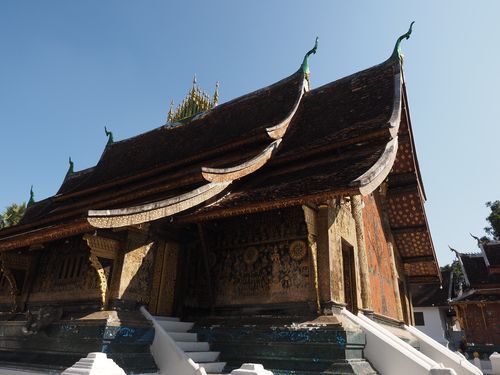
Luang Prabang • Wat Xieng Thong
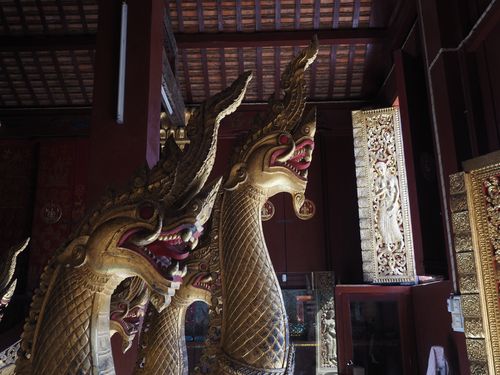
Luang Prabang • Wat Xieng Thong
Monument profile
Wat Xieng Thong
Monument category: Buddhist temple
Monument family: Temple
Monument genre: Religious
Cultural heritage: Buddhist
Geographic location: Luang Prabang • Laos
Construction period: 16th century AD
This monument in Luang Prabang is inscribed on the UNESCO World Heritage List since 1995 and is part of the serial property "Town of Luang Prabang".See the UNESCO monuments featured on this site
• Links to •
• List of videos about Luang Prabang on this site •
Luang Prabang, Royal Palace • Laos
Luang Prabang, the markets • Laos
Luang Prabang, Wat Sensoukharam temple • Laos
Luang Prabang, Sunset on Mount Phou Si • Laos
Luang Prabang, Wat Xieng Thong temple • Laos
Luang Prabang, paper making workshop • Laos
Laos • Fabric Arts
Luang Prabang, a City in the Countryside • Laos
Luang Prabang, some temples • Laos
• References •
UNESCO: Town of Luang Prabang
History of Wat Xieng Thong in Luang Prabang
Foundations, Royal Patronage and Political Meaning
Wat Xieng Thong, founded in the mid-sixteenth century under the reign of King Setthathirat, emerged at a moment when the Lao kingdom of Lan Xang sought to consolidate its political and religious authority. The monarch intended the temple to function not only as a spiritual anchor but also as a visible assertion of dynastic legitimacy. Luang Prabang, once the royal seat before Vientiane became capital, retained profound symbolic weight. Building an important sanctuary there reflected the continuing ambition of the ruling elite to present itself as guardian of Buddhism and protector of the realm.
The temple’s location, near the confluence of the Mekong and Nam Khan rivers, emphasised both ritual significance and strategic visibility. Royal patronage ensured that Wat Xieng Thong served as the site for coronations and ceremonial rites associated with kingship. Rivalries with neighbouring polities, including Lanna and Ayutthaya, also encouraged monarchs to develop distinctive religious monuments that could embody cultural prestige and political sovereignty.
Historical Upheavals, War and Transformation
Throughout its history, Wat Xieng Thong was affected by conflict and change. In the seventeenth century, periods of instability, succession disputes and foreign incursions reshaped the political landscape. Although the temple continued to receive royal support, economic pressures and internal divisions likely weakened the scale of patronage over time.
The nineteenth century brought new upheavals when Siamese military campaigns reached Luang Prabang. Plundering and fires damaged parts of the city and its sacred architecture. Despite these challenges, Wat Xieng Thong largely survived intact compared with other religious sites, reinforcing its role as cultural survivor and symbol of resilience.
French colonial rule from the late nineteenth century to the mid-twentieth century altered the urban surroundings, imposed new administrative structures and introduced preservation policies influenced by European heritage concepts. The temple became part of efforts to document and protect the material culture of Laos. While colonial authorities sometimes framed Buddhist architecture through an orientalist lens, these programmes also contributed to early conservation measures.
A Global Context of Monumental Construction
The creation of Wat Xieng Thong in the sixteenth century coincided with widespread architectural expressions of statehood across Asia. In Burma, the Toungoo dynasty commissioned pagodas and monastic complexes to reinforce power. In Sri Lanka and Khmer territories, royal patrons likewise invested in monumental religious works. Across these regions, monumental construction served both devotional aims and political statement. Wat Xieng Thong can therefore be understood as part of a broader Southeast Asian pattern of sacral architecture embodying legitimacy, cosmology and identity.
Religious Use, Ritual Significance and Later Adaptations
Over the centuries, Wat Xieng Thong continued to operate as a monastic community. Ritual work, education and manuscript preservation occurred within its buildings. Celebrations such as the Pi Mai Lao (Lao New Year) brought large processions that visited the temple, where images of the Buddha were ritually bathed. The presence of a richly decorated funeral chariot pavilion, used for royal ceremonies, further linked the temple with dynastic memory.
As Luang Prabang transformed in the twentieth century—through shifts in political systems and changing economic conditions—the temple adapted. Periods of decline were punctuated by restoration, often driven by religious communities or state institutions. These interventions preserved core elements while allowing discrete modifications, such as mosaic embellishment on certain chapels.
Urban Evolution and Heritage Reframing
The temple’s surroundings evolved from a predominantly royal quarter to an urban environment more oriented towards commerce and tourism. Its continued prominence within the cityscape offered planners and historians a reference point for characterising Luang Prabang’s identity. When the town was inscribed as a UNESCO World Heritage Site in 1995, Wat Xieng Thong became one of the keystones for understanding the heritage values of the city. This new designation reframed the monument not only as a religious site but also as an emblem of national culture.
Contemporary Role, Identity and Cultural Presence
Today, Wat Xieng Thong remains a functioning monastery, a pilgrimage destination and a key attraction for visitors. Monks conduct rituals, maintain the grounds and continue traditions of Buddhist education. For many Laotians, the temple embodies continuity between state, monarchy, religion and community. It contributes to national identity by representing the artistic and spiritual sophistication associated with Lan Xang and Luang Prabang.
Festivals remain central to life at the monument. Ceremonies involving Buddha images, processions, prayer recitations and offerings bind the site to seasonal rhythms and collective memory. The temple’s endurance has allowed it to accumulate layers of meaning, navigating transitions from royal sanctuary to colonial heritage object and to its present role in a globalised cultural economy.
Conservation Challenges and Management
Preservation efforts at Wat Xieng Thong face multiple pressures. Humidity, monsoon cycles, biological decay and insect activity threaten woodwork and decorative materials. Tourism increases wear on floors and access routes. Urban expansion around the site alters drainage patterns and introduces pollution. To address these risks, conservation authorities employ monitoring programmes, supervise interventions using traditional methods and regulate visitor flows.
International cooperation—including training workshops and documentation campaigns—supports technical conservation. Heritage management attempts to respect living religious functions while safeguarding fragile artistic surfaces. The temple’s status within a World Heritage city brings visibility but also heightened expectations, requiring ongoing negotiation between ritual practice, tourism and preservation.
Continuity and Historical Significance
Wat Xieng Thong’s long history illustrates themes central to Southeast Asian political and religious life: the sacralisation of monarchy, the persistence of Buddhism as institutional authority, and the reuse of monuments across epochs. Its construction reflected the ambitions of a flourishing kingdom seeking legitimacy. Later conflicts tested but did not efface its symbolic roles. Modern heritage policies preserved it as a reference point for national culture and identity.
Though transformed by time, Wat Xieng Thong remains a historical archive in built form—its structures, chapels and ritual spaces speaking to centuries of political change, artistic refinement and cultural adaptation. Its endurance testifies to the ability of sacred architecture to transcend shifting regimes while continuing to serve revered communal purposes.
Architectural Overview of Wat Xieng Thong
Wat Xieng Thong is widely regarded as the most accomplished example of traditional Luang Prabang temple architecture. Its ensemble of buildings, roofs and courtyards illustrates a mature stage in the development of religious architecture in the former kingdom of Lan Xang. The complex does not impress by sheer size, but by the refinement of proportions, the coherence of its spatial organisation and the richness of its decorative vocabulary. At the centre stands the main ordination hall (sim), surrounded by chapels, stupas, pavilions and a royal funerary hall, all arranged to form a unified sacred precinct.
Structural Principles and Building Techniques
The structural core of the sim is a timber frame carried by rows of wooden pillars, resting on a masonry or stone base. Carpenters used traditional joinery techniques—mortise and tenon joints secured by wooden pegs—allowing the frame to remain stable yet flexible enough to cope with humidity, seasonal movement and occasional seismic shocks. The roof loads are distributed through principal rafters, purlins and tie beams, which are carefully dimensioned so that the weight of the heavy tiled roof is transmitted evenly to the supports.
The masonry walls, built mainly of brick and mortar, are non-loadbearing to a large extent. Their role is to enclose the interior, regulate light and temperature, and offer a surface for plaster, lacquer and gilding. This hybrid system, combining massive walls with a relatively light but robust timber superstructure, is characteristic of many Lao temples, but at Wat Xieng Thong it reaches a particularly harmonious balance.
Roof Design, Climate and Stability
The multi-tiered roof of Wat Xieng Thong is its most striking architectural feature. Several layers of roof planes descend in a sweeping movement from a high ridge line almost to the ground at the rear. The strong pitch of the roofs ensures rapid evacuation of monsoon rains, while the deep overhangs protect the walls, doors and decorative surfaces from heavy precipitation and direct solar radiation.
From a structural standpoint, the roof design reduces wind uplift and distributes forces over a large area. The overlapping tiers moderate the exposure of each plane, increasing durability. In climatic terms, the deep eaves create shaded bands around the building and help maintain a cooler microclimate. Air heated inside the hall can escape upwards into the roof volume, while openings and joints in the timberwork allow for natural ventilation without compromising the sheltered character of the interior.
Materials, Finishes and Visual Effects
The material palette of Wat Xieng Thong is rooted in local resources and long-standing craft traditions. Timber—often from durable species such as teak—is used for structural elements, doors, shutters, ceilings and carved ornament. Brick and stone are employed for platforms, walls and steps. Roofs are covered with fired clay tiles that contribute both colour and texture.
Surfaces are finished with plaster, pigments, lacquer and gold leaf. Exterior walls may be painted in dark red or ochre tones, contrasted with white bases and steps. Gold leaf is applied to carved frames, column capitals, pediments and decorative panels, producing a strong visual contrast with the darker lacquered backgrounds. In certain chapels, glass mosaics with coloured tesserae depict scenes from Buddhist cosmology and local life, their reflective surfaces catching the light at different times of day. These finishing techniques simultaneously protect the underlying materials and articulate the architecture, turning structural elements into carriers of symbolic meaning.
Artistic Influences and Decorative Programme
The decorative scheme of Wat Xieng Thong demonstrates a synthesis of local Lao traditions and broader regional influences. Carved and gilded motifs on doors, windows and columns include floral scrolls, lotus patterns, mythical animals and protective figures. These can be related to shared Theravāda iconography found in neighbouring regions such as Lanna (northern Thailand) and parts of Myanmar, yet the overall composition and the low, sweeping roof silhouette are specific to Luang Prabang.
The use of inlaid glass mosaics on some façades and interior walls reflects later phases of embellishment, when craftsmen integrated new techniques into the existing architectural fabric. The combination of lacquer, gold and glass gives certain surfaces an almost textile-like richness while remaining firmly anchored to the building’s structural logic. The decorative programme is not random; it reinforces the hierarchy of spaces, concentrating the most elaborate ornament around principal entrances, ritual axes and structures associated with royal memory.
Spatial Organisation and Hierarchy of Buildings
The layout of the Wat Xieng Thong complex follows a clear spatial hierarchy. The main sim stands slightly elevated above the surrounding courtyard, accessed by a modest flight of steps. In front and around it spreads an open, stone- or brick-paved space used for gatherings, processions and everyday circulation. To one side stands the royal funerary chapel, housing an ornate funeral carriage; nearby are smaller stupas marking funerary or commemorative functions. Other auxiliary buildings include halls for ritual objects, storage and possibly a former library for manuscripts.
This arrangement guides movement from the public domain at the edge of the complex towards increasingly focused ritual spaces. The visitor progresses from the open courtyard to the threshold of the sim, then to the interior where the main Buddha image is enshrined. The positioning of the funerary chapel and stupas adds a vertical counterpoint to the largely horizontal composition of the roofs, reminding visitors of the connection between ritual practice, kingship and remembrance.
Distinctive Features and Anecdotal Aspects
Several architectural features distinguish Wat Xieng Thong from other contemporary temples. The extreme elongation of the rear roof segment, descending close to the ground, creates a unique profile that has become emblematic of Luang Prabang. The careful proportioning of façade width, roof height and column spacing produces a sense of monumentality that exceeds the building’s actual dimensions.
Anecdotal accounts from visitors and scholars often emphasise the contrast between the temple’s appearance from different angles: from the front, the sim presents itself as a wide, dignified ceremonial hall; from the rear, it appears almost nestled within its own canopy of tiles, suggesting shelter and intimacy. The presence of the royal funeral carriage, with its intricate carved and gilded structure, adds an additional layer of architectural interest, as its housing building was designed to complement and frame this unique object.
Architectural Significance and Conservation Challenges
Architecturally, Wat Xieng Thong is considered a key reference for understanding the religious built environment of Laos. It encapsulates central principles of the Luang Prabang school: mixed timber-and-masonry construction, multi-tiered roofs adapted to climate, elaborate yet controlled ornamentation, and a close integration of monastic, royal and communal functions.
Conservation poses several challenges. Timber elements are vulnerable to insect attack and rot; plaster, lacquer and gold leaf are sensitive to moisture, temperature fluctuations and physical abrasion from increased visitation. Managing tourism while preserving delicate surfaces requires careful planning of visitor routes, maintenance schedules and restoration campaigns. Interventions must reconcile the need to stabilise the structure with the obligation to respect traditional materials and techniques.
Architectural Legacy
The architecture of Wat Xieng Thong has had a lasting impact on temple building in Laos and beyond. Later constructions and restorations in Luang Prabang often draw inspiration from its roof silhouette, decorative vocabulary and spatial arrangement. As part of a World Heritage town, it serves as both a living monastery and a benchmark for conservation approaches applied to religious architecture in a changing urban and cultural environment. The monument demonstrates how a relatively compact complex can embody a sophisticated synthesis of structural ingenuity, climatic adaptation, artistic expression and symbolic depth, making it a central reference point for the architectural heritage of the region.