

 Français (France)
  Nederlands (nl-NL)
 The Thirumoorti Cave is one of the rock-cut sanctuaries of Mahabalipuram, an important monumental complex on the coast of Tamil Nadu listed as a UNESCO World Heritage Site. Carved into the rock during the Pallava period, the cave illustrates the early development of monumental Hindu architecture in southern India. The sanctuary is associated with the Trimurti, the Hindu triad composed of Brahma, Vishnu and Shiva. Its sculptures and reliefs reflect the artistic and religious evolution of Mahabalipuram between the 7th and 8th centuries. Today, the site remains an important component of the archaeological and cultural heritage of the Tamil coast.
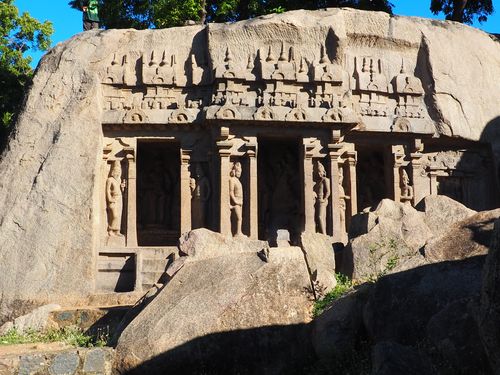
Mahabalipuram • Thirumoorti Cave: overview of the cave
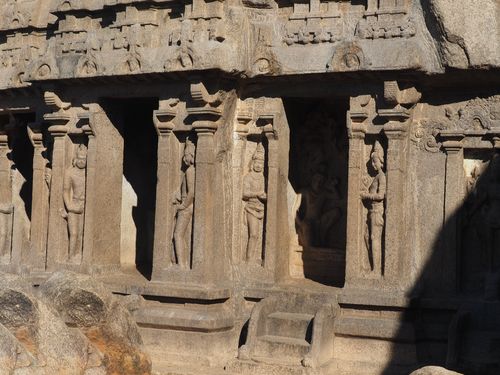
Mahabalipuram • Thirumoorti Cave: cave entrance
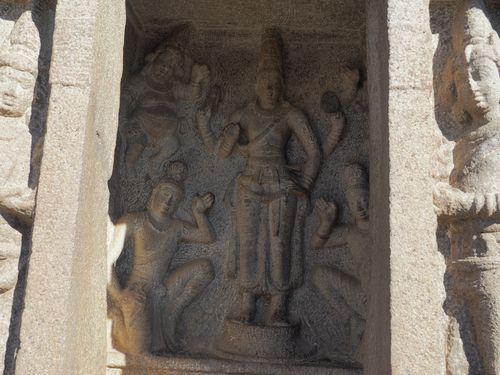
Mahabalipuram • Thirumoorti Cave: bas-relief at the entrance to the cave
Monument profile
Thirumoorti Cave
Monument categories: Hindu Temple, Rock Sanctuary
Monument families: Temple • Rock Sanctuary and Monumental Bas-reliefs
Monument genres: Religious
Cultural heritage: Hindu
Geographic location: Mahabalipuram • Tamil Nadu • India
Construction period: 6th century AD
This monument in Mahabalipuram is inscribed on the UNESCO World Heritage List since 1984 and is part of the serial property "Group of Monuments at Mahabalipuram".See the UNESCO monuments featured on this site
• Links to •
• Dynasties that contributed to the construction of the monument •

• This monument illustrates the following theme •
Architecture • Rock-cut monuments : Rock-cut temples and caves in India
• List of videos about Mahabalipuram on this site •
Mahabalipuram, excavated temples • Tamil Nadu, India
• References •
UNESCO: Group of Monuments at Mahabalipuram
• Sources •
Sources
- Archaeological Survey of India. "Mahabalipuram Group of Monuments - UNESCO World Heritage Centre." http://whc.unesco.org/en/list/249/.
Books and Publications
- Srinivasan, K.R. "Cave Temples of the Pallavas." Archaeological Survey of India, 1964.
The Thirumoorti Cave in the Religious Development of Mahabalipuram
Pallava Foundation and Religious Context
The Thirumoorti Cave belongs to the group of rock-cut sanctuaries created at Mahabalipuram during the Pallava period, most likely in the 7th century under Narasimhavarman I or his immediate successors. The monument was carved directly into the granite outcrops that dominate parts of the coastal landscape of Tamil Nadu. Its construction corresponds to a phase of intense architectural experimentation in which Pallava rulers promoted rock-cut temples as expressions of royal authority and religious patronage.
The name “Thirumoorti” refers to the Hindu Trimurti, the triad formed by Brahma, Vishnu and Shiva. The sanctuary reflects the integration of this theological concept into Pallava religious art and temple planning. Unlike some larger monuments at Mahabalipuram, the cave remains relatively compact, but its historical importance lies in the organisation of its cult spaces and in the development of early Hindu rock-cut architecture in southern India.
Mahabalipuram functioned at the time as an active coastal centre connected to maritime trade networks across the Bay of Bengal. The concentration of shrines, reliefs and ceremonial structures in the area formed part of a broader royal programme intended to associate the Pallava dynasty with religious legitimacy and artistic innovation.
Religious Function and Use of the Sanctuary
The cave was conceived as a multi-shrine sanctuary dedicated to the principal Hindu deities represented by the Trimurti. This arrangement distinguishes it from smaller single-cell sanctuaries of the same period. The internal organisation suggests ritual use centred on devotional worship rather than large-scale ceremonial gatherings.
Although inscriptions directly associated with the monument remain limited, the sculptural programme indicates the importance of Shaivite and Vaishnavite traditions within the religious environment of Mahabalipuram. The coexistence of multiple divine representations inside a single sanctuary illustrates a form of religious synthesis characteristic of several Pallava monuments.
The historical evolution of the cave is less documented than that of larger structures such as the Shore Temple. No major destruction, abandonment or extensive reconstruction phases are clearly recorded. The sanctuary appears to have retained a relatively continuous religious and cultural significance while remaining integrated into the wider sacred landscape of Mahabalipuram.
The monument’s modest dimensions may also explain the limited number of later architectural interventions. Unlike active temple complexes continuously expanded over centuries, the Thirumoorti Cave largely preserved its original spatial configuration.
Archaeological Recognition and Preservation
During the 19th century, British administrators and early archaeologists studying the monuments of southern India identified the Thirumoorti Cave as part of the broader Pallava complex of Mahabalipuram. Surveys and documentation carried out during the colonial period contributed to the recognition of the site’s importance in the history of Indian rock-cut architecture.
In 1984, Mahabalipuram was inscribed on the UNESCO World Heritage List under the official designation “Group of Monuments at Mahabalipuram.” The Thirumoorti Cave forms part of this protected ensemble. Conservation efforts mainly focus on protecting the granite surfaces from erosion caused by humidity, salt air and visitor activity.
Today, the cave functions primarily as a historical and cultural monument rather than as a major active pilgrimage centre. Its significance lies in its testimony to the architectural and religious developments of the Pallava period and in its contribution to the understanding of early Hindu rock-cut sanctuaries in South India.
Chronological Context
The construction of the Thirumoorti Cave during the 7th century coincided with important political and cultural developments in several parts of the world. In northern India, the reign of Harsha influenced much of the Gangetic plain. In China, the Tang dynasty entered a period of major cultural expansion. In the Mediterranean world, the Byzantine Empire continued under the successors of Heraclius, while the early Islamic caliphates expanded across the Near East and parts of Central Asia.
Rock-Cut Layout and Sculptural Composition of the Thirumoorti Cave
Integration into the Granite Landscape of Mahabalipuram
The Thirumoorti Cave is excavated directly into one of the granite outcrops that structure the archaeological landscape of Mahabalipuram. Unlike later structural temples assembled from carved stone blocks, its architecture depends entirely on the geological form of the rock mass. The monument occupies a slightly elevated position within the rocky terrain, allowing the façade to remain visually distinct while preserving a close relationship with the surrounding topography.
The excavation follows the horizontal surface of the granite rather than creating a deeply recessed sanctuary. This relatively shallow configuration allows natural light to penetrate the interior more effectively than in many deeper rock-cut shrines. The composition relies on the balance between open frontal space and enclosed devotional areas.
The monument remains compact in scale. Its proportions suggest that the excavation was intended for a concentrated ritual environment rather than large ceremonial gatherings. Untreated rock remains visible around the carved façade, reinforcing the impression that the sanctuary emerged directly from the stone itself.
The hardness of the granite strongly influenced the monument’s appearance. While limiting elaborate carving, the material provided exceptional structural stability. The cave therefore preserves a clear geometric definition despite centuries of exposure to coastal climatic conditions.
Façade Composition and Structural Supports
The façade consists of a portico carved into the rock face and supported by columns and pilasters left in relief during excavation. These supports create a transitional zone between the exterior landscape and the inner sanctuaries. Their spacing produces a relatively open elevation that avoids the compressed appearance of earlier cave shrines.
The columns display restrained proportions characteristic of early Pallava rock-cut architecture. Their shafts remain simple, with limited decorative treatment, while the capitals preserve compact forms adapted to the structural constraints of the granite. The heavy bases reinforce the visual stability of the composition.
The façade emphasises horizontal alignment rather than vertical monumentality. Decorative density remains moderate, allowing the structural organisation of the monument to remain clearly visible. The stone surfaces still preserve traces of carving techniques used during excavation. Some areas were carefully smoothed, while others retain slight irregularities linked to the natural texture of the granite and to the different stages of the carving process.
Interior Organisation and Sacred Spaces
The interior is organised around multiple shrine cells associated with the Trimurti, the Hindu triad of Brahma, Vishnu and Shiva. This multi-shrine arrangement forms one of the cave’s principal architectural characteristics. Instead of concentrating attention on a single sanctum, the composition distributes devotional focus across several aligned sacred spaces.
The central hall functions as both a circulation and ritual area connecting the shrine chambers. Its restrained dimensions create an enclosed atmosphere in which sculptural elements dominate the visual experience. Because the sanctuary was excavated rather than assembled through masonry construction, walls, ceilings and reliefs form part of the same continuous rock mass.
The shrine entrances are integrated directly into the interior walls without extensive projecting frames. This restraint strengthens the continuity between carved surfaces and sacred chambers. The spatial organisation depends less on architectural complexity than on the relationship between open volumes and recessed devotional spaces.
Interior ceilings remain comparatively flat and geometrically regular, indicating careful planning during excavation. Structural supports inside the monument are limited because the granite itself provides the necessary stability. This allowed Pallava craftsmen to maintain relatively open internal volumes despite the hardness of the material.
The scale of the chambers reinforces the prominence of the sculptural programme. Reliefs and divine representations remain closely integrated with the surrounding architecture, creating a direct relationship between sacred imagery and structural form.
Sculptural Integration and Architectural Reliefs
The architectural identity of the Thirumoorti Cave depends heavily on the integration of sculpture into the excavated structure. Unlike freestanding temples where sculptures may be added onto walls or niches, the reliefs here remain inseparable from the granite mass itself. Architectural surfaces and iconographic compositions therefore function as a unified system.
The relief carving demonstrates careful control of depth and projection. Figures emerge gradually from the rock rather than appearing completely detached from the background plane. This treatment preserves the structural continuity of the walls while maintaining visual hierarchy within the sacred spaces.
Decorative emphasis is concentrated around significant sculptural zones rather than distributed uniformly across every surface. Door frames, pilasters and carved recesses maintain simple geometric outlines that direct attention toward the sculpted divinities. The contrast between plain surfaces and carved reliefs creates a measured visual rhythm throughout the sanctuary.
Conservation and Surface Preservation
The monument’s preservation depends largely on the stability of the granite and protection from environmental erosion. Humidity, salt-laden coastal air and seasonal climatic variations have gradually affected some sculptural details and surface finishes. Erosion is especially visible on exposed exterior areas where fine carving has become less sharply defined.
Modern conservation measures focus mainly on limiting surface deterioration and controlling visitor impact. Structural intervention remains limited because the rock-cut nature of the monument provides strong inherent stability. Preservation efforts therefore concentrate on maintaining the readability of the carved surfaces rather than reconstructing missing architectural elements.