

 Français (France)
  Nederlands (nl-NL)
 Of Islamic tradition, (with additional Hindu and Christian influence), the Sultanate of Mysore ruled for approximately 38 years, ± between 1761 and 1799 over all or part of South India, during the Colonial Period.
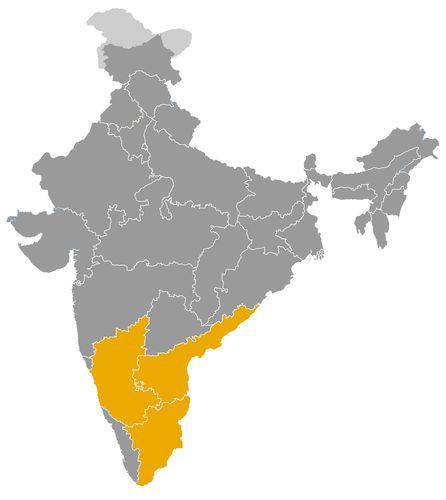
This map illustrates the maximum territory that the Sultanate of Mysore Dynasty had reached at its height, covering the current regions of Karnataka in India. Its main purpose is to provide a visual aid to understand the geographical extent of this dynasty. However, it's important to note that the contemporary borders of these regions may not necessarily coincide with the historical territories.
The Mysore Sultanate and its role in the history of India
A southern Indian power shaped by military authority
The Mysore Sultanate occupies a distinctive place in the history of India because it was not a long established dynastic state in the conventional sense, but a period of effective rule by Haidar Ali and Tipu Sultan over the former Kingdom of Mysore. During the second half of the eighteenth century, Mysore became one of the most powerful states in southern India and one of the most determined opponents of British expansion.
Before Haidar Ali’s rise, Mysore was formally ruled by the Wodeyar dynasty. Haidar Ali, originally a military officer, gradually became the real holder of power from the 1760s. He did not initially rule through hereditary royal legitimacy, but through military command, administrative control and political skill. His son, Tipu Sultan, gave this authority a clearer sovereign identity, adopting the title of sultan and presenting Mysore as an independent and modernising state.
A major political obstacle to British expansion
The political importance of the Mysore Sultanate was closely linked to the Anglo Mysore Wars. Haidar Ali and Tipu Sultan recognised the East India Company as a growing threat to the balance of power in southern India. Their state stood between several major forces, including the Marathas, the Nizam of Hyderabad, the French and the British.
Haidar Ali transformed Mysore into a military power capable of challenging the British in the Carnatic and beyond. He used alliances, rapid campaigns and a disciplined army to make Mysore a central actor in southern Indian politics. Tipu Sultan inherited this conflict and pursued it with even greater determination. His reign was dominated by the effort to preserve Mysore’s independence against a colonial power that was becoming increasingly organised and aggressive.
The fall of Srirangapatna in 1799 and Tipu Sultan’s death marked a decisive turning point. It weakened one of the last strong regional resistances to British dominance in southern India. After this defeat, the British restored the Wodeyars to a reduced kingdom and redistributed territories among themselves and their allies.
Military reform and technological innovation
One of the most notable features of the Mysore Sultanate was its military modernisation. Haidar Ali built a strong army that combined Indian military traditions with elements inspired by European organisation. Mysore developed trained infantry, effective cavalry, artillery and a more centralised military administration.
Tipu Sultan continued and intensified these reforms. He is especially associated with the use of Mysorean rockets, iron cased military rockets that impressed British observers and later influenced European experimentation in rocket artillery. These weapons did not alone determine the outcome of wars, but they show that Mysore was not a passive regional state facing European power. It was technically inventive and willing to adapt military methods to new strategic realities.
Military reform was inseparable from administration. A permanent war effort required revenue, supplies, workshops, fortifications and disciplined command. The Mysore Sultanate therefore linked military power to state building.
Economic policy and state controlled resources
The economy of Mysore under Haidar Ali and Tipu Sultan was based on agriculture, taxation, craft production and control of strategic commodities. The state drew revenue from fertile districts of southern Karnataka and from territories connected to trade routes toward Malabar, the Deccan and the Carnatic.
Tipu Sultan pursued a more interventionist economic policy. He attempted to strengthen state control over valuable goods such as sandalwood, pepper, silk and other commercial products. These policies were intended to increase revenue, reduce dependence on private intermediaries and support the military needs of the state.
Mysore also sought commercial and diplomatic links beyond India. Tipu Sultan looked toward the Indian Ocean, the Islamic world and European rivals of Britain, particularly France. These efforts reflected a wider strategic vision. Economic policy was not only a matter of wealth, but also a tool of sovereignty and resistance.
Cultural identity and courtly representation
The cultural impact of the Mysore Sultanate was shaped by a mixture of Persianate court culture, Islamic symbolism, Kannada regional traditions and the older political world of Mysore. Tipu Sultan used titles, seals, coins, inscriptions and court ceremonies to express sovereign authority. His capital at Srirangapatna became the political and symbolic centre of his rule.
The monuments associated with Haidar Ali and Tipu Sultan, including palaces, mosques, gardens and tombs, reflect this courtly identity. They also show the integration of local craftsmanship with broader Indo Islamic forms. The cultural world of Mysore was not isolated. It belonged to a wider eighteenth century environment in which Indian courts borrowed, adapted and competed through military, architectural and diplomatic expression.
At the same time, the sultanate governed a society that was religiously and socially diverse. Its administration included many local elements, and its political authority had to function within the realities of southern Indian society.
A complex and lasting historical memory
The legacy of the Mysore Sultanate remains complex. Haidar Ali and Tipu Sultan are often remembered as strong opponents of British colonial expansion. Tipu Sultan in particular became a powerful symbol of resistance, sovereignty and military innovation. At the same time, his rule has also been debated because of questions surrounding centralisation, campaigns in neighbouring regions and religious policy.
In the broader history of India, the Mysore Sultanate represents the dynamism of regional powers in the eighteenth century. It shows that Indian states were not merely declining before colonial rule, but were adapting, reforming and resisting. Its defeat was a major step in the expansion of British power, but its history remains associated with political independence, military innovation and the final struggles for regional sovereignty in southern India.
The geographical expansion of the Mysore Sultanate in southern India
A territorial power rooted in southern Karnataka
The Mysore Sultanate, associated with the effective rule of Haidar Ali and Tipu Sultan in the eighteenth century, developed from the older Kingdom of Mysore in southern India. Its territorial core lay in the southern part of present day Karnataka, around Mysore, Srirangapatna and Bangalore. This region was strategically placed between the Western Ghats, the eastern plains, the Tamil country, the Malabar coast and the Deccan.
The rise of Mysore as a major power was rapid. Haidar Ali, originally a military commander, gradually displaced the real authority of the Wodeyar rulers and transformed Mysore into a militarised and centralised state. Tipu Sultan inherited this territorial base and sought to defend and expand it against powerful neighbours. The geography of Mysore made the state both strong and vulnerable. It had access to rich agricultural districts and important routes, but it also stood between the Marathas, the Nizam of Hyderabad, the British and several coastal powers.
Srirangapatna and Bangalore as strategic centres
Srirangapatna became the principal capital and military centre of the Mysore Sultanate. Located on an island in the Kaveri River, it had strong defensive advantages and controlled communications across southern Karnataka. For Haidar Ali and Tipu Sultan, it was not only a residence and administrative centre, but also a fortress from which military campaigns could be organised.
Bangalore was another key centre. Its position made it important for operations toward the east, the Carnatic and the Deccan. Control of Bangalore strengthened Mysore’s ability to defend its plateau heartland and to project power into neighbouring regions. Together, Srirangapatna and Bangalore formed the main axis of Mysore’s territorial organisation.
The central districts of the state provided agricultural revenue, manpower and logistical support. These resources allowed Mysore to maintain a large army and to compete with much larger political formations.
Expansion toward Malabar and the western coast
One of the most important directions of Mysore’s expansion was westward toward Malabar, on the coast of present day Kerala. This region was valuable because of its ports, spice trade and access to the Indian Ocean. For an inland power such as Mysore, control of Malabar offered both economic and strategic advantages.
Haidar Ali and Tipu Sultan sought to dominate this coastal region in order to gain access to maritime commerce and reduce dependence on inland routes. Malabar, however, was politically fragmented and socially complex. Local chiefs, merchant groups, religious communities and older regional powers resisted Mysorean control. The expansion into Malabar therefore created lasting tensions.
This western expansion also affected relations with European powers. The British had commercial and strategic interests along the coast, while the French were potential allies of Mysore against Britain. The struggle for Malabar was therefore not only a local conflict. It was part of the wider contest for influence in the Indian Ocean and southern India.
Northern frontiers with the Marathas and Hyderabad
To the north and northeast, Mysore faced the Maratha confederacy and the Nizam of Hyderabad. These were two of the most important Indian powers of the eighteenth century, and both saw Mysore’s rise with concern. The frontier zones between Mysore, the Marathas and Hyderabad were often contested through campaigns, treaties and shifting alliances.
The Marathas had long claimed influence and tribute in parts of the Deccan and southern India. Mysore’s expansion challenged these claims, leading to repeated conflict. Control of forts, revenue districts and border territories became central to their rivalry.
The Nizam of Hyderabad also played a decisive role in limiting Mysore’s expansion. Depending on the political moment, Hyderabad could negotiate with Mysore or join coalitions against it. In practice, the Nizam often aligned with the British when Mysore appeared too powerful. This made the northern frontier one of the most unstable parts of Mysore’s territorial policy.
Eastern pressure toward the Carnatic
The eastern and southeastern frontier brought Mysore into direct contact with the Carnatic and the British base at Madras. This zone was crucial during the Anglo Mysore Wars. The routes from Bangalore and the Mysore plateau toward the Tamil plains allowed Haidar Ali and Tipu Sultan to threaten British positions on the Coromandel coast.
Haidar Ali’s campaigns in the Carnatic demonstrated Mysore’s capacity to project military power far beyond its core territory. Tipu Sultan continued this strategic orientation, but the British gradually built stronger alliances with Hyderabad, the Marathas and local powers. The eastern frontier therefore became the main theatre in which Mysore’s territorial ambitions collided with British expansion.
Territorial losses during the Anglo Mysore Wars
Mysore reached its greatest territorial influence under Haidar Ali and during the early part of Tipu Sultan’s reign. Yet repeated wars gradually reduced its extent. The Third Anglo Mysore War forced Tipu Sultan to surrender large territories to the British, the Marathas and the Nizam. These losses weakened the state by cutting into its frontier zones and reducing its access to resources.
The Fourth Anglo Mysore War ended the independent power of Tipu Sultan in 1799. After the fall of Srirangapatna, the British restored the Wodeyar dynasty to a reduced kingdom, while other territories were annexed or redistributed among British allies.
A strategic geography that shaped regional relations
The geographical expansion of the Mysore Sultanate explains much of its historical role. From its base in southern Karnataka, it reached toward Malabar, contested the Carnatic, confronted the Marathas and Hyderabad, and challenged British power in southern India. Its territory connected plateau, coast and plain, making Mysore a dynamic regional force.
This same geography also exposed the sultanate to encirclement. Because Mysore threatened several interests at once, its enemies could form powerful coalitions. The history of its expansion is therefore also the history of its limits. Mysore became one of the most ambitious and militarily significant states of eighteenth century India, but its strategic position ultimately drew it into conflicts that ended its independence.
The Mysore Sultanate mainly refers to the period of effective rule by Haidar Ali and Tipu Sultan over the former Kingdom of Mysore. Haidar Ali held power as a military leader and minister who became de facto ruler, while Tipu Sultan clearly adopted the title of sultan. The Wodeyars retained nominal kingship during part of this period and were restored by the British after 1799.
- Haidar Ali (1761–1782, effective rule) • A military commander who became the master of Mysore, he gradually displaced real Wodeyar authority and turned the state into a major power in southern India.
- Tipu Sultan (1782–1799) • Son of Haidar Ali, he ruled as sultan of Mysore, continued military and administrative modernisation and resisted British expansion until his death at Srirangapatna.