

 Français (France)
  Nederlands (nl-NL)
 Howrah Bridge is a steel bridge spanning the Hooghly River between Kolkata and Howrah in the Indian state of West Bengal. Built during the British colonial period, it was designed to support growing transport and commercial links between both sides of the river as the metropolitan area expanded. The bridge continues to carry road traffic and pedestrians, remaining an integral part of Kolkata’s transport network. Its distinctive silhouette has become closely associated with the city’s identity and is frequently featured in photographs, films, and other visual representations of West Bengal’s capital.
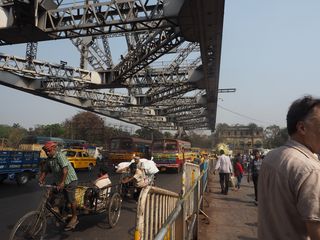
Kolkata • Howrah Bridge
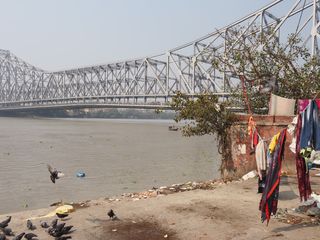
Kolkata • Howrah Bridge
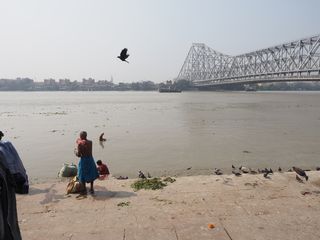
Kolkata • Howrah Bridge
Monument profile
Howrah Bridge
Monument category: Bridge
Monument family: Civil engineering structures (bridges, wells, etc.) and factories
Monument genre: Economic
Geographic location: Kolkata • West Bengal • India
Construction period: 20th century AD
• Links to •
• List of videos about Kolkata on this site •
Kolkata • Urban Life and Trading Traditions
Kolkata • Colonial Heritage and Legacy of the Raj
Kolkata • Religious Diversity and Urban Traditions
Construction and Historical Development of Howrah Bridge
Replacing the Floating Bridge
Howrah Bridge spans the Hooghly River between Kolkata and Howrah in the Indian state of West Bengal. Before the present structure was built, the crossing was provided by a floating bridge completed in 1874. As Kolkata expanded into one of the principal commercial and administrative centres of British India, increasing road traffic, railway connections and port activities quickly exceeded the capacity of this earlier crossing.
To provide a permanent and more efficient link, the authorities of British India began studying alternative designs during the early twentieth century. Following several decades of engineering proposals and administrative discussions, the final project was approved during the 1930s. Construction officially began in 1936 under the supervision of the Howrah Bridge Commissioners, the body responsible for planning, financing and managing the new bridge.
Construction During the Second World War
The bridge was erected under difficult circumstances created by the outbreak of the Second World War. The conflict disrupted international supplies of structural steel and construction materials, forcing engineers to rely extensively on steel produced in India. Assembly was carried out by Braithwaite, Burn & Jessop Construction Company using a cantilever design that avoided placing piers within the Hooghly River, where strong currents and heavy river traffic would have complicated construction and future maintenance.
The bridge was opened to traffic on 3 February 1943 while the war was still in progress. At that time, Kolkata played an important logistical role for British military operations in Asia. The new crossing immediately became a strategic transport link between Howrah Railway Station, the largest railway terminal in eastern India, and Kolkata’s commercial and administrative districts. Its capacity greatly exceeded that of the former floating bridge and allowed uninterrupted movement throughout the year.
From Colonial Infrastructure to Modern Kolkata
Following India’s independence in 1947, the bridge retained its original transportation function and continued to support the rapid growth of the metropolitan area. Increasing urbanisation and industrial development on both sides of the Hooghly led to steadily rising traffic volumes, making the bridge an essential component of the region’s road network. Even after the opening of the Vidyasagar Setu in 1992, Howrah Bridge continued to accommodate substantial numbers of vehicles and pedestrians every day.
In 1965 the bridge officially received the name Rabindra Setu in honour of Rabindranath Tagore. Nevertheless, the historical name “Howrah Bridge” remains the designation most commonly used by residents, visitors and published works. This coexistence of names reflects the transition from the colonial period to independent India while preserving the bridge’s long-established identity.
The structure continues to fulfil the purpose for which it was designed more than eight decades ago. Regular maintenance programmes address corrosion, structural wear and the effects of exceptionally heavy traffic, allowing the bridge to remain in continuous operation without significant alteration to its original design.
Historical Context
Construction of Howrah Bridge began in 1936, the same year the Berlin Olympic Games were held. The Second World War started in 1939, and the bridge entered service in 1943 while the conflict was still ongoing. Germany surrendered in 1945, ending the war in Europe, and India achieved independence two years later, in 1947.
Structural Design and Engineering Features of Howrah Bridge
Location and Overall Configuration
Howrah Bridge spans the Hooghly River between central Kolkata and the city of Howrah in the Indian state of West Bengal. Its location was selected to provide a permanent crossing between the commercial centre of Kolkata and the region’s principal railway terminal without obstructing navigation on the river. This requirement determined the bridge’s overall configuration, with all major supporting elements located on the riverbanks rather than within the waterway.
The bridge deck accommodates multiple traffic lanes, wide pedestrian walkways and utility services. Its width allows different forms of traffic to operate simultaneously while providing direct connections with the principal roads on both sides of the river. The structure forms an integral part of Kolkata’s urban transport network and continues to serve as one of its busiest road crossings.
Cantilever Structure and Load Distribution
Howrah Bridge is designed as a balanced cantilever bridge. Two large cantilever arms project from the riverbanks and support a suspended central span, eliminating the need for intermediate piers within the Hooghly. This solution was chosen because of the river’s strong currents, varying water levels and intensive navigation.
The bridge has an overall length of approximately 705 metres, while its main span measures about 457 metres. Its structural system consists of interconnected steel trusses forming a rigid triangular framework that efficiently distributes loads throughout the entire bridge. The arrangement enables the deck to carry heavy and continuous traffic while limiting structural deformation.
The bridge’s most recognisable elements are the two massive steel portal frames rising above the roadway. Unlike suspension bridges, these towers do not support main cables or vertical hangers. Instead, they form part of the cantilever framework itself, transferring loads through compression and tension within the trussed members. Their appearance reflects structural efficiency rather than decorative intent, giving the bridge its distinctive industrial character.
Materials and Construction Techniques
The bridge was constructed almost entirely from high-strength steel. Because construction coincided with the Second World War, imported materials became increasingly difficult to obtain, leading to extensive use of steel produced in India. Individual structural components were fabricated separately before being assembled on site.
One of the bridge’s most notable engineering features is the extensive use of riveted connections. The principal structural members were assembled using millions of hot-driven rivets, while welding played only a very limited role in the primary load-bearing framework. Riveting provided durable mechanical connections capable of distributing stresses across the steel members and was regarded as the most reliable technique for a bridge of this scale during the period.
The lattice structure incorporates numerous diagonal and horizontal members that create an efficient system of bracing. This dense network increases rigidity and enables the bridge to withstand dynamic traffic loads, wind forces and thermal expansion while maintaining structural stability.
Maintenance and Structural Preservation
The overall structural configuration of Howrah Bridge has remained virtually unchanged since its opening. Architectural interventions have largely been confined to resurfacing the roadway, upgrading traffic equipment and strengthening selected components subjected to long-term wear.
The bridge operates in a demanding environment characterised by high humidity, atmospheric pollution and exceptionally heavy daily traffic. These conditions require continuous maintenance of the steel framework. Regular inspections monitor the condition of rivets, joints and structural members, while periodic cleaning, corrosion treatment and repainting protect the exposed steel from deterioration. These conservation measures are essential for preserving the bridge’s structural performance while allowing it to continue serving its original transportation function.