

 Français (France)
  Nederlands (nl-NL)
 The Göreme Open Air Museum, located in Cappadocia, Turkey, is one of the most significant heritage complexes in the region. It brings together several rock-cut monuments carved into volcanic stone, reflecting a long history of human and religious occupation. The site is especially known for its churches, chapels, communal spaces, and remains of former dwellings. It offers valuable insight into a landscape shaped both by geology and by human activity. Listed as a UNESCO World Heritage Site, Göreme is one of the principal places for discovering historic Cappadocia.
Cappadocia • The Göreme Open Air Museum
Cappadocia • The Göreme Open Air Museum
Cappadocia • The Göreme Open Air Museum
Monument profile
The Göreme Open Air Museum
Monument category: Rock-Cut Habitats and Halls
Monument family: Archaeological
Monument genre: Archaeological site
Cultural heritage: Byzantine
Geographic location: Cappadocia • Turkey
Construction period: 4th century AD
This natural site in Cappadocia is inscribed on the UNESCO World Heritage List since 1985 and is part of the serial property "Göreme National Park and the Rock Sites of Cappadocia".See the UNESCO natural sites featured on this site
• Links to •
• List of videos about Cappadocia on this site •
Cappadoce • Göreme, valleys and cave villages Turkey
Historical Development of the Göreme Open Air Museum
Early Monastic Occupation and First Rock-Cut Establishments
The Göreme Open Air Museum consists of a concentration of rock-cut churches, monastic cells, communal rooms, and associated dwellings carved into the volcanic tuff of central Cappadocia. Its history does not begin with a single act of foundation, but with the gradual occupation of a valley whose geology made excavation practical. The earliest Christian use of the area is generally placed between the fourth and fifth centuries, when hermits and small ascetic communities adapted natural cavities or enlarged them into habitable chambers.
This first phase was linked to the growth of Cappadocian Christianity. The region was an important centre of theological life, and forms of withdrawal from urban society developed strongly there. Göreme offered relative seclusion, access to cultivable land, and rock soft enough to permit the rapid creation of shelters and chapels. The earliest establishments were likely modest in scale, consisting of cells, prayer spaces, storage rooms, and simple service areas.
The later museum area therefore emerged through accumulation rather than through a planned monastic complex. Different structures visible today belong to separate phases and reflect continued use over centuries.
Byzantine Expansion and the Age of Painted Churches
The principal period of development took place between the ninth and eleventh centuries, during the Middle Byzantine era. Several of the most important churches were excavated, enlarged, or redecorated at this time. This phase followed the end of Iconoclasm within the Byzantine Empire and coincided with renewed ecclesiastical patronage and artistic production.
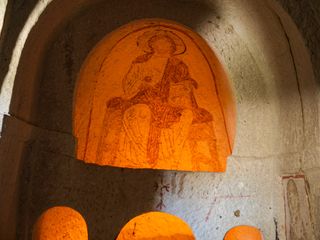
Among the best-known monuments are the Dark Church, the Apple Church, the Snake Church, and other sanctuaries decorated with painted cycles of biblical scenes, saints, and liturgical imagery. These interiors demonstrate that Göreme was not an isolated rural refuge but a religious centre connected to the visual culture of Byzantium. The quality of painting in some chapels suggests access to trained workshops and financial support from local patrons, clergy, or regional elites.
The valley also contained refectories, kitchens, storage rooms, and residential spaces. Such elements indicate organized communal life rather than scattered individual hermitages alone. Some churches were probably linked to specific monastic groups, while others may have served broader local congregations.
Political Change and Later Use
From the eleventh century onward, political transformations in Anatolia altered the conditions in which the Göreme complexes functioned. The arrival of Seljuk power, followed by later Turkish principalities and Ottoman rule, reduced the central role of many Byzantine monastic institutions. Christian use did not end immediately, but some communities declined, relocated, or adapted to new circumstances.
Several excavated spaces remained useful regardless of their original religious purpose. Rock-cut rooms could continue to serve as shelters, agricultural storage areas, stables, or seasonal habitations. Some painted churches suffered smoke damage, erosion, or casual reuse, while others survived because they were less accessible.
During the Ottoman centuries, surrounding settlements remained inhabited, but the former monastic concentration lost its earlier institutional significance. Many chapels gradually passed from active worship into local memory and occasional use. Their relative isolation contributed both to neglect and to partial preservation.
Rediscovery, Museum Formation, and Conservation
The site entered a new historical phase in the nineteenth and twentieth centuries when travellers, scholars, and historians of Byzantine art drew attention to Cappadocia’s rock-cut monuments. The painted churches of Göreme became especially important for the study of provincial Byzantine wall painting and monastic landscapes. Research campaigns helped identify chronological phases, iconographic programs, and architectural types.
The progressive transformation of the valley into an open air museum involved clearing debris, organizing visitor routes, protecting fragile interiors, and regulating access. The former monastic environment thus became a heritage site intended for study and public visitation. Conservation work has focused on structural stability, control of moisture, protection from vandalism, and management of visitor numbers in enclosed painted spaces.
The Göreme Open Air Museum forms part of the UNESCO World Heritage property inscribed in 1985 under the official name Göreme National Park and the Rock Sites of Cappadocia. It is now one of Turkey’s most important archaeological and artistic sites for understanding Byzantine Anatolia and the long use of rock-cut landscapes.
World Historical Context
The earliest Christian occupation of Göreme began while the later Roman Empire was progressively becoming Christianized. The major painted phases of the ninth to eleventh centuries were contemporary with the Carolingian and post-Carolingian world in western Europe, the Abbasid Caliphate in the Middle East, and the Tang then Song dynasties in China. Later transformations of the site coincided with the rise of Turkish powers in Anatolia.
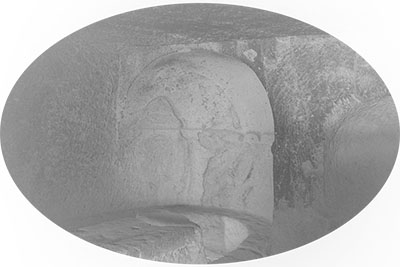
Rock-Cut Composition and Spatial Organization of the Göreme Open Air Museum
Topographical Setting and Overall Layout
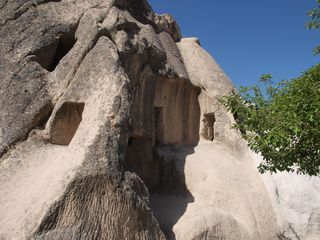
The Göreme Open Air Museum occupies a valley in central Cappadocia shaped by erosion within soft volcanic tuff. Its architecture is inseparable from the terrain. Churches, refectories, monastic cells, storage chambers, and ancillary spaces were excavated directly into cliffs, cones, and rock faces rather than constructed as freestanding masonry buildings. The result is a dispersed monumental ensemble structured by slopes, terraces, natural ridges, and carved circulation paths.
The site does not follow a single axial plan. Instead, it consists of several clusters distributed across the valley according to the quality of the rock, accessibility, orientation, and available mass for excavation. Visitors move between separate monuments linked by paths, stairways, and stepped ascents. This fragmented arrangement reflects practical adaptation to geology rather than formal urban planning.
Spatial unity comes from repeated constructive logic. Distinct monuments share the same method of transforming solid rock into interior volume. The museum therefore functions architecturally as a network of related excavated spaces rather than as one enclosed complex.
Excavation Methods and Material Characteristics
The primary material is volcanic tuff, soft enough to cut with hand tools yet sufficiently coherent to retain walls, ceilings, and carved supports under stable conditions. Builders created the monuments through subtractive techniques: removing stone while preserving structural masses where necessary. This method determined proportions, room depth, and ceiling span.
Interior surfaces vary from rough tool-cut areas to carefully smoothed finishes. In ceremonial spaces, walls were often regularized to receive plaster and painted decoration. More utilitarian chambers preserve irregular textures or unfinished sections. These differences help distinguish spaces of higher liturgical or communal importance from service zones.
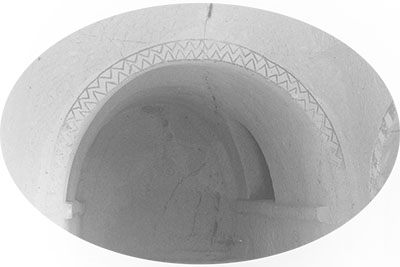
Ceilings frequently adopt barrel-vaulted, domed, or gently curved forms carved from the living rock. Such profiles reduce weak angles and distribute weight more effectively than flat cuts. In wider halls, residual pillars or thick wall masses were left in place to support the roof. Columns visible in some churches are often carved from the same stone block rather than assembled elements.
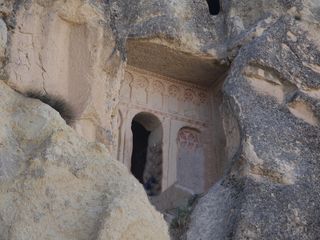
Exterior façades remain comparatively restrained. Openings were cut into cliff faces with modest portals, small windows, or recessed entrances. Architectural emphasis lies inside rather than on monumental external elevation.
Church Plans and Liturgical Interiors
The most important monuments of Göreme are its rock-cut churches, which display several adapted Byzantine plan types. Some consist of a single nave terminating in an apse. Others reproduce cross-in-square or cruciform arrangements within the limits of the rock mass. These plans were not copied mechanically; each was adjusted to the available volume and structural constraints.
The Dark Church is among the most sophisticated interiors. It contains a central nave, side bays, barrel vaulting, domed compartments, and a clearly articulated sanctuary zone. Proportions are carefully balanced, and the carved architecture creates a sense of enclosure comparable to built masonry churches. Similar refinement appears in other monuments where apses, transverse arches, and bay divisions are simulated in stone.
Columns and piers serve both structural and symbolic roles. Left in reserve during excavation, they separate spaces while evoking the vocabulary of constructed architecture. Arches and vault lines are often carved decoratively rather than structurally necessary, demonstrating the desire to reproduce established ecclesiastical forms inside a monolithic medium.
Wall painting is integral to the architecture. Frescoes emphasize apses, vault surfaces, cornice lines, and sacred focal points. Painted decoration therefore organizes visual hierarchy and reinforces spatial reading, not merely ornament.
Monastic Service Areas and Functional Spaces
The museum also preserves non-liturgical structures essential to understanding the complete architectural program. Refectories contain long dining tables and continuous benches carved from the floor and walls. Their linear arrangement imposes communal order and defines circulation within narrow halls.
Kitchens and service chambers include hearths, storage recesses, and working surfaces. Smaller cells likely served as living quarters or retreat rooms for monks. These spaces are compact, minimally ornamented, and positioned close to churches or communal rooms, suggesting an efficient daily routine.
Storage chambers often occupy deeper or cooler parts of the rock mass. Their simple geometry and enclosed character indicate practical use for provisions, tools, or agricultural goods. Some interconnected rooms may have served multiple purposes over time.
The relation between sacred and domestic functions is one of the site’s principal architectural traits. Instead of separating monastery life into detached buildings around a courtyard, Göreme integrates worship, residence, food preparation, and storage into a continuous carved landscape. Paths and terraces between monuments perform the role that cloisters or streets would serve in built complexes.
Alterations, Preservation, and Present Readability
Many monuments underwent later modifications. Entrances were widened, annexes added, partitions removed, or interiors repainted. Erosion has altered several façades, exposing rooms that were once more enclosed. In some churches, outer vestibules or secondary chambers have partially collapsed, making the surviving interior easier to read but less complete.
Modern conservation has focused on structural stability, visitor circulation, and protection of painted surfaces. Paths, railings, controlled entrances, and limited access zones have been introduced where necessary. Sensitive interiors, especially richly painted churches, are subject to stricter environmental management because humidity, dust, and crowding can damage plaster and pigment.
The tuff itself remains vulnerable to water infiltration, freeze-thaw cycles, and surface loss. Preservation therefore involves drainage control, monitoring of cracks, and reduction of excessive physical contact. Unlike masonry monuments, conservation here concerns the gradual decay of the rock mass forming both structure and finish.
The architectural significance of the Göreme Open Air Museum lies in its ability to transpose the full vocabulary of a monastic complex into excavated stone. Churches, dining halls, cells, stairs, apses, columns, and circulation systems were all created by hollowing the landscape itself, making geology, structure, and architectural form inseparable.