

 Français (France)
  Nederlands (nl-NL)
 Urban wells and water basins in Kathmandu form a long-standing component of the city’s public space. Distributed throughout historic neighborhoods, they reflect collective systems developed to manage water supply and daily urban life. Their presence is closely connected to the growth of Kathmandu as a political, religious, and commercial center of the valley. Beyond their practical role, these sites also functioned as shared spaces that supported social interaction and community organization. Today, they remain key elements for understanding the historical fabric of the city and the continuity of urban practices shaped by collective needs.
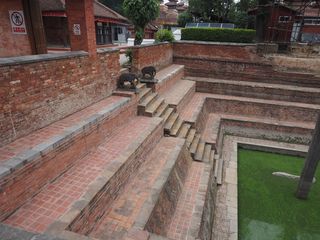
Kathmandu • Water basins
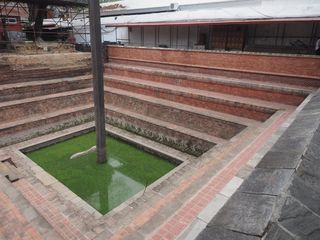
Kathmandu • Water basins
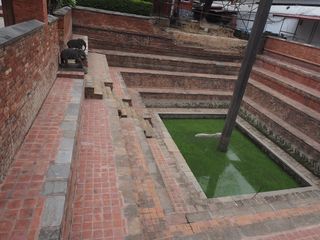
Kathmandu • Water basins
Water basins
History and urban uses of the water basins of Kathmandu
Origins and early urban development
The urban water basins of Kathmandu form part of an ancient hydraulic system closely linked to the valley’s emergence as an urban and religious centre. From the earliest phases of settlement, water was regarded not only as a vital natural resource but also as a structuring element of urban organisation. The construction of open ponds (pokhari) and sunken water points equipped with stone spouts (hiti) enabled permanent habitation in an environment characterised by seasonal rainfall and fluctuating natural springs. These installations were integrated into residential neighbourhoods, marketplaces, religious zones and palace complexes, contributing to the functional coherence of the urban fabric.
Daily uses and social functions
The basins fulfilled several essential functions simultaneously. They provided water for domestic needs, daily hygiene and certain artisanal activities. At the same time, they acted as social spaces where communal practices were embedded in everyday life. Water collection, often carried out at specific times of the day, played a role in shaping neighbourhood routines and social interaction. In addition, many basins held ritual significance: water drawn from particular hiti was used for religious purification, ceremonial acts and festivals, reinforcing their symbolic importance within the urban hierarchy.
Political and institutional framework
During the Malla period (approximately 12th–18th centuries), the network of urban basins was significantly expanded and formalised. Rulers, aristocratic families and religious institutions financed the construction and restoration of water structures as acts of religious merit (punya) and public service. Inscriptions, donations and local traditions attest to this patronage. Day-to-day management was often entrusted to local communities, responsible for cleaning, maintenance and supervision. This collective organisation ensured the long-term sustainability of the system.
Transformation and partial decline
From the late 18th century onwards, the incorporation of the Kathmandu Valley into the Shah kingdom led to increasing administrative centralisation. Attention to locally managed infrastructure gradually declined. During the 19th and early 20th centuries, several basins suffered from silting, pollution or partial infilling. Nevertheless, many continued to function as alternative water sources, particularly during dry seasons and periods of political instability.
Contemporary use and heritage value
Today, the urban water basins possess a dual significance. They are both remnants of a traditional system largely replaced by modern water networks and active elements within certain neighbourhoods. Recent restoration initiatives emphasise their role as living heritage and as examples of sustainable water management. In the collective memory of the city, these basins symbolise urban continuity, community cohesion and the enduring relationship between water, ritual and the built environment.
Hydraulic system, typology and architecture of the urban water basins
Hydraulic principles and water circulation
The urban hydraulic system is based on a coherent network of natural springs, rainwater collection and underground channels extending across the valley. Unlike modern pressurised networks, this system relies entirely on gravity and natural flow. Water is conveyed through gently sloping channels, often hidden beneath streets, courtyards and sacred spaces, towards basins and stone spouts. Continuous circulation reduces stagnation and allows a degree of natural filtration, which is particularly important in a dense urban environment.
Water supply and network management
Water supply is ensured by springs located in higher areas of the valley as well as by the capture of monsoon rainfall. The system functioned only through regular maintenance: channels had to be cleaned, collapses repaired and spouts kept clear. Management was generally organised at a local level, often by neighbourhoods, and required collective responsibility. While the technical simplicity of the system enabled long-term use, it also made it vulnerable to neglect when social structures weakened.
Typology of water structures
Several main types of structures coexist within this hydraulic network. Pokhari are open basins, usually rectangular or square, functioning as storage reservoirs and buffer zones during periods of heavy rainfall. Their scale varies widely, from large basins serving entire neighbourhoods to smaller, more local features. Hiti are sunken water points equipped with one or more stone spouts, designed for daily water collection. Smaller in scale but more numerous, they are strategically distributed throughout the urban fabric. This combination of types provides flexibility and resilience.
Architectural layout and urban integration
Architecturally, the basins are characterised by a restrained and functional design closely integrated into the urban landscape. Stairways connect street level to the water, creating a gradual transition between public space and functional area. The sunken layout protects the water from direct pollution and temperature fluctuations. Basins are often located near crossroads, temples or residential clusters, emphasising their central role in daily life without any intention of monumentality.
Materials and construction techniques
Construction relies primarily on locally available materials, notably fired brick and stone. Steps, edges and floors are faced with stone to resist wear, while spouts are usually carved from single stone blocks. Underground channels built from brick and clay are carefully laid to minimise water loss and enable natural filtration. These techniques reflect a sophisticated understanding of hydrology, material behaviour and long-term maintenance.
Decoration, symbolism and cultural context
Although essentially utilitarian, many water structures include decorative elements. Reliefs depicting mythical creatures such as naga or makara symbolise protection, purity and abundance. The proximity of temples and shrines gives the water a ritual dimension closely linked to religious practices. This fusion of hydraulic technology and symbolism reflects the broader cultural context of the valley, where infrastructure and belief systems are deeply intertwined.
Transformations and contemporary restoration
Over time, many basins have been adapted to changing needs. Some were deepened or enlarged, others rebuilt after periods of neglect. Contemporary restoration projects focus on restoring water circulation and original materials, while discreetly incorporating modern interventions to improve water quality and safety. This approach highlights the dual significance of the basins as functional infrastructure and as living architectural heritage within the modern city.