

 Français (France)
  Nederlands (nl-NL)
 Street shops in Kathmandu form an integral part of the urban landscape and everyday life. Distributed along historic streets, squares, and residential districts, they reflect a long-standing tradition of local commerce. Typically located on the ground floor of residential buildings, these shops illustrate an urban model where trade, housing, and social interaction coexist within the same space. They contribute to the constant activity of the city and represent a form of neighborhood-based economy shaped by continuity of use, adaptation to modern demands, and the persistence of established commercial practices within Kathmandu’s dense urban fabric.

Kathmandu • Street shops

Kathmandu • Street shops
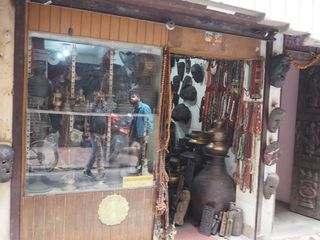
Kathmandu • Street shops
Monument profile
Street shops
Monument category: Historic urban landscape
Monument family: Historic or traditional habitat
Monument genre: Residential
Geographic location: Kathmandu • Nepal
• Links to •
• List of videos about Kathmandu on this site •
Kathmandu • Great Buddhist stupas and sacred landscape
Kathmandu • Durbar Square, historic royal and religious centre
Kathmandu • Urban life, local temples and everyday spaces
Kathmandu • Pashupatinath, Hindu sanctuary on the Bagmati River
History of the Street Shops of Kathmandu
Urban and Commercial Origins
The street shops of Kathmandu are the product of a long process of urban and commercial development rooted in the Kathmandu Valley’s role as a political, religious, and economic center. From Late Antiquity onward, the city benefited from its strategic position along trade routes linking the Indian plains, the Himalayan regions, and the Tibetan plateau. Early urban growth during the Licchavi period (c. 4th–9th centuries) fostered the emergence of permanent commercial streets, where everyday goods, artisanal products, and services were exchanged within a dense urban fabric.
During the Malla period (12th–18th centuries), the organization of street-based commerce became more clearly defined. Kathmandu expanded as a royal capital and a hub of religious patronage, and commercial activity was increasingly integrated into residential neighborhoods. Shops were typically established on the ground floors of houses, reflecting an urban model in which trade, domestic life, and social interaction coexisted within the same built environment. Professional guilds and caste-based occupational groups played an important role in regulating commercial activities and maintaining continuity across generations.
Political Change and Functional Continuity
The unification of Nepal in the late 18th century under the Shah dynasty altered the political framework of the city but did not fundamentally disrupt the role of street shops. Although administrative power became more centralized, local commerce continued to rely on established streets and traditional marketplaces. During the Rana period (19th to mid-20th century), when Nepal experienced relative isolation from global trade networks, street shops remained essential to urban life, ensuring the distribution of food, tools, textiles, and ritual items within the city.
In the second half of the 20th century, political reforms, economic liberalization, and increased tourism introduced new commercial pressures. Some shops adapted their merchandise to changing demand, while others maintained long-standing activities rooted in local consumption. Despite these transformations, many street shops retained their original locations and functions, contributing to a sense of historical continuity within the urban landscape.
Social Role and Collective Memory
Beyond their economic function, street shops occupy a significant place in the social memory of Kathmandu. They serve as everyday points of contact between residents, reinforcing neighborhood identities and sustaining informal networks of exchange. The persistence of family-run shops over multiple generations has contributed to a strong association between specific streets and particular trades.
As a result, street shops are widely perceived as living elements of the city’s heritage rather than isolated commercial units. Their continued operation within historic streetscapes embodies the resilience of traditional urban forms and provides a tangible link between past and present. In this sense, they play a key role in preserving Kathmandu’s historical identity at both the local and national levels.
Architecture and Spatial Organization of Kathmandu’s Street Shops
Integration into the Traditional Urban Fabric
The architecture of Kathmandu’s street shops is characterized by their close integration into traditional residential buildings. Most shops occupy the ground floor of urban houses, while upper levels are reserved for domestic use. This vertical distribution reflects a long-standing urban model in which economic and residential functions are deliberately intertwined rather than spatially separated.
Street-facing façades are designed to allow direct interaction with the public space. Large rectangular openings at ground level provide visibility and accessibility, enabling goods to be displayed and transactions to occur directly at the threshold between interior and street. This architectural arrangement emphasizes practicality and continuity of use rather than monumental expression.
Materials and Construction Techniques
The construction of street shops relies on the same materials and techniques used throughout the historic urban fabric of the Kathmandu Valley. Fired brick forms the primary structural material, while timber is extensively employed for doors, shutters, window frames, and internal supports. Mortars based on lime or earth were traditionally used, reflecting local building practices and available resources.
Wooden elements often display varying degrees of craftsmanship. While less elaborate than those found in temples or palaces, carved lintels and frames occasionally incorporate decorative motifs, indicating the cultural value attributed even to modest commercial spaces. Structural systems are designed to accommodate both residential loads and commercial activity, underscoring the adaptability of traditional construction methods.
Transformations and Modern Adaptations
Over time, street shops have undergone incremental modifications in response to changing economic and regulatory conditions. Openings have sometimes been widened, modern materials introduced, or signage added to improve visibility. These alterations generally affect surface elements rather than the core structure of the buildings, allowing the overall architectural character to remain intact.
Restoration efforts, when undertaken, typically prioritize continued use over strict historical reconstruction. This pragmatic approach has enabled street shops to remain active components of the urban environment rather than static heritage objects. Collectively, these spaces form a coherent architectural ensemble defined by repetition, material continuity, and long-term functional stability, contributing significantly to the visual and cultural identity of Kathmandu’s historic streets.