

 Français (France)
  Nederlands (nl-NL)
 The Garuda Dhwaja is a votive pillar located in Kathmandu Durbar Square in Nepal, in front of the former royal palace. The monument is generally attributed to the Malla period and was probably erected in the late sixteenth century as part of the ceremonial arrangement of the royal square. The pillar is associated with the cult of Vishnu, whose mythological mount is Garuda. The sculpture placed at the top of the monument is traditionally identified as Garuda, although some iconographic observations suggest that it may also represent Vishnu or a related Vaishnavite composition. Today the pillar remains a recognizable element within the historic monumental landscape of Kathmandu Durbar Square.
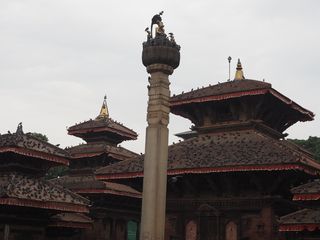
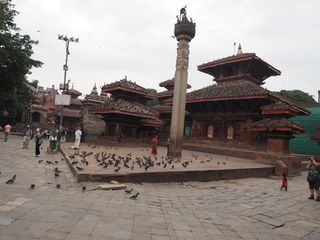
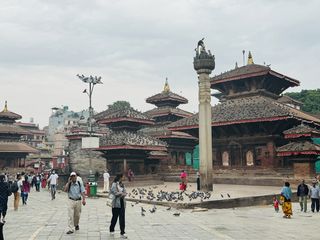
Monument profile
Garuda Dhwaja
Monument category: Votive pillar
Monument family: Monumental pillar, column or stele
Monument genre: Religious
Cultural heritage: Hindu
Geographic location: Kathmandu • Nepal
Construction period: 16th century AD
This monument in Kathmandu is inscribed on the UNESCO World Heritage List since 1979 and is part of the serial property "Kathmandu Valley".See the UNESCO monuments featured on this site
• Links to •
• Dynasties that contributed to the construction of the monument •

• List of videos about Kathmandu on this site •
Kathmandu • Great Buddhist stupas and sacred landscape
Kathmandu • Durbar Square, historic royal and religious centre
Kathmandu • Urban life, local temples and everyday spaces
Kathmandu • Pashupatinath, Hindu sanctuary on the Bagmati River
History of the Garuda Dhwaja in Kathmandu
The Garuda Dhwaja is a votive pillar located on Kathmandu Durbar Square in Nepal, positioned in front of the former royal palace that served for centuries as the political centre of the Kathmandu Valley. The monument forms part of the ceremonial landscape that developed around the royal court and the principal temples of the capital. Consisting of a stone base, a vertical column and a sculpture placed at its summit, the structure reflects a long architectural tradition in South Asia in which pillars and symbolic markers were used to express religious devotion and political authority within public urban spaces.
The monument is generally attributed to the late sixteenth century, most likely during the reign of King Lakshmi Narsingh Malla, who ruled Kathmandu between 1581 and 1614. The sculpture at the top of the pillar is traditionally interpreted as Garuda, the mythical mount of the Hindu god Vishnu. However, some scholars have noted that the iconography is not entirely unambiguous and that the figure may also represent a form closely associated with Vishnu himself. This uncertainty illustrates the complexity of religious symbolism in the artistic traditions of the Kathmandu Valley.
Political and social context of the construction
The construction of the Garuda Dhwaja must be understood within the political landscape of the Kathmandu Valley during the Malla period. Between the thirteenth and eighteenth centuries, the valley was divided into several independent kingdoms ruled by different branches of the Malla dynasty. The three principal capitals—Kathmandu, Patan and Bhaktapur—were important centres of political authority, trade and artistic production.
This fragmentation of power encouraged intense rivalry among the ruling courts. Each kingdom sought to demonstrate its prestige and legitimacy through monumental construction projects. Royal palaces, temples and public monuments were erected as visible symbols of political authority and religious devotion. The Durbar Squares of the three cities became focal points where architecture, ceremony and governance were closely intertwined.
Within this context, the installation of votive pillars and statues formed part of a broader strategy of symbolic representation. Garuda, the mythological bird associated with Vishnu, embodies loyalty, protection and divine authority in Hindu tradition. By placing a pillar dedicated to Garuda in front of the royal palace, the ruler visually linked the monarchy with the protection of Vishnu. This symbolic association reinforced the idea that royal authority operated within a divine cosmic order and enjoyed the support of sacred forces.
The pillar also contributed to the ceremonial organization of the Durbar Square. Royal squares functioned as spaces where political rituals, religious festivals and public gatherings took place. Monuments such as the Garuda Dhwaja helped structure the visual and symbolic landscape of the square, guiding processions and reinforcing the relationship between palace, temples and urban society.
Historical events affecting the site
During the Malla period, Kathmandu Durbar Square served as the administrative and ceremonial heart of the city. Royal coronations, public audiences and important religious festivals were held in this space. The temples, shrines and monuments that surrounded the square created a ceremonial setting that emphasized the authority of the court and the religious significance of the city.
A major political transformation occurred in the eighteenth century when the Gorkha kingdom began its expansion into the Kathmandu Valley. Under the leadership of King Prithvi Narayan Shah, the Gorkhali forces gradually conquered the cities of the valley. In 1768 Kathmandu was captured, marking the end of the independent Malla kingdoms and the beginning of the political unification of Nepal.
Despite this dynastic change, many ceremonial traditions associated with the Durbar Square continued. The Shah rulers adopted aspects of the ritual practices established during the Malla era, and the monuments already present on the square remained integrated into the symbolic environment of the royal court. The Garuda Dhwaja therefore continued to function as part of the ceremonial landscape even after the political transformation of the kingdom.
Over the centuries, the Kathmandu Valley has also experienced numerous earthquakes that have affected the architectural heritage of the region. Several temples and palace structures on Durbar Square were damaged or rebuilt after these events. Votive pillars such as the Garuda Dhwaja, however, often proved more resilient because of their compact and structurally simple design, although periodic maintenance and restoration were likely required to preserve their stability.
Global context at the time of construction
The late sixteenth century was a period of significant political and cultural transformation in many parts of the world. In South Asia, the Mughal Empire was expanding under the rule of Emperor Akbar, whose reign was marked by the construction of monumental cities, palaces and religious buildings intended to express imperial authority and cultural synthesis.
At the same time, European monarchies were strengthening centralized political power and investing heavily in architectural projects designed to symbolize royal prestige. Palaces, ceremonial squares and public monuments were increasingly used as instruments of political representation and urban organization.
Although the Kathmandu Valley remained politically independent from these larger empires, the architectural developments of the Malla period reflect a comparable tendency. Local rulers employed monumental architecture and symbolic structures to define the centres of power within their capitals. The Garuda Dhwaja can therefore be understood as part of a broader global pattern in which architecture and urban design were used to express political legitimacy and religious authority.
Transformations and evolution of the monument
Since its construction, the Garuda Dhwaja has undergone relatively few structural changes. Its simple architectural form—a base, a column and a sculpture—has contributed to its long-term preservation. However, the urban environment surrounding the monument has evolved significantly over time.
During the seventeenth and eighteenth centuries, additional temples and palace structures were built around Durbar Square, gradually altering the visual composition of the site. The expansion of Kathmandu in later centuries further transformed the relationship between the historic royal square and the surrounding urban fabric.
In the modern period, Kathmandu Durbar Square has become both a major religious centre and an important historical landmark. The area continues to host traditional festivals and ceremonies associated with the Newar community and with Hindu religious practices.
The devastating earthquake that struck Nepal in 2015 caused significant damage to many monuments within the Kathmandu Valley. Several temples on Durbar Square collapsed or were severely damaged. Although the Garuda Dhwaja did not suffer the same level of destruction as some nearby structures, the disaster highlighted the vulnerability of the region’s architectural heritage and reinforced the importance of ongoing conservation efforts.
Contemporary role and cultural significance
Today the Garuda Dhwaja remains an identifiable element of the historic landscape of Kathmandu Durbar Square. For the inhabitants of the valley, it represents a visible reminder of the Malla period, which is widely regarded as a flourishing era of artistic and architectural development.
The monument also forms part of the ceremonial setting of the square, which continues to host major cultural and religious events throughout the year. Festivals organized by the Newar community often involve processions and ritual activities that make use of the temples and monuments located around the square.
For historians, architects and visitors, the pillar provides insight into the symbolic organization of royal squares in the Kathmandu Valley. It demonstrates how relatively modest structures could play an important role in defining the ceremonial and political space of a historic capital.
Conservation and contemporary challenges
Kathmandu Durbar Square is part of the Kathmandu Valley World Heritage Site, recognized internationally for the exceptional value of its historic architecture and cultural landscape. This designation highlights the importance of preserving the monuments that form part of this unique urban ensemble.
However, conservation efforts face several ongoing challenges. Earthquake risk remains a constant concern in the Himalayan region. In addition, pollution, rapid urban development and heavy tourist activity can accelerate the deterioration of historic materials.
Nepalese authorities, working in collaboration with international organizations, have undertaken several restoration and conservation programs to protect the monuments of the valley. These initiatives aim to stabilize damaged structures, restore traditional architectural features and ensure the long-term preservation of the historic environment.
Within this broader context, the Garuda Dhwaja illustrates the heritage value of smaller monuments that contribute to the overall understanding of historic urban ensembles. Although less imposing than the temples surrounding it, the pillar remains a meaningful element of Kathmandu’s ceremonial landscape and a lasting witness to the political and religious traditions that shaped the city during the Malla period.
Architecture of the Garuda Dhwaja in Kathmandu
The Garuda Dhwaja located on Kathmandu Durbar Square represents a distinctive example of a votive pillar integrated into the ceremonial architecture of the historic capitals of the Kathmandu Valley. Positioned in front of the former royal palace, the monument consists of a stone base, a vertical shaft and a sculptural element placed at its summit. Although modest in scale compared with the surrounding temples and palace structures, the pillar plays a significant role in the spatial organization of the royal square. Its architecture reflects both the symbolic requirements of Hindu devotional practice and the technical expertise of Newar craftsmen during the Malla period.
Within the architectural landscape of the Durbar Square, the Garuda Dhwaja functions primarily as a vertical marker. Unlike temples or pavilions designed for ritual activities within enclosed spaces, the pillar was conceived as an external monument intended to structure the visual field of the square and establish a symbolic relationship between the royal palace, the surrounding temples and the open civic space of the plaza.
Technological innovations and construction knowledge
The construction of a vertical monument such as the Garuda Dhwaja required careful consideration of structural stability, especially in a region known for frequent seismic activity. The craftsmen responsible for the monument belonged to the Newar artisan tradition, which had developed sophisticated building techniques combining stone masonry, metalwork and sculpture.
One of the principal technical challenges of a pillar monument lies in the control of vertical proportions. The column must be tall enough to be visible within the architectural environment of the square, yet stable enough to resist lateral forces generated by earthquakes or strong winds. Newar builders addressed this challenge through a structural hierarchy composed of a broad base, a relatively slender shaft and a lighter sculptural crown.
The base of the pillar plays a crucial role in stabilizing the structure. By concentrating a large proportion of the monument’s mass near the ground, the builders lowered the center of gravity and increased resistance to tilting. This strategy reflects a broader architectural principle found throughout the Kathmandu Valley, where temples and towers often rely on wide foundations to counterbalance vertical height.
Another important aspect of the design lies in the visual clarity of the monument. The pillar was intended to stand out within the complex architectural environment of Durbar Square. The vertical form creates a strong visual axis that draws attention upward toward the sculptural figure at the top. This effect allows the monument to function simultaneously as a religious symbol and as an element of urban orientation within the square.
Materials and construction techniques
The Garuda Dhwaja is primarily constructed from stone, a material widely used in the Kathmandu Valley for structural elements exposed to weather and long-term environmental stress. Stone offers excellent compressive strength and durability, making it particularly suitable for monuments intended to endure for centuries.
The base of the pillar consists of carefully cut stone blocks arranged to form a stable platform. These blocks distribute the weight of the column evenly across the ground and protect the structure from moisture infiltration. Slight elevation above the surface of the square also helps to protect the monument from surface water and seasonal humidity.
The shaft of the pillar is composed of carved stone elements shaped with traditional masonry tools. The surface treatment of the column is generally restrained, emphasizing structural clarity rather than elaborate ornamentation. Subtle mouldings or horizontal divisions may appear along the shaft, providing visual rhythm and reinforcing the perception of vertical height.
The sculptural element at the top of the pillar is usually made of metal, commonly bronze or a copper alloy. Metal casting allows for finer detail than stone carving and enables artisans to produce expressive iconographic features. In some cases, the sculpture may have been gilded or partially covered with a thin layer of gold, enhancing its visibility and reinforcing its symbolic importance within the ceremonial space.
Architectural and artistic influences
The Garuda Dhwaja belongs to a long-standing architectural tradition found throughout the Indian subcontinent in which pillars and commemorative columns serve religious or political purposes. Ancient examples include victory columns, sacred markers and pillars erected near temples to signify divine protection.
In the Kathmandu Valley, this broader South Asian tradition was adapted to the specific cultural environment of the Newar kingdoms. The artisans of the valley integrated pillar monuments into the ceremonial spaces of royal squares, combining architectural simplicity with symbolic meaning.
The sculptural figure placed at the summit of the pillar represents the central artistic feature of the monument. Garuda, the mythical bird associated with Vishnu, is typically depicted in a kneeling posture of devotion. This pose expresses reverence toward the deity and symbolizes loyalty and protection. In many cases, Garuda figures are oriented toward a temple or sacred shrine associated with Vishnu.
However, the figure atop the Garuda Dhwaja in Kathmandu has occasionally been the subject of scholarly discussion. While the monument is traditionally identified as a Garuda pillar, the iconography of the sculpture is not entirely unequivocal. Some interpretations suggest that the figure may represent Vishnu himself or a stylized form related to Garuda iconography. Such ambiguities are not uncommon in Newar sculpture, where religious imagery often evolves through successive restorations and reinterpretations.
The artistic style of the sculpture reflects the aesthetic traditions of the Malla period. Newar artists were known for their ability to combine delicate ornamentation with strong symbolic forms. Even when decorative details remain relatively restrained, the expressive posture of the figure conveys the religious significance of the monument.
Spatial organization and structural composition
Architecturally, the Garuda Dhwaja follows a clear three-part composition consisting of the base, the vertical column and the sculptural crown. This tripartite structure is typical of pillar monuments across South Asia and serves both structural and symbolic purposes.
The base acts as the structural foundation of the monument. It elevates the column slightly above ground level, protecting the structure and visually distinguishing it from the surrounding pavement of the square. The base also serves as a transition between the horizontal plane of the plaza and the vertical axis of the column.
The shaft of the pillar forms the main structural element. Its proportions are carefully balanced to maintain stability while ensuring visual prominence within the square. The vertical surface of the shaft emphasizes height and guides the observer’s gaze toward the sculpture above.
The sculpture placed at the summit completes the architectural composition. This element transforms the column into a religious monument rather than a purely structural feature. Its orientation toward the royal palace establishes a symbolic connection between divine authority and royal power.
The position of the Garuda Dhwaja within Kathmandu Durbar Square contributes to the spatial organization of the site. The pillar stands in front of the palace complex, creating a visual dialogue between sacred imagery and royal architecture. It acts as a transitional marker linking the royal residence, the surrounding temples and the open civic space where public ceremonies were historically performed.
Dimensions and notable characteristics
Although not among the tallest structures of the square, the Garuda Dhwaja rises several meters above the ground, ensuring its visibility within the open space of the plaza. The height of the pillar was likely chosen to achieve a balance between symbolic prominence and structural stability.
One particularly notable feature of the monument is the orientation of the sculptural figure. Instead of facing a temple shrine, the figure is oriented toward the royal palace. This unusual alignment emphasizes the political symbolism of the pillar by associating divine protection directly with the authority of the monarch.
Another striking characteristic is the relative austerity of the monument. Compared with the richly carved wooden struts and decorative facades of the surrounding temples, the pillar relies on its vertical form and symbolic sculpture rather than elaborate ornamentation. This simplicity enhances the clarity of its visual message within the complex architectural environment of the square.
Similar votive pillars can be found in the Durbar Squares of Patan and Bhaktapur. These monuments share comparable structural principles but differ in sculptural details and proportions. Their presence suggests that pillar monuments formed part of a broader architectural vocabulary associated with royal squares during the Malla period.
Heritage recognition and conservation challenges
The Garuda Dhwaja forms part of the architectural ensemble of Kathmandu Durbar Square, which belongs to the Kathmandu Valley World Heritage Site. This designation recognizes the exceptional cultural value of the valley’s historic architecture and urban landscape.
Despite this recognition, the conservation of monuments in the Kathmandu Valley remains a complex challenge. Environmental factors such as air pollution, humidity and seasonal climate variations gradually affect both stone and metal materials. Additionally, the region’s seismic activity poses an ongoing threat to vertical structures such as pillars and towers.
The devastating earthquake of 2015 demonstrated the vulnerability of the valley’s historic monuments. Although the Garuda Dhwaja itself did not collapse, the disaster highlighted the importance of preventive conservation and structural monitoring.
Restoration programs implemented by Nepalese authorities and international conservation organizations aim to preserve the architectural integrity of the Durbar Square while respecting traditional construction techniques. Protecting smaller monuments such as the Garuda Dhwaja is particularly important because these elements contribute to the coherence and historical readability of the entire urban ensemble.
Through its architectural simplicity and symbolic clarity, the Garuda Dhwaja illustrates how relatively modest structures can play an essential role in shaping ceremonial urban landscapes. The monument remains a visible reminder of the architectural traditions developed in the Kathmandu Valley during the Malla period and continues to contribute to the historical identity of Kathmandu Durbar Square.