

 Français (France)
  Nederlands (nl-NL)
 The Royal Palace in Phnom Penh, Cambodia, has been the official residence of the Cambodian king since it was built in the late 19th century during the reign of King Norodom. This majestic complex is a symbol of the Cambodian monarchy and houses several significant buildings, including the Silver Pagoda, which holds important religious artifacts. The palace is used for royal ceremonies and official receptions, while also serving as a cultural and spiritual landmark. It attracts many visitors who come to admire its well-maintained gardens, golden facades, and structures influenced by both Khmer and French architectural styles.
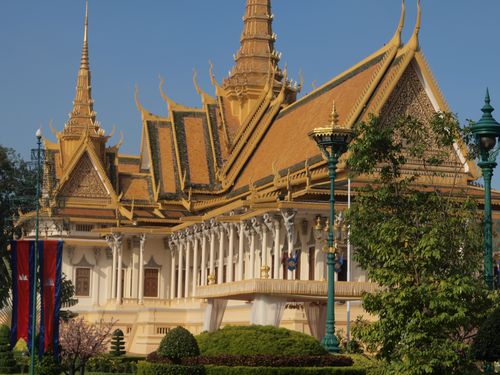
Phnom Penh • Royal Palace
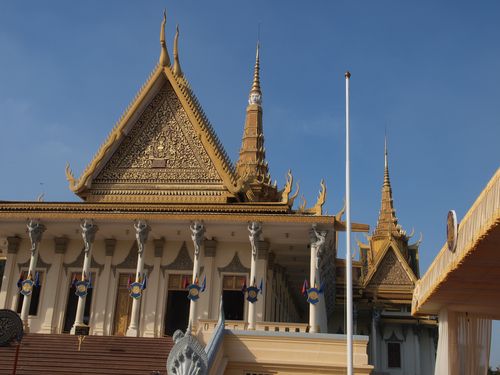
Phnom Penh • Royal Palace
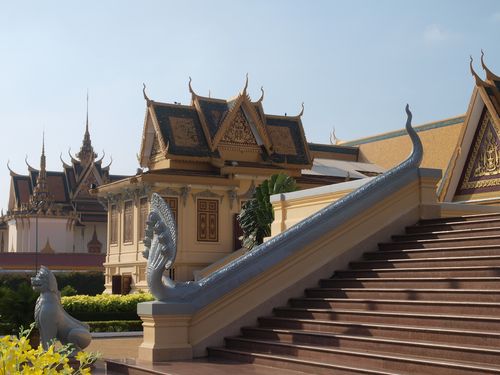
Phnom Penh • Royal Palace
Monument profile
Royal Palace
Monument category: Palace
Monument family: Palace and Annexes
Monument genre: Residential
Cultural heritage: Buddhist
Geographic location: Phnom Penh • Cambodia
Construction period: 19th century AD
• Links to •
• List of videos about Phnom Penh on this site •
Phnom Penh, the capital • Cambodia
• References •
Wikipedia EN: Royal Palace of Cambodia
The Royal Palace of Phnom Penh: Political Motivations, Historical Events, and Preservation Challenges
Political and Social Motivations Behind the Construction
The Royal Palace of Phnom Penh was constructed in 1866 during the reign of King Norodom, in a period marked by political and social change in Cambodia. The decision to build the palace came shortly after Cambodia had signed a protectorate agreement with France in 1863, which aimed to secure the kingdom’s sovereignty in the face of pressure from neighboring Siam (Thailand) and Vietnam. The palace’s construction in Phnom Penh, then a rising capital, symbolized a new era of centralized royal authority and modern governance, while also signaling Cambodia’s cultural and political identity under a new colonial reality.
The architecture and location of the Royal Palace were strategic choices, reflecting the monarchy’s desire to project power and stability. The shift of the royal capital from Oudong to Phnom Penh demonstrated the monarchy’s intent to embrace modernity and consolidate its authority in a geographically advantageous city, located on the Mekong and Tonlé Sap rivers, a hub for trade and diplomatic relations.
Historical Events and Their Influence on the Region
The Royal Palace has been a witness to numerous key historical events that shaped Cambodia. One of the most significant was the establishment of French colonial rule in the late 19th century. Though Cambodia remained under French protection, the palace became a site of political negotiation between the monarchy and the French administration. The palace was instrumental in legitimizing the king’s authority while allowing France to maintain control over much of the country’s political and economic infrastructure.
In the 20th century, the Royal Palace was deeply affected by Cambodia's turbulent political history. During the Khmer Rouge regime (1975-1979), the palace was largely neglected, as Phnom Penh was emptied and the monarchy was abolished. However, the palace survived this period, albeit with some damage and looting. With the fall of the Khmer Rouge and the restoration of the monarchy, the palace once again became a symbol of national resilience and continuity. The return of King Norodom Sihanouk in 1993 marked a significant moment in Cambodia’s modern history, reinforcing the palace’s role in the country’s cultural and political life.
Global Context and Comparisons with Other Regions
The construction of the Royal Palace in Phnom Penh took place during a period of global imperialism, particularly in Southeast Asia. At the time, many Asian nations were negotiating their sovereignty in the face of European expansion. Cambodia’s neighboring states, such as Siam and Vietnam, were undergoing similar transformations, with the former modernizing rapidly to avoid colonization, and the latter falling under French rule.
The Royal Palace of Phnom Penh can be compared to other royal complexes in the region, such as the Grand Palace in Bangkok, built to symbolize the strength and legitimacy of the Thai monarchy. Like the Royal Palace of Phnom Penh, these structures served as political centers, cultural symbols, and physical embodiments of the nation’s identity during periods of colonial or foreign influence.
Major Transformations of the Royal Palace Over the Centuries
The Royal Palace has undergone several significant transformations throughout its history. Initially constructed to assert royal authority, the palace complex expanded over time with the addition of new buildings and renovations. Under King Sisowath, the palace was enhanced with the construction of the Throne Hall and other important structures like the Chanchhaya Pavilion, which was used for royal dance performances.
The palace experienced another transformation during the Khmer Rouge era when it was neglected and suffered damage. However, it was not destroyed, and after the regime's collapse, substantial restoration efforts were undertaken to return the palace to its former glory. The most notable restoration took place in the 1990s, with the return of the monarchy, marking the palace as a key symbol of Cambodia's reconstruction and return to traditional values.
These transformations reflect the shifts in power in Cambodia and the external influences that have shaped the country’s political and cultural landscape. French architectural elements introduced during the protectorate, combined with traditional Khmer designs, make the palace a unique blend of both local and foreign styles.
Cultural Importance and Current State of Conservation
Today, the Royal Palace is not only the official residence of the king but also a cultural and religious landmark of great significance. It remains central to royal ceremonies such as coronations, weddings, and religious festivals. The Silver Pagoda, located within the palace grounds, holds priceless Buddhist relics, further enhancing the site’s spiritual importance.
The palace is a major tourist attraction, drawing visitors from around the world who come to admire its architecture and historical significance. However, this influx of tourists, combined with Cambodia’s tropical climate, poses challenges to the preservation of the palace’s buildings and artifacts.
Challenges to Preservation in the Face of Modern Threats
The preservation of the Royal Palace faces several modern challenges. The tropical climate of Phnom Penh, characterized by high humidity and heavy monsoons, accelerates the degradation of materials such as wood, stone, and gold leaf. The palace’s intricate frescoes, murals, and wooden structures are particularly vulnerable to these environmental factors, requiring ongoing conservation efforts.
Tourism presents another major challenge. While essential to Cambodia’s economy, the high number of visitors can cause physical wear and tear on the palace grounds, especially in sensitive areas like the Silver Pagoda. To address these issues, the Cambodian government, along with international conservation organizations, has implemented measures such as restricting access to certain areas and carrying out regular maintenance and restoration work.
Efforts are also being made to balance modern needs with the preservation of traditional methods. For example, conservationists strive to maintain the integrity of the palace by using traditional Khmer techniques in restoration projects while incorporating modern technologies to monitor environmental conditions and structural stability.
Conclusion
The Royal Palace of Phnom Penh stands as a testament to Cambodia’s rich political, cultural, and spiritual history. Built during a time of great change, it has survived periods of colonial rule, political upheaval, and war, emerging as a symbol of national identity and continuity. Its architecture, blending Khmer traditions with foreign influences, reflects the complexities of Cambodia’s history. Despite the challenges posed by the climate and modern tourism, the Royal Palace remains a focal point of Cambodian heritage, and efforts to preserve it ensure that it will continue to inspire future generations.
The Royal Palace of Phnom Penh: Architectural Innovation and Cultural Fusion
Technological Advancements and Construction Materials
The Royal Palace of Phnom Penh, constructed in 1866 during the reign of King Norodom, represents a significant technological and architectural achievement for its time. The palace’s construction reflects Cambodia’s embrace of both traditional craftsmanship and modern innovations. The primary materials used in the palace include wood, stone, and precious metals such as gold leaf, which were carefully selected to convey the grandeur and wealth of the Cambodian monarchy.
The use of local timber for beams and frameworks aligns with traditional Khmer architecture, while the introduction of concrete in certain structures, particularly during later renovations, highlights a blend of modern techniques with time-honored methods. The palace’s design showcases an ability to adapt to contemporary construction practices, ensuring both durability and aesthetic beauty.
A key element of innovation lies in the integration of drainage and ventilation systems, which were modern at the time of construction. These systems were essential in managing the tropical climate of Phnom Penh, protecting the palace from water damage and humidity. Such technological advancements underscore the foresight in designing a royal complex capable of withstanding Cambodia’s environmental challenges.
Architectural Features and Fusion of Artistic Traditions
The architecture of the Royal Palace is a remarkable fusion of Cambodian and foreign influences. The complex is primarily designed in traditional Khmer style, with its multi-tiered, ornate roofs and spire-like structures that are emblematic of Cambodia’s rich architectural heritage, reminiscent of the ancient temples of Angkor. These elements symbolize the connection to Cambodia’s past while also establishing the palace as a contemporary royal seat.
However, the palace also incorporates significant foreign influences, particularly from France, due to the colonial presence at the time. French-inspired elements are visible in the geometric layout of the gardens, the use of imported glass, and certain decorative motifs that reflect European tastes. The combination of these styles creates a unique architectural blend, with the elegance of Khmer artistry complemented by modern European touches.
The Throne Hall (Preah Tineang Tevea Vinichhay) is a perfect example of this fusion. Its soaring ceilings and intricately carved columns reflect traditional Cambodian craftsmanship, while the introduction of stained glass windows and metal frameworks speaks to European architectural influence. This blend of artistic traditions showcases the cultural openness of the Cambodian monarchy during the late 19th century, while still emphasizing its national identity.
Notable Structure and Layout of the Monument
The Royal Palace complex follows a well-organized layout that separates public and private spaces, highlighting the ceremonial and residential functions of the royal family. One of the most significant structures is the Silver Pagoda, located within the palace grounds, which houses sacred Buddhist relics, including the revered Emerald Buddha. The Silver Pagoda is famed for its floor, which is paved with over 5,000 silver tiles, weighing a total of nearly six tons. This striking feature symbolizes the wealth and spiritual devotion of the Cambodian monarchy.
The palace grounds are divided into different sections, each with a specific function. The Throne Hall is used for coronations and official state ceremonies, while the Pavilion of Chanchhaya is used for royal performances. The Royal Residence is located in the northern section of the complex, illustrating the separation between the ceremonial and private life of the monarchy. The overall plan of the palace reflects both the functionality required for governance and the cultural significance of its design.
Statistics and Notable Anecdotes
One of the most fascinating facts about the Royal Palace is the sheer amount of silver used in the Silver Pagoda, which is said to contain over 5,000 silver tiles, each weighing around 1.125 kilograms. Additionally, the Golden Buddha, housed inside the pagoda, is made of pure gold and weighs about 90 kilograms, adorned with 9,584 diamonds, including a 25-carat diamond. These treasures reflect not only the wealth of the Cambodian royal family but also the significant spiritual and cultural importance placed on the palace.
An interesting anecdote involves the construction of the Pavilion of Chanchhaya, which was completed in less than a year. This feat of engineering and organization highlights the dedication and skill of the Cambodian artisans who worked alongside French engineers to complete the project.
International Recognition and UNESCO World Heritage Status
Although the Royal Palace of Phnom Penh is not currently listed as a UNESCO World Heritage site, it remains one of Cambodia’s most significant cultural landmarks and has garnered international recognition for its architectural beauty and historical significance. The palace attracts thousands of visitors each year, drawn by its unique blend of Khmer and French architectural styles and its importance as a symbol of Cambodia’s monarchy.
The palace’s international recognition has bolstered efforts to preserve its structures and artifacts. While the palace is not part of the UNESCO World Heritage list, international collaboration and support have played a key role in maintaining its historical and cultural integrity. Preservation initiatives focus on restoring damaged structures, conserving the palace’s intricate murals, and protecting the precious religious artifacts housed within the Silver Pagoda.
Challenges to Preservation in Modern Times
The Royal Palace faces several challenges related to its preservation. The tropical climate of Phnom Penh, characterized by high humidity and frequent rainfall, poses a constant threat to the structural integrity of the palace buildings, particularly the wooden elements and the ornate gold leaf decorations. Additionally, the effects of pollution and environmental degradation have further complicated preservation efforts.
Tourism is another significant challenge. While the palace is a major attraction, the heavy foot traffic from thousands of visitors annually can lead to wear and tear, particularly in sensitive areas such as the Silver Pagoda. The Cambodian government, in cooperation with international preservation experts, has implemented measures to limit access to certain areas, conduct regular maintenance, and raise awareness about the importance of preserving the site’s cultural heritage.
Conclusion
The Royal Palace of Phnom Penh is an architectural masterpiece that exemplifies both technological innovation and cultural fusion. Its use of advanced construction techniques and materials, combined with a harmonious blend of Khmer and foreign influences, makes it one of Cambodia’s most important historical sites. Despite the challenges posed by the environment and tourism, ongoing preservation efforts ensure that the palace will continue to serve as a symbol of Cambodian royalty and national identity for generations to come. Through its unique architecture and historical significance, the Royal Palace remains a key landmark in the country’s cultural heritage.