Français (France)
  Nederlands (nl-NL)
 Palm alcohol distillation is a traditional craft practiced in the region of Bagan, where palm trees provide sap used to make fermented and distilled beverages. The activity combines agricultural knowledge, control of fermentation, and locally developed heating techniques. It forms part of the rural economy and is often linked to everyday village life. Beyond its food and drink function, it reflects the efficient use of palm resources in local communities. Today, this production remains an important cultural marker of central Myanmar.
Bagan • Palm Wine Distillation
Bagan • Palm Wine Distillation
Bagan • Palm Wine Distillation
Tradition profile
Palm Wine Distillation
Tradition categories: Craftsmanship, Work in the countryside
Tradition families: Crafts and professions • Traditional practices and lifestyle
Tradition genres: Trade and Local Creativity, Agricultural and rural traditions
Geographic location: Bagan • Myanmar
• Links to •
• List of videos about Bagan on this site •
Bagan, the gods • Myanmar
Bagan, the people • Myanmar
Bagan, the craftsmen • Myanmar
Bagan, a palm liquor distillery • Myanmar
Palm Alcohol Distillation in Bagan: History of a Rural Burmese Craft
Origins and Early Development
Palm alcohol distillation belongs to a long tradition of using palm resources in the dry central zone of Myanmar. In the region of Bagan, where palm trees have long formed part of the rural landscape, sap collection provided communities with a versatile raw material. Fresh sap could be consumed directly, naturally fermented, or distilled into a stronger and more stable drink.
The exact beginnings of this practice are difficult to date, yet it likely emerged from early agrarian societies seeking to make full use of available resources. Palm trees offered not only sap, but also timber, fibre, leaves, sugar products, and shade. Distillation represented an additional stage of value creation from a familiar crop.
This craft developed gradually through household knowledge rather than through centralized institutions. Skills were transmitted locally and refined through repeated practice.
Historical Role in the Bagan Region
For centuries, Bagan was an important political, religious, and agricultural centre. Beyond its monumental temples, the surrounding countryside supported villages engaged in dry-zone farming, livestock raising, and small-scale craft production. Palm alcohol distillation formed part of this broader rural economy.
Its importance lay in flexibility. Families could combine palm work with seasonal agriculture, using labour when fields required less attention. Distilled alcohol could be consumed locally, exchanged with neighbours, or sold in nearby markets. Because the product had a longer shelf life than fresh sap, it was economically more practical for trade.
During successive Burmese kingdoms and later under British colonial administration, such village industries generally continued alongside larger commercial networks. They required modest equipment and relied mainly on family labour, allowing them to survive changing political contexts.
Social and Community Significance
Palm alcohol production was more than an economic activity. In many rural societies of South and Southeast Asia, fermented and distilled beverages played roles in hospitality, communal gatherings, family ceremonies, and local exchange systems. In the Bagan area, production often contributed to everyday village relationships.
The craft also reinforced domestic cooperation. Different household members might collect sap, manage heating fires, prepare containers, or handle sales. In this sense, distillation was linked to family organization as much as to technical skill.
Because the work depended on local trees and practical knowledge, it also reflected a close relationship between communities and their environment.
Change, Decline, and Adaptation
During the twentieth century, modernization, regulation of alcohol production, industrial beverages, and migration toward towns altered the position of many rural crafts. Some palm alcohol activities declined where younger generations sought other forms of employment or where raw materials became less central to household income.
Elsewhere, production adapted through small technical changes, improved containers, and local market diversification. In some cases, interest from visitors and researchers gave renewed visibility to practices once considered ordinary village work.
In the Bagan region, where cultural heritage tourism expanded, palm-related production increasingly came to represent part of the wider identity of central Myanmar.
Present Importance and Transmission Challenges
Today palm alcohol distillation remains a reminder of how rural communities historically transformed local resources into tradable goods. It illustrates the combination of agriculture, household labour, and practical chemistry developed outside industrial systems.
Its future depends on economic viability, continued access to palm groves, health regulations, and the willingness of younger people to learn demanding manual work. When the craft disappears, technical memory and elements of rural social history are lost with it. When maintained, it continues to show the adaptive resourcefulness of communities around Bagan.
Practical Characteristics of Palm Alcohol Distillation in Bagan
Production Setting and General Organization
Palm alcohol distillation is mainly practiced in the rural areas surrounding Bagan, close to palm groves and cultivated land. Production is usually small-scale and household-based. Sap collection, fermentation, heating, and sale are often managed by one family or by a small working group.
Workspaces are simple and functional. Distillation commonly takes place in a yard, beneath an open shelter, or beside the family house. Because palm sap ferments quickly in warm conditions, production usually follows a daily rhythm in which raw material is processed soon after collection.
Sap Collection and Raw Materials
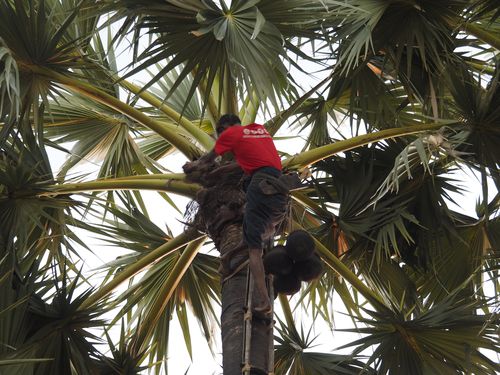
The main raw material is sap drawn from palm trees. Collectors climb the trunks using ladders, rope loops, or footholds cut into the bark. Containers are fixed near the flowering stem or tapping point to gather the liquid.
Collection often happens early in the morning or late in the day. Fresh sap is mildly sweet but begins fermenting rapidly once exposed to heat and airborne yeasts. Depending on local practice, it may be consumed fresh, left to ferment naturally, or transferred directly for distillation.
Visible signs of quality include clean vessels, quick transport from tree to workshop, freshness of the sap, and careful maintenance of the palms.
Distillation Equipment and Technical Skills
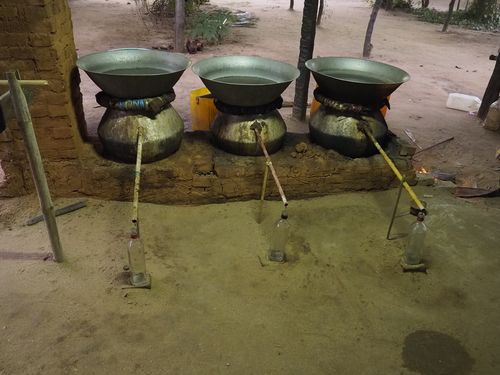
Traditional equipment is based on a compact system: a fire source, a boiling pot or metal vessel, a fitted lid, a condensation tube, and a receiving container. Depending on resources, components may be made of metal, clay, bamboo, or more recent manufactured materials.
Fermented sap is heated gradually. Fire control is one of the most important skills. Excessive heat can damage flavour or disrupt the distillation process, while a steady temperature allows more regular vapour flow.
Alcohol vapour passes through a cooling section where it condenses into liquid form. The operator constantly observes flame intensity, steam output, and collection speed. These actions are practical skills generally learned through family transmission rather than formal training.
Participants and Division of Labour
Several people may participate in the process. One person may collect sap, another maintain the fire, while others clean containers, filter liquid, or handle sales. The exact division depends on household size and available labour.
Women often play an important role in preparation, measuring, bottling, or local trade, while men may undertake climbing and heavier physical tasks. However, roles vary according to family organization rather than fixed rules.
Most sales occur locally, either from the home, through village markets, or through small intermediaries.
Sensory Environment and Distinctive Features
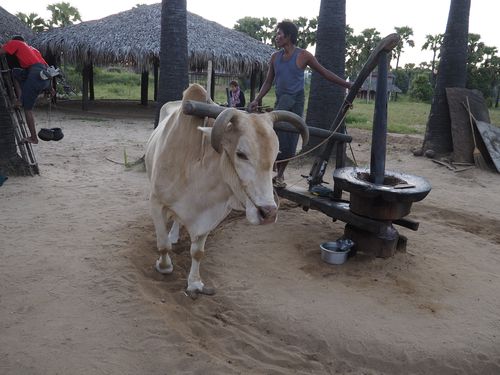
The production setting combines dry vegetation, palm silhouettes, hanging pots, smoke from wood fires, and rows of storage vessels. Smells typically mix sweet fermenting sap, heated liquid, and burning fuel. Sound is limited to conversation, boiling vessels, fire movement, and routine work activity.
What distinguishes this tradition in the Bagan region is the immediate transformation of a highly perishable natural product into a more durable commercial good. The process links agriculture, household labour, and practical technical knowledge in a direct and visible way.
Continuity and Present Adaptation
Some producers now use stronger metal containers or slightly modernized fittings, yet the essential principle remains unchanged. The real continuity lies in the gestures: selecting good sap, judging fermentation, regulating heat, and knowing when to collect the best portion of the distilled liquid.
 Links to the main sections of the site