Français (France)
  Nederlands (nl-NL)
 Bhojanshala (free meal service) refers to a community dining service offering meals to visitors, pilgrims, or people in need in Bagdana. The practice is based on principles of sharing, charity, and hospitality found in several religious traditions of India. Meals are generally prepared collectively through donations, voluntary service, and local organization. Beyond its nutritional role, the bhojanshala also serves as a place of social contact and symbolic equality among participants. It remains an important part of local communal and spiritual life today.
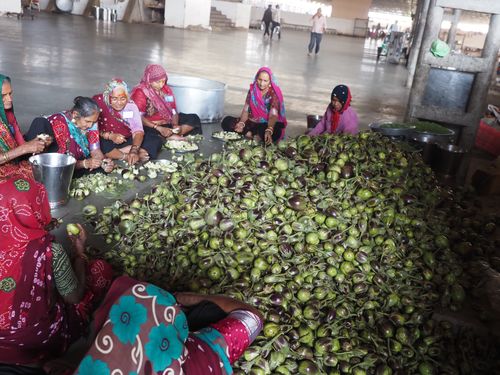
Bagdana • Bhojanshala (free meal)
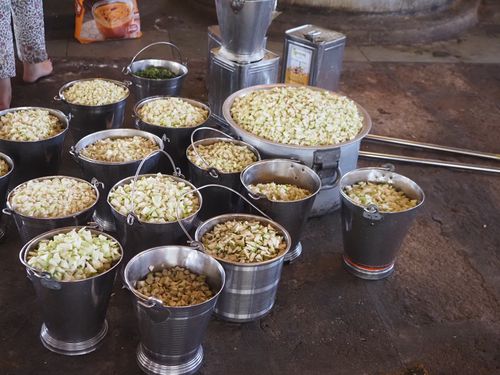
Bagdana • Bhojanshala (free meal)
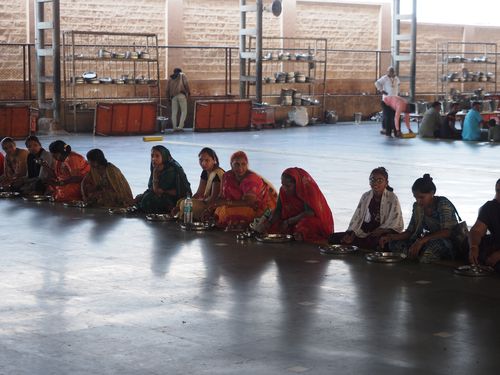
Bagdana • Bhojanshala (free meal)
Tradition profile
Bhojanshala (free meal)
Tradition category: Ritual meal
Tradition family: Religious traditions
Tradition genre: Religious Festivals and Celebrations
Cultural heritage: Hindu
Geographic location: Bagdana • Gujarat • India
• Links to •
• List of videos about Bagdana on this site •
Bagdana • Pilgrimage Site and Continuous Community Meals
The Bhojanshala of Bagdana: history of a free community meal tradition
Religious origins and founding principles
The Bhojanshala (free meal service) of Bagdana belongs to a long Indian tradition of offering free food to pilgrims, visitors, ascetics, and people of modest means. The word bhojanshala broadly refers to a dining hall or place dedicated to meals. In many religious settings across India, feeding others is regarded as a meritorious act linked to charity, hospitality, and service.
Its deeper roots are connected with the concept of anna dana, the donation of food, valued in several Hindu, Jain, and Sikh traditions as well as in regional devotional practices. Providing a meal is understood not only as material assistance, but also as moral duty and spiritual generosity.
At Bagdana, a known devotional centre in Gujarat, the bhojanshala developed in connection with the steady arrival of worshippers and travellers.
Growth through pilgrimage and local support
As pilgrimage activity increased, organized food service became increasingly important. Visitors arriving from distant villages or towns required practical support, especially during festivals, commemorative days, or seasonal gatherings. A free meal hall answered this need efficiently.
Over time, such institutions generally evolved from occasional charity into structured operations with kitchens, storage areas, serving spaces, and systems for receiving donations. Volunteer participation became central to their continuity.
In many parts of Gujarat, a religious site able to feed large numbers of people also gained social prestige. Generosity toward visitors strengthened the standing of the shrine and reinforced ties between devotees and the institution.
Social and symbolic meaning
The bhojanshala carries a strong communal dimension. Participants share the same meal in a common setting regardless of wealth, origin, or social position. Although local realities may vary, the stated principle is one of open hospitality.
It also transforms devotion into visible action. Donors contribute funds or food, volunteers give labour, and visitors receive assistance without formal distinction. In this sense, the meal hall functions as both charitable service and religious expression.
Because pilgrims often travel in groups or spend extended time at sacred places, the bhojanshala also becomes a space of rest, conversation, and social contact.
Modern adaptations
During the twentieth and twenty-first centuries, many bhojanshalas adapted to changing expectations. Larger visitor numbers required expanded kitchens, improved hygiene standards, better water systems, and more efficient organization.
Traditional voluntary support often continues, but it may now be complemented by organized trusts, associations, or wider donor networks. Some institutions introduced modern equipment while preserving the principle of free service.
These changes allowed the custom to remain functional rather than merely ceremonial.
Present importance and future challenges
Today, the bhojanshala of Bagdana remains an important part of local religious and community life. It represents the idea that pilgrimage involves not only worship, but also care for those who gather there.
Its current challenges include rising food costs, maintenance of facilities, management of large crowds, food safety requirements, and renewal of volunteer participation. As long as community support continues, the bhojanshala remains a living tradition of shared responsibility and public generosity in Gujarat.
Practical Operation of the Bhojanshala at Bagdana
General layout of the community meal hall
The Bhojanshala (free meal service) at Bagdana is a communal dining facility where meals are served without charge to pilgrims, visitors, and people in need. Its physical organization is usually functional rather than decorative, designed to receive many people efficiently.
The site commonly includes a kitchen zone, storage areas for grains and vegetables, washing spaces, and one or more dining sections. Entry and exit routes are arranged to keep movement orderly, especially during busy religious days. Floors and surfaces are selected for durability and ease of cleaning.
Depending on attendance, the hall may operate continuously for several hours or in successive rounds of seating.
Food preparation and kitchen equipment
Meals are generally based on vegetarian cooking, common in many devotional contexts of Gujarat. Rice, lentils, vegetable dishes, flatbread such as roti or chapati, khichdi, buttermilk, or simple sweets may be offered according to local custom and available donations.
Large-scale preparation requires substantial equipment: metal cauldrons, cooking vats, gas burners, preparation tables, ladles, containers, and water supply systems. Ingredients are cleaned, cut, cooked in batches, and kept warm until serving time.
Kitchen work often begins early in the day. Teams divide tasks between washing produce, preparing dough, stirring lentils, seasoning dishes, and moving finished food to serving stations. Timing is important so that meals remain fresh while large numbers of people are fed.
Sequence of the meal service
Visitors usually enter in groups and take their places in rows on the floor, on benches, or at simple tables depending on the hall’s design. This arrangement allows servers to move quickly through aisles and distribute food evenly.
Each person may receive a metal plate, tray, or reusable dish. Volunteers then serve items in sequence: bread, rice, vegetables, lentils, and additional portions when supplies permit. Water is commonly provided separately.
The service rhythm is fast but controlled. When one group finishes, used utensils are collected or moved to washing areas, the space is cleaned, and the next group is admitted. This rotation allows the bhojanshala to accommodate many participants in limited time.
Participants and visible roles
Several groups of people keep the institution functioning. Cooks manage production, servers distribute meals, cleaners maintain hygiene, and organizers supervise supplies and crowd flow. Donors may finance ingredients for a particular day or support general operations.
The diners themselves are diverse: pilgrims, local residents, travelling families, workers, and economically vulnerable persons. This mixture of backgrounds is one of the most visible characteristics of the bhojanshala.
Interactions are usually practical and respectful. Efficiency, courtesy, and equal treatment are more important than ceremony.
Atmosphere and practical customs
The sound environment is shaped by metal utensils, footsteps, brief instructions, conversation, and the movement of serving vessels. In a religious setting, noise is generally moderate. The atmosphere tends to be disciplined rather than festive.
Several unwritten rules are often evident: waiting one’s turn, avoiding waste, accepting the meal offered, clearing space promptly after eating, and respecting the shared environment.
These habits allow the meal hall to function smoothly even during heavy attendance.
What distinguishes the Bhojanshala of Bagdana
At Bagdana, the bhojanshala stands out because free dining is directly integrated into local devotional life. Visitors do not simply observe a kitchen; they see a working system where food, charity, volunteer labour, and pilgrimage operate together.
Its most remarkable feature is the transformation of large-scale meal service into a daily expression of community responsibility.
 Links to the main sections of the site