Français (France)
  Nederlands (nl-NL)
 The Landscapes of Cappadocia, located in Turkey, are renowned for their unique geological formations. Shaped by the erosion of soft volcanic deposits, these landscapes feature fairy chimneys, valleys, and plateaus. The region is also known for its cave dwellings, rock-hewn churches, and ancient underground cities, reflecting a remarkable human adaptation to this natural environment. Cappadocia is now a popular tourist destination, especially known for hot air balloon flights that provide spectacular views of the scenery.
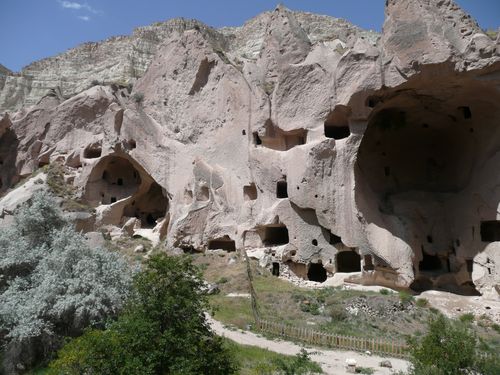
Cappadocia • Landscapes of Cappadocia

Cappadocia • Landscapes of Cappadocia

Cappadocia • Landscapes of Cappadocia
Natural site profile
Landscapes of Cappadocia
Natural site categories: Fairy chimneys
Natural site families: Natural volcanic sculptures • Natural habitats
Natural sites genres: Terrestrial
Geographic location: Cappadocia • Turkey
This natural site in Cappadocia is inscribed on the UNESCO World Heritage List since 1985 and is part of the serial property "Göreme National Park and the Rock Sites of Cappadocia".See the UNESCO natural sites featured on this site
• Links to •
• List of videos about Cappadocia on this site •
Cappadocia, its magical landscapes • Turkey
• References •
UNESCO: Göreme National Park and the Rock Sites of Cappadocia
The Preservation and Valorization of Cappadocia's Landscapes: Political, Economic, and Cultural Motivations
The landscapes of Cappadocia, located in central Turkey, are globally recognized for their unique geological formations and rich cultural heritage. Over the centuries, various political, economic, and cultural motivations have driven the preservation and valorization of this natural site. The region’s distinct rock formations, carved by natural forces and human intervention, have become a focal point for tourism and cultural heritage conservation efforts. Understanding the historical and contemporary influences that have shaped Cappadocia’s preservation provides insight into its importance on ecological, economic, and social levels.
The Beginning of the Preservation Process and Key Motivations
The preservation of Cappadocia’s landscapes can be traced back to the Byzantine period (4th–11th centuries), when early Christian communities sought refuge in the region’s soft volcanic rock, carving out churches, monasteries, and dwellings. This period marked the initial cultural motivation for preservation, as the region became a center of religious significance and architectural adaptation.
Economic motivations emerged more prominently in the 20th century with the rise of tourism. Cappadocia’s designation as a UNESCO World Heritage Site in 1985 further accelerated preservation efforts by establishing regulatory frameworks to protect the natural and cultural assets of the region. The Turkish government and local stakeholders recognized the site’s potential to attract international tourists, contributing to regional economic development through sustainable tourism initiatives.
Politically, Cappadocia's unique landscape has been leveraged to promote Turkey's cultural heritage on the global stage, reinforcing national identity and fostering diplomatic engagement through cultural tourism and heritage diplomacy.
Historical Events and Regional Development
Several historical events have significantly influenced the importance of Cappadocia and its development in ecological, economic, and social contexts:
- Byzantine and Ottoman Influence: During the Byzantine era, Cappadocia played a strategic role in religious and military affairs, with underground cities providing shelter from invasions. In the Ottoman period, the region continued to thrive as a trade hub due to its location along key caravan routes.
- Modern Tourism Boom: The mid-20th century witnessed a surge in international interest, leading to economic diversification and an increased focus on conservation strategies. The expansion of infrastructure, including hotels and transportation networks, allowed Cappadocia to become a major tourist destination.
- UNESCO Recognition in 1985: The inclusion of Cappadocia in the UNESCO World Heritage list highlighted its global cultural and natural significance, prompting policies aimed at balancing tourism with ecological conservation. This event marked a turning point, encouraging both national and international funding for preservation initiatives.
Global Context and Comparison with Similar Sites
Cappadocia’s preservation efforts can be compared with other world-renowned sites such as the Grand Canyon in the United States and the Meteora rock formations in Greece. While the Grand Canyon is primarily managed for its geological and ecological significance, Cappadocia presents a unique blend of human habitation and natural heritage, necessitating a more complex conservation approach.
Like Meteora, where monasteries were built atop towering rock formations, Cappadocia’s cave dwellings and churches illustrate a historical symbiosis between humans and nature. However, unlike Meteora, Cappadocia faces greater challenges related to tourism management, as it is more integrated into the local economy and daily life.
Transformations Over the Centuries
Cappadocia has undergone significant transformations over the centuries, reflecting environmental, political, and cultural changes.
- Environmental Changes: Erosion and climate variations have shaped the region’s topography, with natural forces continuously sculpting the fairy chimneys and valleys. In recent decades, climate change has accelerated erosion, posing new challenges for preservation efforts.
- Cultural Transformations: From its early use as a refuge to its current status as a major tourism hub, Cappadocia’s cultural identity has evolved while retaining its core heritage. The introduction of modern amenities and commercial establishments has altered the traditional landscape, leading to debates about authenticity and preservation.
- Political and Economic Shifts: Cappadocia's growing economic significance has led to increased investments in tourism infrastructure, bringing both opportunities and challenges for sustainable development.
Ecological and Symbolic Importance
Cappadocia holds both ecological and symbolic significance. Ecologically, it serves as a unique example of natural formations shaped by volcanic activity and erosion, with distinct flora and fauna adapted to its semi-arid environment. Symbolically, it represents centuries of human resilience and ingenuity, showcasing a deep connection between people and their environment.
Current State of Preservation and Challenges
Today, Cappadocia faces several preservation challenges:
- Mass Tourism: The growing number of visitors puts immense pressure on the fragile rock formations and local ecosystems. Measures such as visitor quotas and designated viewing areas have been implemented to mitigate the impact.
- Urban Development: Expansion of tourism infrastructure, such as hotels and restaurants, risks altering the visual and cultural authenticity of the site.
- Environmental Degradation: Climate change and natural erosion threaten the longevity of the formations, requiring constant monitoring and conservation efforts.
- Balancing Conservation and Economic Growth: Ensuring economic benefits for local communities while preserving the site's integrity remains a key challenge for policymakers.
Conclusion
The preservation and valorization of Cappadocia’s landscapes have been shaped by a blend of cultural, political, and economic motivations over the centuries. The region’s recognition on the global stage through UNESCO has provided both opportunities and responsibilities in terms of conservation and sustainable development. As Cappadocia continues to attract global attention, striking a balance between heritage protection and economic viability will be crucial for its future.
Cappadocia's Landscapes: A Geological, Biological, and Ecological Marvel
Cappadocia, located in central Turkey, is renowned for its unique natural landscapes, characterized by remarkable geological formations, diverse biodiversity, and ecological processes that have evolved over millions of years. The region serves as an exceptional example of how natural forces and human activity have interacted to create a landscape of unparalleled beauty and significance. This article explores the innovative geological, biological, and ecological aspects of Cappadocia, highlighting its global importance and the impact of conservation efforts.
Geological Processes and Unique Formations
Cappadocia's landscapes are primarily the result of complex geological processes that date back to millions of years. The region was shaped by volcanic activity, with eruptions from the Erciyes, Hasan, and Melendiz volcanoes depositing thick layers of volcanic tuff, a soft rock composed of ash and lava. Over time, natural forces such as wind and water erosion sculpted these deposits into the iconic fairy chimneys, deep valleys, and unusual rock formations that define the region today.
The formation of fairy chimneys is a striking example of differential erosion, where softer layers of tuff are gradually eroded, leaving behind harder, resistant rock caps that protect the pillars underneath. This natural process has resulted in the development of unique landscapes that continue to evolve due to ongoing weathering and erosion.
Cappadocia’s topography also includes vast plateaus, deep canyons, and underground cities carved directly into the soft rock, demonstrating how geological characteristics have influenced human settlement and adaptation.
Biological and Ecological Aspects
Despite its arid and rugged environment, Cappadocia supports a variety of plant and animal species adapted to its unique ecological conditions. The region’s microclimates, influenced by elevation and rock formations, allow for the existence of diverse ecosystems. Native vegetation includes drought-resistant plants such as juniper, wild thyme, and endemic flower species that thrive in the region’s semi-arid climate.
Wildlife in Cappadocia includes species such as foxes, hares, and various bird species, including eagles and owls, which have adapted to the rocky terrain and open landscapes. The natural caves and rock shelters provide crucial habitats for several bat species and smaller mammals, contributing to the region's ecological richness.
The interaction between natural features and traditional agricultural practices has further shaped Cappadocia’s ecological landscape. The fertile volcanic soil has supported the cultivation of vineyards and fruit orchards for centuries, illustrating a sustainable balance between human activity and the natural environment.
A Unique Blend of Local and Global Environmental Influences
Cappadocia’s landscapes exemplify a combination of local geological conditions and broader environmental influences. While the region’s unique rock formations are the result of localized volcanic activity and erosion, global climate patterns have also played a role in shaping the area. Changes in precipitation and temperature over time have contributed to soil formation, vegetation distribution, and the ongoing evolution of the landscape.
In recent years, global environmental challenges such as climate change have started to impact Cappadocia, with increased temperatures and changing rainfall patterns accelerating erosion processes and threatening the stability of rock formations. Efforts to mitigate these challenges require a combination of local conservation initiatives and broader international cooperation.
Recognition and Conservation Efforts
Cappadocia’s outstanding geological and cultural significance led to its designation as a UNESCO World Heritage Site in 1985. This recognition has brought international attention to the region, emphasizing the need for sustainable conservation efforts to preserve its unique landscapes and cultural heritage.
The UNESCO designation has had several positive impacts, including:
- Increased awareness and funding for conservation projects, ensuring the protection of key geological formations and historic sites.
- Regulations to manage tourism, balancing economic benefits with the need to protect the fragile environment.
- Promotion of sustainable tourism initiatives, encouraging responsible visitor behavior and reducing environmental impact.
Despite these efforts, challenges persist, particularly related to mass tourism and urban development. The increasing number of visitors to Cappadocia places significant pressure on the delicate rock formations and local ecosystems, necessitating ongoing monitoring and management to prevent irreversible damage.
Interesting Statistics and Anecdotes
Cappadocia covers an area of approximately 5,000 square kilometers, with its most famous attractions located within the Göreme National Park.
The region attracts over 3 million visitors annually, drawn by its iconic landscapes and cultural heritage.
The underground city of Derinkuyu, carved into the soft volcanic rock, extends to a depth of 60 meters and could accommodate up to 20,000 people, highlighting the region’s historical ingenuity in adapting to its environment.
Hot air balloon rides have become a defining feature of Cappadocia, with hundreds of balloons taking to the skies daily, offering breathtaking views of the surreal landscape.
Current Conservation Challenges
Cappadocia faces several pressing conservation challenges, including:
- Erosion and Climate Change: The increasing frequency of extreme weather events accelerates the natural erosion of the rock formations, threatening their longevity.
- Tourism Management: Unregulated tourism activities can lead to physical degradation of rock surfaces, littering, and disruption of local ecosystems.
- Urban Expansion: Growing tourism infrastructure, including hotels and transportation networks, risks altering the region's authentic landscape and cultural atmosphere.
- Resource Management: Ensuring sustainable water use and waste management in an arid environment is critical to maintaining the ecological balance.
Conclusion
Cappadocia’s landscapes are a remarkable testament to the power of natural forces and human resilience. Its geological formations, ecological diversity, and cultural heritage make it one of the world's most unique natural sites. The region's recognition as a UNESCO World Heritage Site underscores its global importance and the need for ongoing conservation efforts to preserve its beauty and ecological integrity for future generations.
As Cappadocia continues to evolve under the pressures of tourism and environmental change, balancing economic opportunities with responsible stewardship remains a key priority for ensuring the long-term sustainability of this extraordinary landscape.
 Links to the main sections of the site