Français (France)
  Nederlands (nl-NL)
 Of Hindu tradition, the Nayak of Madurai dynasty ruled for approximately 207 years, ± between 1529 and 1736 over all or part of South India, during the Medieval Period and the Colonial Period.
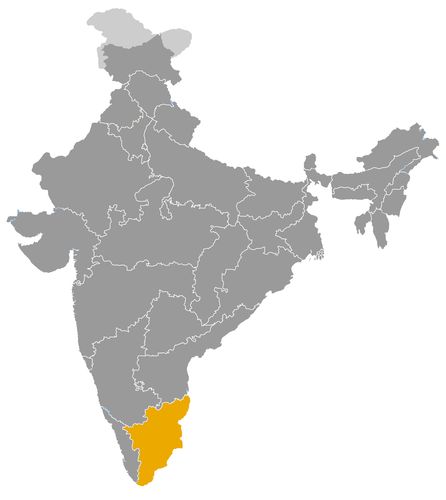
This map illustrates the maximum territory that the Nayak of Madurai Dynasty had reached at its height, covering the current regions of Tamil Nadu in India. Its main purpose is to provide a visual aid to understand the geographical extent of this dynasty. However, it's important to note that the contemporary borders of these regions may not necessarily coincide with the historical territories.
The Madurai Nayak Dynasty and Its Role in the Political, Cultural and Economic History of South India
A regional power born from the Vijayanagara imperial order
The Madurai Nayak dynasty played a major role in the history of South India between the sixteenth and eighteenth centuries. It emerged within the political and military framework of the Vijayanagara Empire, which entrusted strategic provinces to Nayak commanders. These chiefs were responsible for defence, revenue collection, local administration and the maintenance of imperial authority in distant regions.
Madurai, an ancient city associated with the Pandya past, became the centre of one of the most powerful Nayak states in the Tamil country. Viswanatha Nayaka is generally regarded as the founder of the dynasty. Under his rule, and under his successors, the former Pandya region was reorganised within a Nayak political structure. As Vijayanagara weakened after the sixteenth century, the Madurai Nayaks gradually acquired greater autonomy and became one of the leading regional powers of southern India.
A kingdom organised around Madurai and Tiruchirappalli
The political strength of the Madurai Nayaks depended on their ability to govern a large and varied territory in southern Tamil Nadu. Madurai remained the symbolic and religious centre of the kingdom, but Tiruchirappalli also became strategically important, especially during periods when the political focus shifted northward. Its fort and position on important routes made it a crucial centre of military and administrative control.
The dynasty governed through a network of local chiefs, fortified posts, revenue districts and military obligations. Its authority had to accommodate powerful temples, rural communities, warrior groups, merchants and regional elites. This system allowed the kingdom to function across a wide area, but it also created tensions, especially when local chiefs or frontier authorities challenged central power.
Political rivalry in the post Vijayanagara world
The Madurai Nayaks operated in a South Indian political world marked by fragmentation. After the decline of Vijayanagara, no single power immediately replaced imperial authority. Instead, several regional states competed for territory, legitimacy and resources. Madurai had to manage relations with the Nayaks of Thanjavur and Gingee, the Wodeyars of Mysore, the Marathas, the Nawabs of the Carnatic and, later, European commercial powers.
Relations with Thanjavur were particularly important. Both kingdoms had emerged from the Vijayanagara system and both sought influence over fertile lands, forts and trade routes in the Tamil region. Mysore also became a significant rival from the northwest, while the Carnatic powers increasingly affected the politics of the eighteenth century.
The later history of the dynasty was marked by internal instability, succession disputes and external intervention. Rani Mangammal, who acted as regent in the late seventeenth century, is remembered as one of the most capable political figures of the dynasty. Rani Meenakshi, the last effective ruler, governed during a period of deep instability that ended with the absorption of Madurai into the wider struggles of the Carnatic.
Tirumala Nayaka and the monumental expression of power
The cultural impact of the Madurai Nayaks was exceptionally important. The reign of Tirumala Nayaka in the seventeenth century is often regarded as the high point of the dynasty’s artistic and architectural patronage. He strengthened the court, promoted ceremonial kingship and commissioned the palace in Madurai that still bears his name.
The dynasty also played a major role in the development of temple architecture. The Meenakshi Sundareswarar Temple in Madurai, already an ancient sacred centre, expanded greatly under Nayak patronage. Large mandapas, processional corridors, gopurams and sculptural programmes helped transform the temple into a major religious, urban and economic institution.
Nayak architecture in Madurai combined elements inherited from Vijayanagara with regional Tamil forms and courtly experimentation. Monumental spaces were designed not only for worship, but also for festivals, processions, royal display and the integration of the city’s social life around the temple.
A court culture shaped by Tamil, Telugu and Sanskrit traditions
The Madurai Nayak court was culturally composite. The ruling elite had strong links with the Telugu speaking military and administrative world of Vijayanagara, while the kingdom itself was deeply rooted in Tamil society. Sanskritic religious traditions also remained important in ritual, learning and royal legitimation.
This mixture shaped the identity of the dynasty. The Madurai Nayaks did not simply impose an external political culture on the Tamil country. They adapted Vijayanagara models to the religious, linguistic and social environment of southern Tamil Nadu. Their support for temples, festivals, literary traditions and learned communities helped embed their authority in local society.
The dynasty therefore acted as a cultural mediator between imperial Vijayanagara traditions and the older Tamil sacred landscape. Its legacy is visible in the ceremonial life of Madurai and in the architectural forms that define much of the city’s historic identity.
Economic foundations in agriculture, temples and regional exchange
The economy of the Madurai Nayak kingdom rested mainly on land revenue. Control over villages, cultivated fields, irrigation systems and taxation provided the resources needed to maintain armies, officials, fortifications and religious patronage. The fertile districts of southern Tamil Nadu formed the material base of the state.
Temples also played a major economic role. They held land, employed artisans, organised festivals, attracted pilgrims and stimulated trade. Nayak patronage strengthened these institutions and helped connect political authority with urban and rural economic life.
Madurai’s position on routes linking inland areas to coastal zones gave the kingdom access to wider commercial networks. Agricultural products, textiles, ritual goods and coastal trade all contributed to the region’s economy. The kingdom was not primarily maritime, but it benefited from the circulation of goods between the interior and the coasts.
A decisive regional dynasty in South Indian history
The Madurai Nayak dynasty was not a pan Indian empire, but it was one of the most important regional powers of South India after Vijayanagara. Its rulers transformed a provincial military command into a kingdom with lasting political, cultural and economic influence.
Their role lies in the administration of southern Tamil Nadu, the development of monumental architecture, the strengthening of temple centred urban life and the negotiation of complex relations with neighbouring powers. The dynasty’s legacy remains especially visible in Madurai, where palace architecture, temple expansion and ritual traditions continue to reflect the importance of Nayak rule in the history of India.
The Geographic Reach of the Madurai Nayak Dynasty in Southern Tamil Nadu and South Indian Politics
A kingdom rooted in the former Pandya country
The Madurai Nayak dynasty developed its territorial power in southern Tamil Nadu, in a region long associated with the earlier Pandya kingdom. Its principal centre was Madurai, an ancient city of political, religious and cultural importance. The city’s prestige, especially through the Meenakshi Sundareswarar Temple, gave the Nayaks a strong symbolic foundation for rule over the Tamil south.
The dynasty first emerged within the imperial framework of Vijayanagara. The early Nayak rulers were appointed as military governors responsible for defending the southern Tamil region, collecting revenue and maintaining order in a distant but strategically valuable province. Their territory was therefore not originally an independent kingdom with fixed borders. It was a zone of delegated authority, shaped by military obligation, revenue rights, local alliances and imperial loyalty. As Vijayanagara weakened, especially from the later sixteenth century onward, Madurai developed into an increasingly autonomous regional kingdom.
Madurai as the political and sacred core of the realm
The heartland of the Madurai Nayaks lay around Madurai and the surrounding agricultural plains. This region provided the economic base of the kingdom through cultivated land, villages, markets, temple estates and irrigation systems. Control of Madurai also allowed the dynasty to associate itself with the older Pandya heritage, a valuable source of legitimacy in the Tamil country.
Madurai was more than a capital. It was a religious and urban centre around which political authority, temple ritual, craft production and commerce were organised. The Nayak rulers strengthened this role through temple patronage, public works and monumental architecture. Their control over the city gave them influence over both the sacred geography and the economic life of southern Tamil Nadu.
Expansion toward Tiruchirappalli and central Tamil routes
Tiruchirappalli became one of the most important strategic points within the Madurai Nayak kingdom. Its fort and location on major routes made it useful for controlling the central Tamil region and for monitoring the northern approaches to the kingdom. At certain times, part of the political authority of the state shifted toward Tiruchirappalli, showing that the kingdom’s geography extended well beyond Madurai itself.
This northern orientation brought the Madurai Nayaks closer to the territory of the Thanjavur Nayaks, who controlled the rich Kaveri delta. The frontier between Madurai and Thanjavur was not simply a line on a map. It was a contested zone of forts, cultivated lands, local chiefs and trade routes. Competition between the two dynasties was therefore both political and economic, since control of fertile districts and communications could strengthen royal power.
Southern territories and access to the Gulf of Mannar
To the south, the Madurai Nayak sphere extended into the old Pandya regions toward Tirunelveli, Ramanathapuram and the coastal routes leading to the Gulf of Mannar. These areas were important for agriculture, pilgrimage, fishing, pearl resources and contact with Sri Lanka. The route to Rameswaram had particular religious and political value, since it connected the kingdom with one of the major sacred landscapes of South India.
The dynasty’s authority in these southern territories was not always direct or uniform. Local poligars, warrior lineages, temple authorities and regional chiefs retained significant influence. The Madurai rulers therefore governed through a layered system of military and fiscal relationships. This allowed them to control a large region, but it also made the kingdom vulnerable to rebellion, decentralisation and succession disputes.
Relations with Mysore and the western approaches
The northwestern and inland frontiers of the Madurai Nayak kingdom placed it in contact with Mysore. The Wodeyars of Mysore became increasingly important in the political geography of South India, especially as they expanded from the Karnataka plateau toward adjacent regions. The relationship between Madurai and Mysore was shaped by frontier pressure, fort control, military campaigns and attempts to influence local chiefs.
The geography of Madurai made these relations unavoidable. A kingdom that controlled the southern Tamil plains also had to defend the routes leading from the interior plateau. The western and northwestern approaches were therefore zones of vigilance and conflict. Relations with Mysore alternated between confrontation, negotiation and temporary accommodation, depending on the strength of each state and the wider political situation.
Coastal connections and the role of Ramnad
The eastern and southeastern margins of the kingdom linked Madurai to coastal powers and local authorities. The region of Ramnad, connected with the approaches to Rameswaram and the coast, was especially important. It controlled access to pilgrimage routes, maritime contacts and the coastal world of the Palk Strait and the Gulf of Mannar.
The Madurai Nayaks often had to negotiate with or assert authority over local rulers and chiefs in this area. These relationships were essential because the coast offered economic opportunities but also political complications. Coastal regions brought Madurai into indirect contact with Sri Lanka, maritime traders and later European commercial interests. Although Madurai was not primarily a maritime kingdom, its southern and eastern territories made coastal access part of its political world.
A large regional territory shaped by rivalry and decentralisation
The geographic extension of the Madurai Nayak dynasty made it one of the major regional powers of post Vijayanagara South India. Its authority centred on Madurai, extended northward toward Tiruchirappalli, reached southward into the old Pandya country and maintained influence over routes leading to the eastern and southern coasts.
This geography gave the dynasty considerable strength. It controlled sacred centres, fertile agricultural districts, fortified routes, temple economies and access to coastal networks. At the same time, the size and diversity of the territory made the kingdom difficult to govern. Relations with Thanjavur, Mysore, Ramnad, local poligars, Carnatic powers and coastal actors were shaped by this territorial complexity.
The history of the Madurai Nayaks therefore shows how a regional dynasty could transform an imperial province into a powerful kingdom, while remaining vulnerable to the very geography that gave it importance. Its reach across southern Tamil Nadu made it influential, wealthy and culturally productive, but also exposed it to rival dynasties, frontier wars and internal fragmentation.
The rulers of Madurai are generally known by the titles Nayaka or Nayak; the dynasty also included queen regents or ruling queens. Its beginnings belonged to the framework of Vijayanagara suzerainty, while autonomy increased after the weakening of the empire. The reigns of the late sixteenth century are especially uncertain, with co-rulers, princes associated with power and sometimes disputed successions.
- Viswanatha Nayaka (c. 1529–1563) • Generally recognised as the founder of the Madurai Nayak dynasty. He established Nayak authority over the former Pandya country under Vijayanagara suzerainty.
- Kumara Krishnappa Nayaka (c. 1563–1573) • Successor of Viswanatha Nayaka. He consolidated the kingdom and continued the political organisation of Madurai.
- Muttu Krishnappa Nayaka I (c. 1573–1595, probable co-rule) • Nayak prince associated with government after Kumara Krishnappa. His exact position varies between chronological traditions.
- Muttu Virappa Nayaka I (c. 1573–1595, probable co-rule) • Co-ruler or principal ruler of Madurai according to several accounts. His reign is described as relatively stable.
- Krishnappa Nayaka II (c. 1595–1601) • Ruler of Madurai after the period of co-rule. He maintained changing but generally cautious relations with the later rulers of Vijayanagara.
- Kasturi Rangappa Nayaka (c. 1601–1602, very brief contested reign) • Pretender or short-lived ruler mentioned in some traditions. His authority was quickly interrupted.
- Muttu Krishnappa Nayaka II (c. 1602–1609) • Ruler of Madurai known for attention to the southern and coastal regions. His reign preceded the rise of Muttu Virappa Nayaka.
- Muttu Virappa Nayaka II (c. 1609–1623) • Ruler of Madurai during a phase of rivalry with Thanjavur and neighbouring powers. He shifted part of political authority toward Tiruchirappalli.
- Tirumala Nayaka (c. 1623–1659) • One of the most famous rulers of Madurai. He developed Nayak architecture, strengthened the court and built the palace that bears his name.
- Muthu Alakadri Nayaka (c. 1659–1662) • Successor of Tirumala Nayaka. His reign was brief and preceded that of Chokkanatha Nayaka.
- Chokkanatha Nayaka (c. 1662–1682) • Ruler active in conflicts with Thanjavur, Mysore and other regional powers. His reign was marked by internal revolts and frontier wars.
- Rangakrishna Muthu Virappa Nayaka (c. 1682–1689) • Successor of Chokkanatha Nayaka. His reign was brief, but it preserved dynastic continuity before Mangammal’s regency.
- Rani Mangammal (c. 1689–1704, regency) • Queen regent of Madurai for her minor grandson. She is known for her administration, roads, public works and diplomacy.
- Vijaya Ranga Chokkanatha Nayaka (c. 1704–1731) • Ruler of Madurai after Mangammal’s regency. His reign saw the gradual weakening of central Nayak authority.
- Rani Meenakshi (c. 1731–1736, rule or regency) • Last effective ruler of the Madurai Nayak dynasty. Her reign ended with the intervention of Chanda Sahib and the kingdom’s absorption into the rivalries of the Carnatic.
 Links to the main sections of the site