Français (France)
  Nederlands (nl-NL)
 Of Hindu tradition, the Nayak of Thanjavur dynasty ruled for approximately 141 years, ± between 1532 and 1673 over all or part of South India, during the Medieval Period.
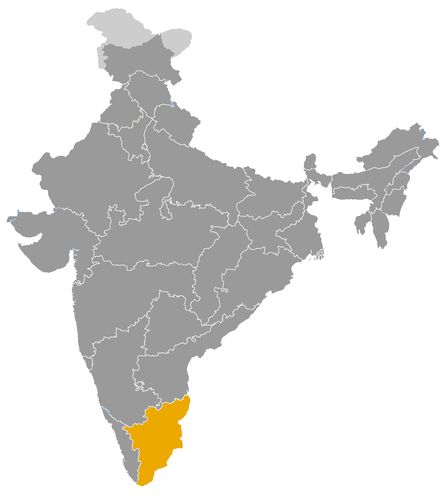
This map illustrates the maximum territory that the Nayak of Thanjavur Dynasty had reached at its height, covering the current regions of Tamil Nadu in India. Its main purpose is to provide a visual aid to understand the geographical extent of this dynasty. However, it's important to note that the contemporary borders of these regions may not necessarily coincide with the historical territories.
The Thanjavur Nayak Dynasty and Its Role in the History of South India
A Regional Power Shaped by the Vijayanagara Legacy
The Thanjavur Nayak dynasty occupied an important position in the history of South India during the sixteenth and seventeenth centuries. Its rise was closely connected with the political structure of the Vijayanagara Empire, which relied on regional governors known as Nayaks or Nayakas to administer strategic provinces. In Thanjavur, these governors gradually transformed delegated authority into a more autonomous regional kingship.
The dynasty ruled from the fertile Kaveri delta, in present day Tamil Nadu. This region had already been a major political and cultural centre under the Cholas, and the Nayaks inherited an environment rich in temples, agrarian institutions, literary traditions and commercial links. Their importance in Indian history lies not in the creation of a vast empire, but in their ability to maintain regional stability, adapt imperial traditions and support a remarkable cultural life during a period of political fragmentation.
Thanjavur as a Strategic Centre of Power
Thanjavur was one of the most valuable centres of southern India because of its agricultural wealth and symbolic prestige. The Kaveri delta produced abundant rice and supported dense networks of villages, temples and markets. Control over this region gave the Nayaks access to substantial revenue, allowing them to maintain a court, patronise religious institutions and finance military forces.
Politically, the Thanjavur Nayaks belonged to a wider group of post Vijayanagara powers, alongside the Nayaks of Madurai and Gingee. These states shared elements of administrative and military culture, but they also competed with one another for territory, prestige and influence. The Thanjavur kingdom therefore functioned as both a successor to Vijayanagara authority and an independent participant in the politics of the Tamil region.
Political Continuity in a Fragmented South India
The fall of Vijayanagara influence after the Battle of Talikota in 1565 did not immediately produce political disorder throughout South India. Instead, regional polities such as Thanjavur continued many of the empire’s institutions while adapting them to local conditions. The Nayaks preserved courtly rituals, systems of land revenue, military organisation and forms of temple patronage that were rooted in earlier imperial practice.
Their rule illustrates the resilience of regional kingship in India. Authority was not based solely on conquest. It also depended on negotiation with local chiefs, temple establishments, Brahman communities, merchants and military groups. The Thanjavur Nayaks governed through a layered political order in which the ruler’s legitimacy came from protection, donation, military capacity and ritual status.
Cultural Patronage and the Prestige of the Court
The cultural role of the Thanjavur Nayaks was one of their most significant contributions. Their court became a centre of literary, artistic and musical activity. The dynasty supported works in Tamil, Telugu and Sanskrit, reflecting both the local Tamil environment and the broader cultural world inherited from Vijayanagara, where Telugu speaking elites played an important role.
Raghunatha Nayak is especially associated with this cultural florescence. His reign is remembered for patronage of music, literature and performance traditions. Thanjavur’s later reputation as a major centre of South Indian classical music and dance cannot be attributed only to the Nayaks, but their court helped preserve and strengthen the artistic environment that later dynasties, especially the Marathas of Thanjavur, would continue to develop.
Temples as Religious, Social and Economic Institutions
The Nayaks maintained close links with temples, which were central to the social and economic life of South India. Temples were not only places of worship. They held land, employed priests, musicians, dancers, artisans and administrators, and organised festivals that involved large sections of society. Royal patronage of temples was therefore both a religious act and a political strategy.
By supporting temples, the Thanjavur Nayaks reinforced their authority over the local population and connected themselves with prestigious sacred landscapes. Their interventions did not replace the monumental legacy of the Cholas, but they contributed to the continuing vitality of temple based culture in the Kaveri delta. This patronage helped link royal power, religious legitimacy and regional identity.
An Economy Based on Agriculture, Revenue and Exchange
The economic strength of the dynasty rested mainly on the irrigated agriculture of the Kaveri delta. Rice production supported taxation, redistribution and temple endowments. The prosperity of the countryside allowed the court to maintain political institutions and fund cultural patronage.
The Thanjavur region also participated in wider commercial networks. Its proximity to the Coromandel Coast connected it to trade in textiles, agricultural products and artisanal goods. During the Nayak period, European maritime powers became increasingly active along the coast. Although the Thanjavur Nayaks were not primarily maritime rulers, their kingdom existed in an economic environment shaped by both inland agrarian wealth and coastal exchange.
A Dynasty Whose Influence Outlasted Its Rule
The Thanjavur Nayak dynasty ended in the seventeenth century, when Vijaya Raghava Nayak was defeated and the political order of the region changed. Yet its historical importance continued beyond the dynasty itself. The Nayaks helped preserve Thanjavur as a major centre of South Indian culture, religion and political authority during a period between imperial Vijayanagara and later Maratha rule.
Their role in Indian history is therefore best understood as that of regional stabilisers, cultural patrons and economic managers of a highly productive landscape. They did not dominate the whole subcontinent, but they shaped one of its most important cultural regions. Through their patronage of temples, arts and literature, and through their control of the Kaveri delta, the Nayaks of Thanjavur contributed to the long historical continuity of South Indian civilisation.
The Geographic Extent of the Thanjavur Nayak Dynasty in South India
A Regional Kingdom Anchored in the Kaveri Delta
The Thanjavur Nayak dynasty ruled a compact but highly significant territory in South India between the sixteenth and seventeenth centuries. Its power was centred on Thanjavur, in present day Tamil Nadu, and especially on the fertile delta of the Kaveri River. This region had long been one of the most productive and culturally important zones of the Tamil country. Under the Cholas, it had already acquired great political, religious and agricultural prestige, and the Nayaks inherited this deeply structured landscape.
The kingdom of Thanjavur was not a vast territorial empire. Its strength lay instead in the control of a dense agrarian region, rich in irrigation networks, temple institutions, market towns and cultivated villages. The Kaveri delta provided a solid economic foundation for the dynasty, enabling it to maintain a court, support religious establishments and participate in regional politics. The geographic importance of the dynasty must therefore be understood not by the size of its territory alone, but by the value and strategic position of the land it governed.
Thanjavur and the Transformation of Vijayanagara Authority
The Nayaks of Thanjavur emerged from the administrative structure of the Vijayanagara Empire. In the sixteenth century, Nayaks served as governors or military chiefs entrusted with the management of important provinces. Thanjavur was one of these southern centres, and its rulers initially operated within the wider authority of Vijayanagara.
As imperial control weakened, especially after the Battle of Talikota in 1565, several Nayak houses became increasingly autonomous. Thanjavur followed this pattern. The dynasty’s territory developed from a provincial command into a regional kingdom. This process explains why its borders were not always fixed in the modern sense. Authority depended on revenue rights, military control, temple patronage, local alliances and the loyalty of subordinate chiefs.
The geographic extent of the Thanjavur Nayaks was therefore both territorial and institutional. They controlled land, but they also governed through networks of temples, agrarian communities and military retainers. Their realm was part of the broader post Vijayanagara political order, in which several successor states competed for influence across the Tamil and Telugu regions.
The Kaveri Delta as the Core of Dynastic Power
The essential territory of the Thanjavur Nayaks was the Kaveri delta. This region included Thanjavur and surrounding districts, with important links to places such as Kumbakonam and other temple centred settlements. The delta’s fertile fields, supported by river branches and irrigation channels, produced abundant rice and sustained a dense rural population.
Control of this region gave the dynasty substantial fiscal power. Agricultural revenue was the principal basis of state income, while land grants and temple endowments helped integrate religious institutions into the political economy of the kingdom. In a region where water management was crucial, authority over irrigation, land rights and village administration was inseparable from political power.
The delta also gave the Thanjavur Nayaks a strong cultural identity. The area contained major temples, sacred sites and learned communities. By governing this landscape, the dynasty inherited not only agricultural wealth but also the prestige associated with one of the historic heartlands of Tamil civilisation.
Flexible Frontiers and Contested Zones
The outer limits of the Thanjavur Nayak kingdom were not always stable. At different times, the rulers exerted influence over neighbouring areas connected to the lower Kaveri region and, in some periods, zones near Tiruchirappalli or the approaches toward the interior. However, the dynasty’s authority was strongest in the delta and weaker in contested frontier areas.
This flexibility was typical of many South Indian polities of the period. Borders were often shaped by military pressure, succession disputes, tributary arrangements and the ambitions of local chiefs. Control over a district could shift according to the balance of power between Thanjavur, Madurai, Gingee and other regional authorities.
The Thanjavur Nayaks therefore governed a kingdom whose centre was relatively stable but whose margins were vulnerable. Their political strategy depended on defending the agrarian core while negotiating or fighting over frontier zones.
Relations with Madurai and Gingee Shaped by Geography
The geographic position of Thanjavur strongly influenced its relations with neighbouring Nayak states. To the south and southwest, the Nayaks of Madurai represented a major rival power. Madurai controlled a larger and militarily active kingdom in the southern Tamil region. The proximity between the two states created both diplomatic contact and recurrent tension.
To the north and northeast, the Nayaks of Gingee formed another important power within the post Vijayanagara world. Gingee’s position closer to northern Tamil regions and routes toward the Telugu country gave it a different strategic orientation. Thanjavur, located between these regional powers and the coast, had to preserve its autonomy through alliances, military preparedness and control over its productive core.
The final phase of the dynasty shows the importance of these regional rivalries. Vijaya Raghava Nayak, the last effective ruler of Thanjavur, was defeated in the context of intervention by the Nayaks of Madurai. This event underlines how the kingdom’s valuable but limited territory made it both resilient and exposed.
Connections with the Coromandel Coast and Maritime Trade
Although the Thanjavur Nayaks were primarily inland agrarian rulers, their territory was linked to the Coromandel Coast. The coastal zone of southeastern India was increasingly important during the sixteenth and seventeenth centuries because of trade in textiles, rice, horses, metals and other commodities. European merchants, including the Portuguese and later the Dutch and others, became active along this coastline.
Thanjavur’s position near these commercial circuits influenced its economy and diplomacy. The dynasty did not become a maritime empire, but its agrarian surplus and proximity to coastal markets connected it to wider commercial networks. This gave the kingdom economic opportunities while also exposing it to new political forces beyond the traditional framework of South Indian dynastic rivalry.
A Compact Territory with Lasting Regional Importance
The geographic extent of the Thanjavur Nayak dynasty was limited when compared with the great empires of Indian history, but its importance was considerable. The dynasty controlled one of the richest agricultural landscapes in South India, a region with exceptional religious, cultural and economic density. Its power rested on the Kaveri delta, where fertile land, temples, markets and local institutions formed a strong base of rule.
The dynasty’s territory shaped its historical role. It allowed the Nayaks to maintain a stable regional kingdom, support cultural and religious patronage, and participate in the politics of the post Vijayanagara world. At the same time, its location between Madurai, Gingee, local chiefs and coastal trading powers made Thanjavur vulnerable to external pressure.
The Nayaks of Thanjavur therefore illustrate a central feature of South Indian history: the ability of compact regional states to exercise influence beyond their territorial size when they controlled agriculturally rich and culturally prestigious zones.
The rulers of Thanjavur bore the title Nayak or Nayaka, often rendered as “king” in historiography. Regnal dates vary between sources, especially where co-rule, abdication, or gradual transfer of authority is involved.
- Sevappa Nayak (c. 1532–1560) • Founder of the Thanjavur Nayak kingdom, he first ruled within the framework of Vijayanagara authority before the local dynasty became more firmly established.
- Achyutappa Nayak (c. 1560–1600 or 1614) • He consolidated Thanjavur’s power and continued the political and religious traditions established by his predecessor.
- Raghunatha Nayak (c. 1600–1634) • His reign is generally associated with strong literary, artistic and musical patronage, as well as European commercial contacts.
- Vijaya Raghava Nayak (c. 1634–1673) • The last effective ruler of the Thanjavur Nayak line, he was overthrown during the intervention of the Nayaks of Madurai.
 Links to the main sections of the site