Français (France)
  Nederlands (nl-NL)
 Of Hindu tradition, (with additional Buddhist influence), the Lichchhavi dynasty ruled for approximately 300 years, ± between -600 and -300 over all or part of East India and North India, during the Ancient Period.
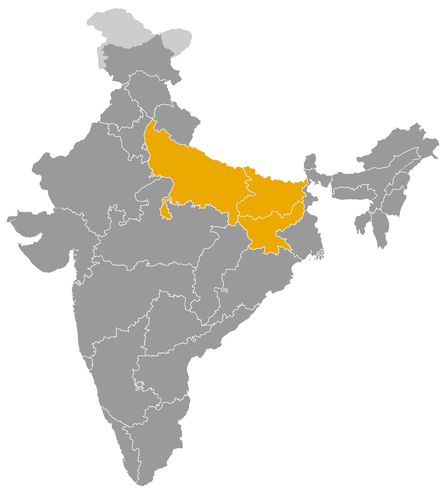
This map illustrates the maximum territory that the Lichchhavi Dynasty had reached at its height, covering the current regions of Bihar, Jharkand and Uttar Pradesh in India. Its main purpose is to provide a visual aid to understand the geographical extent of this dynasty. However, it's important to note that the contemporary borders of these regions may not necessarily coincide with the historical territories.
The Lichchhavis and Their Role in the Political and Cultural History of Ancient India
An aristocratic clan in the early history of the Gangetic plain
The Lichchhavis occupy an important place in the history of ancient India, not as a conventional royal dynasty with a continuous succession of monarchs, but as one of the best known aristocratic clans of the middle Gangetic region. Their principal centre was Vaishali, in present-day Bihar, a city closely associated with the Vajji or Vrijji confederacy. This area lay in a politically dynamic zone where several major powers, including Magadha, Kosala and other mahajanapadas, competed for influence.
The word dynasty must therefore be used with caution. The Lichchhavis were not ruled by a single hereditary king in the same manner as later Indian kingdoms. Ancient sources describe them as part of a republican or oligarchic political order, often called a gana sangha. In this system, power was exercised by a group of aristocratic rajas rather than by one sovereign ruler. Their historical significance lies precisely in this alternative model of government, which illustrates the diversity of political institutions in early India.
A political system based on collective aristocratic authority
The Lichchhavi political system was based on clan authority, assemblies and shared decision-making among the ruling elite. The rajas of the clan were not necessarily kings in the strict monarchical sense, but members of an aristocratic order who participated in government. This system gave the Lichchhavis a distinctive identity in a period when territorial monarchies were becoming stronger in northern India.
Their role within the Vajji confederacy was particularly important. The confederacy brought together several clans and political communities north of the Ganges, and the Lichchhavis appear to have been one of its leading components. This organization allowed them to pool military, diplomatic and economic resources while preserving a degree of internal autonomy.
The Lichchhavi model also demonstrates that early Indian state formation did not follow a single path. Alongside monarchies, there existed oligarchic republics where political authority depended on lineage, councils and collective deliberation. These institutions were not democratic in the modern sense, since power remained concentrated in aristocratic families, but they represented a significant contrast with the centralized monarchies that later dominated the region.
A regional counterweight to the expansion of Magadha
The political importance of the Lichchhavis is closely linked to their relationship with Magadha. During the sixth and fifth centuries BCE, Magadha emerged as one of the most powerful kingdoms of northern India. Its rulers sought to expand their influence across the Gangetic plain, and the Vajji confederacy, with the Lichchhavis as a major element, became a significant obstacle to that expansion.
Relations between the Lichchhavis and Magadha included both diplomacy and conflict. Marriage alliances connected ruling families across the region, but strategic rivalry remained strong. Control of the territories north of the Ganges was important for access to fertile lands, trade routes and river crossings. For Magadha, weakening the Vajji confederacy meant securing its northern frontier and strengthening its position in the wider Gangetic world.
The eventual decline of Lichchhavi autonomy marked a broader historical transition. It reflected the growing advantage of centralized monarchies over clan-based confederacies. Magadha’s success helped prepare the way for the later rise of larger imperial formations, including the Nanda and Maurya states. In this sense, the Lichchhavis stand at a crucial point in Indian political history, representing an older aristocratic order gradually absorbed by expanding territorial kingdoms.
Vaishali as a centre of religious and intellectual activity
The cultural impact of the Lichchhavis is inseparable from the importance of Vaishali. The city was one of the notable urban centres of early northern India and played a prominent role in Buddhist and Jain traditions. It is associated with several episodes in the life of the Buddha and with the early development of the Buddhist community. In Jain tradition, the region is also linked to the social and political background of Mahavira.
This religious significance gives the Lichchhavis a cultural role beyond their political institutions. Their territory formed part of an environment in which new religious movements, ascetic traditions and philosophical debates developed. The middle Gangetic region was a zone of intense intellectual change, where older ritual traditions coexisted with emerging teachings on renunciation, ethics and liberation.
The Lichchhavis were not known primarily as imperial patrons or monumental builders on the scale of later dynasties. Their cultural importance lies instead in the urban, social and institutional setting they helped sustain. Vaishali provided a context in which religious teachers, merchants, aristocrats and monastic communities interacted. This made the Lichchhavi sphere an important setting for the transformation of Indian religious life.
Economic foundations in agriculture, trade and urban growth
The economic role of the Lichchhavis was rooted in the fertile plains of northern Bihar. Their territory benefited from productive agricultural land, access to riverine networks and connections with overland routes. These conditions supported the growth of Vaishali as an urban centre and helped sustain the aristocratic institutions of the clan.
Agriculture provided the material foundation of local power, but trade and mobility also played a significant role. The movement of merchants, ascetics and political envoys through the Gangetic region created networks of exchange that linked Vaishali with other centres of northern India. The prosperity of the region helped the Lichchhavis maintain alliances, support collective institutions and resist external domination for a time.
Their economy should not be imagined as imperial or highly centralized. It was probably based on a combination of rural production, urban exchange, tribute, taxation and control of local routes. This economic base gave the Lichchhavis enough strength to become an influential regional power, even without a large territorial empire.
A lasting example of republican traditions in ancient India
The lasting significance of the Lichchhavis lies in their representation of a non-monarchical political tradition in ancient India. Their history shows that the subcontinent’s early political landscape included clans, councils, confederacies and aristocratic republics, not only kings and empires.
Their decline did not erase their memory. Vaishali remained associated with religious history, republican institutions and the political diversity of the early Gangetic world. The Lichchhavis therefore occupy a distinctive place in Indian history: they were not great conquerors, but they embodied an alternative form of power at a formative moment in the development of Indian states, economies and religious communities.
The Geographic Reach of the Lichchhavis in Ancient India
A territorial base centred on Vaishali in northern Bihar
The Lichchhavis of ancient India were based primarily around Vaishali, in the northern part of present day Bihar. Their political space belonged to the middle Gangetic plain, one of the most active regions of early Indian state formation. Unlike later Indian dynasties, the Lichchhavis did not rule a clearly bounded kingdom governed by a single hereditary monarch. Their power was rooted in a clan based aristocratic republic, or gana sangha, in which several rajas or aristocratic leaders shared authority.
For this reason, the geographic extent of Lichchhavi power must be understood as a sphere of control and influence rather than as a centralized territorial state. Vaishali was their principal urban centre and the core of their authority. Around it lay an agricultural hinterland that supplied the material foundations of their political institutions. This area was strategically placed north of the Ganges, between the fertile plains of Bihar, the routes leading toward Mithila and the lands approaching the Himalayan foothills.
The Lichchhavis within the Vajji confederacy
The Lichchhavis were one of the leading groups within the Vajji, or Vrijji, confederacy. This broader political formation included several clans and communities in the region north of the Ganges. The confederacy was not a unified kingdom in the strict sense, but a collective arrangement among allied groups that shared certain political, military and diplomatic interests.
The territory associated with the Vajji confederacy probably covered a significant part of northern Bihar. Its sphere of influence extended around Vaishali and toward neighbouring regions such as Mithila and Videha. The Lichchhavis were especially prominent within this framework, and their importance may have exceeded the size of the territory directly controlled by their own clan.
This confederal structure influenced the nature of Lichchhavi expansion. They did not expand mainly through imperial conquest or the annexation of distant provinces. Their power developed through clan alliances, shared institutions, aristocratic assemblies and control of key urban and rural zones. Their geographic reach was therefore flexible, depending on the strength of the Vajji alliance and the ability of its member groups to act together.
Vaishali as a political and economic centre
Vaishali was the central point of Lichchhavi power. Its location gave the clan access to fertile agricultural land, commercial routes and religious networks. The city stood in a region where urban growth, trade and political experimentation were closely connected. The northern Bihar plains were suitable for agriculture, while the Ganges and its associated routes linked the area to other centres of northern India.
The Lichchhavis benefited from this geographic position. Their control over Vaishali and its surrounding lands allowed them to participate in regional trade, collect resources and maintain an aristocratic political order. The city also had cultural and religious importance. It was associated with Buddhist and Jain traditions and became part of the wider sacred geography of the middle Gangetic plain.
The economic value of their territory strengthened their political autonomy. A clan republic could not survive only through prestige or lineage. It needed agricultural production, access to routes, military resources and diplomatic contacts. The geography of Vaishali provided these advantages and helped the Lichchhavis resist neighbouring powers for a time.
The Ganges as frontier and connection with Magadha
The Ganges played a central role in defining Lichchhavi relations with Magadha. The Lichchhavis and the Vajji confederacy were located north of the river, while Magadha developed as a powerful kingdom to the south. This geographic division made the river both a frontier and a link. It separated two political systems, but it also connected them through trade, diplomacy and military movement.
Magadha’s rulers saw the lands north of the Ganges as strategically important. Control over this region would give them access to fertile territory, river crossings and routes leading toward Mithila and the Himalayan foothills. For the Lichchhavis, maintaining autonomy north of the river was essential to preserving the Vajji confederacy and resisting Magadhan expansion.
Relations between the two sides were complex. They included marriage alliances, diplomatic contacts and military rivalry. The Lichchhavis were not isolated enemies of Magadha, but they represented a serious obstacle to its territorial ambitions. Their geographic position made them a northern counterweight to Magadha’s growing power in the middle Gangetic plain.
Relations with Videha, Mithila and neighbouring polities
The Lichchhavi sphere was closely connected with the regions of Videha and Mithila. These areas formed part of the same northern Gangetic environment and were linked through political traditions, clan relations and cultural exchange. The Vajji confederacy appears to have included or interacted with groups associated with this wider region.
These connections gave the Lichchhavis a broader diplomatic horizon. They were not confined to Vaishali alone. Through alliances and confederal ties, they participated in a network of aristocratic communities and early states. This network helped them maintain influence beyond their immediate urban centre.
To the west and southwest, other mahajanapadas such as Kosala and Magadha shaped the political environment. The Lichchhavis had to navigate between cooperation and competition with these powers. Their position in northern Bihar made them part of the same world of regional diplomacy that connected royal courts, aristocratic clans, merchants and religious communities.
The limits of Lichchhavi territorial expansion
The geographic reach of the Lichchhavis was significant but not imperial. They did not control a vast empire, nor did they leave evidence of a large administrative structure spread over distant provinces. Their strength lay in a compact but strategically valuable territory around Vaishali, enlarged politically by participation in the Vajji confederacy.
This limited but resilient territorial base explains their historical role. They were strong enough to delay or complicate Magadha’s expansion, but not strong enough to prevent the eventual dominance of centralized monarchy in the region. The decline of Lichchhavi autonomy formed part of a wider transformation in northern India, as clan republics and confederacies gradually lost ground to territorial kingdoms.
A regional power with long historical significance
The Lichchhavis controlled a relatively modest area compared with later Indian empires, but their location gave them importance out of proportion to their size. Their authority over Vaishali and their role in the Vajji confederacy placed them at the centre of political, economic and religious developments in the middle Gangetic plain.
Their geographic position shaped their relations with neighbouring powers. It made them allies of some regional groups, rivals of Magadha and participants in the wider world of the mahajanapadas. The Lichchhavis therefore represent a form of regional power whose influence depended less on conquest than on strategic location, confederal organization and control of one of the most important urban centres of ancient northern India.
The Lichchhavis of ancient India, centred on Vaishali, did not form a continuous monarchy comparable to later Indian kingdoms. The sources describe them rather as an aristocratic republic or gana sangha, ruled by numerous rajas of the clan, of whom very few individual names are preserved. The dates are therefore indicative and may vary according to Buddhist, Jain and historical reconstructions.
- Assembly of the Lichchhavi rajas of Vaishali (c. 6th to 5th century BCE) • Collective authority of the Lichchhavi clan within the Vajji confederacy. It exercised power through an aristocratic council rather than through a single hereditary monarchy.
- Chetaka of Vaishali (c. late 6th to early 5th century BCE) • Raja or leading chief of the Lichchhavis, known mainly from Jain traditions. He is associated with Vaishali, the family of Mahavira and marriage alliances with several states of northern India.
 Links to the main sections of the site