Français (France)
  Nederlands (nl-NL)
 Of Hindu tradition, (with additional Jain influence), the Jhala dynasty ruled for approximately 858 years, ± between 1090 and 1948 over all or part of North India and West India, during the Classical Period, the Medieval Period and the Colonial Period.
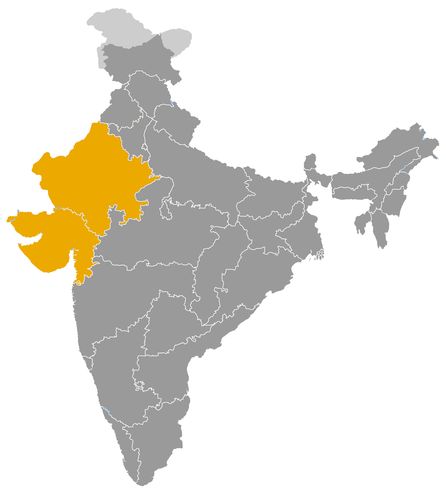
This map illustrates the maximum territory that the Jhala Dynasty had reached at its height, covering the current regions of Gujarat and Rajasthan in India. Its main purpose is to provide a visual aid to understand the geographical extent of this dynasty. However, it's important to note that the contemporary borders of these regions may not necessarily coincide with the historical territories.
The Jhala Dynasty and the Regional Rajput Powers of Western India
A Rajput house rooted in Gujarat and Saurashtra
The Jhala dynasty was a Rajput ruling house associated mainly with Gujarat, Saurashtra and Kathiawar in western India. It did not create a large empire comparable to the Mughals, the Marathas or the major Rajput states of Rajasthan, but it maintained a durable regional presence through several princely centres. Its history is linked especially to Patdi, Kuwa, Halvad and Dhrangadhra, as well as to related branches in Wankaner, Wadhwan, Limbdi, Lakhtar, Sayla and Jhalawar.
The Jhalas are often connected in genealogical traditions with the Makwana Rajputs. As with many Rajput lineages, their early history combines dynastic memory, heroic tradition and more firmly documented political developments from the medieval and later periods. Their importance in Indian history lies not in imperial conquest, but in the persistence of regional authority in a politically fragmented zone between Gujarat, Rajasthan, Saurashtra and the western trade routes.
Political continuity through adaptation and relocation
The political history of the Jhalas was shaped by adaptation. Their ruling centres shifted over time from Patdi to Kuwa, then to Halvad and later Dhrangadhra. These moves reflected changing military pressures, regional conflicts and the need to preserve dynastic authority in a contested landscape.
In western India, power was rarely stable for long periods. Rajput houses, local chiefs, the Gujarat Sultanate, Mughal authorities, Maratha interests and later British political agencies all influenced the region. The Jhalas survived by negotiating with these powers, defending fortified centres, accepting suzerainty when necessary and preserving local legitimacy through lineage and territorial control.
Their political role was therefore characteristic of many medium sized Rajput houses. They were not dominant enough to impose authority over all of Gujarat, but they were strong enough to maintain princely status and dynastic continuity for centuries. This endurance is one of the most significant aspects of their history.
Relations with neighbouring dynasties and larger powers
The location of the Jhala territories placed them in contact with several neighbouring powers. In the medieval period, the rise of the Gujarat Sultanate created pressure on local Rajput houses. Some Jhala centres were affected by warfare, displacement or forced accommodation. The move toward Halvad and later Dhrangadhra can be understood partly in relation to these changing political conditions.
Under the Mughals, western India became part of a broader imperial framework. The Jhalas, like other regional elites, had to adjust to Mughal authority while maintaining their local standing. Later, the decline of Mughal power and the rise of Maratha influence changed the balance again. Tribute, alliance, conflict and negotiation became central to survival.
In the British period, several Jhala states were incorporated into the princely order of western India. Dhrangadhra became one of the most visible Jhala principalities. British paramountcy stabilised borders and succession practices to some extent, but it also reduced real sovereignty. The rulers retained internal authority and ceremonial status, while external relations and strategic questions were controlled by the colonial system.
Cultural patronage in a regional princely setting
The cultural impact of the Jhalas was regional rather than pan Indian. Their courts supported temples, palaces, fortified residences, public buildings and traditions of dynastic memory. In centres such as Halvad and Dhrangadhra, architecture served to express lineage continuity, royal legitimacy and Rajput identity.
Jhala culture belonged to the wider Rajput world, with emphasis on descent, honour, martial prestige, religious patronage and protection of territory. At the same time, the dynasty ruled in Gujarat and Saurashtra, regions marked by commercial networks, Jain communities, Hindu devotional traditions and contact with coastal trade. This environment gave Jhala political culture a western Indian character, different from that of the larger desert kingdoms of Rajasthan.
The dynasty’s religious identity was mainly Hindu, but its courts operated in socially diverse surroundings. Patronage of temples and local cults helped reinforce ties between ruler, territory and community. In the colonial period, some Jhala rulers also participated in administrative, educational and urban reforms, reflecting the gradual transformation of princely states under British influence.
Economic foundations in land, routes and local administration
The economy of the Jhala states rested on land revenue, local taxation, pastoral resources, trade routes and the administration of princely towns. Gujarat and Saurashtra included semi arid zones where control of water, grazing land and agricultural production was essential. The ability to manage these resources shaped the stability of Jhala rule.
The Jhala states were not among the richest or largest powers of India, but their territories were connected to the regional economy of western India. Trade routes linking Gujarat, Kathiawar, Rajasthan and coastal zones gave political value to even relatively small principalities. Control of towns, customs, village revenues and local markets allowed these states to sustain courts, armies and administrative structures.
Economic power was therefore closely tied to geography. The Jhalas controlled territories that were modest in size but strategically placed within a wider network of inland and coastal exchange.
A distinctive place among Rajput lineages
The Jhalas occupy a secondary but meaningful place within the history of the Rajputs. They do not have the same broad historical visibility as the Sisodias of Mewar, the Rathores of Marwar, the Kachwahas of Jaipur or the Chauhans of Ajmer and Ranthambore. Yet they are important for understanding the diversity of Rajput power in western India.
Their history shows that Rajput authority was not limited to large kingdoms and famous heroic centres. It also existed through smaller princely houses that governed specific regions over long periods. The Jhalas represent this durable local aristocracy, rooted in lineage, fortification, landholding and negotiated sovereignty.
A long lasting regional legacy
The Jhala dynasty’s legacy is visible in the former princely centres of Dhrangadhra, Halvad, Wankaner, Wadhwan, Limbdi and related territories. Their rule shaped parts of Gujarat, Saurashtra and Kathiawar through political continuity, architectural patronage and integration into the princely order of western India.
In the wider history of India, the Jhalas illustrate the importance of regional Rajput houses that survived between stronger powers. Their role was not imperial, but it was historically significant: they maintained local authority, adapted to successive political systems and preserved a distinct Rajput identity within the complex landscape of western India.
The Geographical Expansion of the Jhala Dynasty in Western India
A regional Rajput lineage centred on Gujarat and Saurashtra
The Jhala dynasty was a Rajput ruling lineage whose geographical influence was concentrated mainly in western India, especially in Gujarat, Saurashtra and Kathiawar. Unlike larger imperial dynasties, the Jhalas did not build a single continuous kingdom extending across wide parts of the subcontinent. Their territorial history was instead shaped by successive centres of power, related princely branches and adaptation to changing regional conditions.
The main line is commonly associated with Patdi, Kuwa, Halvad and later Dhrangadhra. Other Jhala branches ruled or held authority in Wankaner, Wadhwan, Limbdi, Lakhtar and Sayla, while Jhalawar in Rajasthan represented a later extension of Jhala prestige beyond Gujarat. This pattern shows that Jhala expansion was not a simple military conquest from one capital, but the gradual formation of a network of related Rajput principalities.
Patdi and the early base in northern Gujarat
The earliest political traditions of the Jhalas are linked to Patdi, in northern Gujarat. This region occupied a strategic position between the plains of Gujarat, the approaches to Saurashtra, the margins of the Rann of Kutch and routes leading toward Rajasthan. Such a location gave the early Jhala chiefs access to agrarian settlements, pastoral zones and regional routes.
Control in this environment depended less on vast territorial size than on the ability to hold fortified places, protect local communities, collect revenue and negotiate with neighbouring chiefs. Patdi therefore represented both a geographical base and a dynastic point of origin. It anchored the Jhalas in a region where political authority was fragmented among Rajput houses, local lineages and larger regional powers.
Kuwa, Halvad and the movement of dynastic centres
As regional pressures changed, the Jhala centre of power shifted from Patdi to Kuwa and then to Halvad. These relocations were not accidental. They reflected the need to respond to warfare, political pressure and the rise of stronger powers in Gujarat. The move toward Halvad placed the dynasty in a more secure and strategically useful position within Saurashtra.
Halvad became an important centre for the Jhala house. It allowed the rulers to participate more directly in the politics of Kathiawar and to maintain influence across a region where many small and medium sized states coexisted. The Jhala territories were never an entirely unified block, but rather a combination of fortified towns, rural districts and zones of negotiated authority.
The later prominence of Dhrangadhra marked another phase in this territorial history. Dhrangadhra became one of the most visible Jhala princely states, particularly in the colonial period. Its position gave the dynasty a durable political identity within the princely map of western India.
Jhala branches across Kathiawar and Saurashtra
The geographical expansion of the Jhalas was strongly linked to branching. Several related houses established themselves in different parts of Kathiawar and Saurashtra. Wankaner, Wadhwan, Limbdi, Lakhtar and Sayla became associated with Jhala rule or Jhala princely authority. These states were often modest in size, but they formed part of a larger Rajput political world.
Kathiawar was a highly fragmented region, with many princely houses, merchant communities, pastoral groups and local chiefs. In such a landscape, territorial control was rarely absolute. Authority depended on alliances, marriage ties, military strength, recognition by superior powers and the ability to manage local revenues.
This fragmentation limited the growth of a large Jhala state, but it also helped the lineage survive. When one branch faced pressure, others could continue to rule. The dynasty’s geographical influence therefore endured through dispersion rather than centralisation.
Relations with the Gujarat Sultanate and neighbouring powers
The position of the Jhala territories brought them into contact with the Gujarat Sultanate, one of the major regional powers of western India. As the sultanate expanded, local Rajput houses faced military pressure, political subordination or displacement. Jhala history includes episodes of resistance, movement of capitals and adjustment to changing power structures.
Their relations with neighbouring dynasties were shaped by geography. In northern Gujarat, they had to deal with inland routes and rival Rajput groups. In Saurashtra and Kathiawar, they interacted with other princely houses, coastal powers and commercial networks. Their location between Gujarat, Rajasthan and the western seaboard made diplomacy essential.
Under Mughal and later Maratha influence, the Jhala states had to accept new hierarchies while preserving local authority. They could not dominate the region, but they remained useful and resilient regional actors.
Dhrangadhra and the colonial princely order
During the British period, the Jhala states were incorporated into the wider system of princely India. Dhrangadhra became the most prominent Jhala state in this context. Like other princely states, it retained internal rulers, titles, courts and local administration, while its external relations and strategic decisions were controlled by British paramountcy.
This period brought a more formal definition of territorial boundaries. Earlier forms of fluid influence, tributary relations and local authority were increasingly mapped and classified by colonial administration. For the Jhalas, this stabilised some princely territories but reduced effective sovereignty.
Other Jhala states and branches continued within the same political order. Their rulers maintained ceremonial authority and local prestige, even though they no longer acted as fully independent sovereigns. The colonial period therefore preserved Jhala identity while transforming its political meaning.
Jhalawar as a later extension into Rajasthan
Jhalawar in Rajasthan represents a distinct later extension of Jhala influence outside the core Gujarat and Saurashtra zone. It emerged in the princely politics of Rajasthan and reflected the broader mobility of Rajput elites. Although geographically separate from the main Jhala centres, it helped extend the name and prestige of the lineage beyond western Gujarat.
This connection also shows how Rajput lineages could operate across regional boundaries. Clan identity, military service and princely recognition could create new centres of power far from the original homeland.
A regional territorial legacy in western India
The geographical history of the Jhala dynasty was regional, dispersed and adaptive. Its main centres lay in Patdi, Kuwa, Halvad and Dhrangadhra, with related branches across Kathiawar, Saurashtra and parts of Rajasthan. The Jhalas did not create a large unified empire, but they maintained a long lasting network of princely territories.
Their territorial position shaped their relations with the Gujarat Sultanate, Mughal authorities, Maratha powers, neighbouring Rajput houses and the British. Their legacy remains visible in the former princely centres of Gujarat and Saurashtra, where Jhala rule contributed to the political mosaic of western India.
The Jhalas were a Rajput clan of Gujarat and Saurashtra, with several princely branches. This list mainly follows the senior line of Patdi, Kuwa, Halvad and later Dhrangadhra; other Jhala branches ruled especially in Wankaner, Wadhwan, Limbdi, Lakhtar and Sayla. The early dates are indicative, and the rulers’ titles varied between rana, Raj Sahib, Maharana Raj Sahib and, in the late colonial period, maharaja.
- Harapal Devji (c. 1090–1130) • Traditional founder of Jhala rule at Patdi, he established the political base of the lineage in northern Gujarat.
- Sodhaji (c. 1130–1160) • He succeeded Harapal Devji and maintained family authority in early Jhalawad.
- Durjansalji (c. 1160–1185) • His reign belongs to the early and partly traditional phase of the Jhala lineage.
- Malakdevji (c. 1185–1210) • He continued dynastic continuity in the Patdi region.
- Arjansinhji (c. 1210–1240) • He is associated with the consolidation of the Jhala house before the rise of its medieval branches.
- Deorajji (c. 1240–1265) • He maintained the lineage’s authority in a poorly documented regional context.
- Dudaji (c. 1265–1280) • His short reign belongs to the continuity of the early Jhala chiefs.
- Sursinhji (c. 1280–1305) • He ruled before the clearer structuring of the Patdi and Kuwa lines.
- Santalji (c. 1305–1325) • He preceded a better documented phase of succession around Patdi.
- Vajepalji (1325–1326) • Rana of Patdi, he ruled very briefly before the succession of Meghpalji.
- Meghpalji (1326–1331) • Rana of Patdi, he continued the line during a phase of family transition.
- Padamsinhji (1331–1340) • Rana of Patdi, he is associated with dynastic continuity supported by local alliances.
- Umedsingji (1340–1352) • Rana of Patdi, he transmitted power to the branch that subsequently dominated the lineage.
- Vegadji (1352–1368) • Rana of Patdi, he strengthened the family succession and the Jhala position in northern Gujarat.
- Ramsinhji (1368–1385) • Rana of Patdi, he ruled during a phase of regional assertion by the house.
- Virsinhji (1385–1392) • His short reign belongs to the period preceding major conflicts with the Gujarat Sultanate.
- Ranmalsinhji (1392–1408) • Rana of Patdi, he passed authority to Satarsalji amid growing tensions.
- Satarsalji (1408–1420) • Rana of Patdi, he resisted the authority of the Gujarat Sultanate and marked a martial phase of the dynasty.
- Jetsinhji (1420–1441) • Rana of Kuwa, he abandoned Patdi and established a safer new centre under pressure from Gujarat.
- Wanwirji (1441–1460) • Rana of Kuwa, he maintained the line in a context of regional rivalries.
- Bhimdevsinhji (1460–1469) • Rana of Kuwa, he preceded the military crisis that deeply affected the capital.
- Waghoji (1469–1487) • Rana of Kuwa, he fought the forces of the Gujarat Sultanate and died during the fall of Kuwa.
- Rajodharji (1487–1500) • Rana Raj Sahib of Halvad, also known as Raydharji, he founded Halvad as the new centre of the lineage.
- Ranoji (1500–1523) • Rana Raj Sahib of Halvad, he secured the succession in the new Jhala capital.
- Mansinhji I (1523–1564) • Rana Raj Sahib of Halvad, he faced pressure from the Gujarat Sultanate and was later restored to authority.
- Raisinhji (1564–1584) • Rana Raj Sahib of Halvad, he ruled amid Rajput alliances and conflicts with neighbouring powers.
- Chandrasinhji (1584–1628) • Maharana Raj Sahib of Halvad, he consolidated the state and dealt with Mughal authority under Jahangir.
- Askaranji (1628–1634) • Maharana Raj Sahib of Halvad, he ruled during an internal succession crisis.
- Amarsinhji (1634–1645) • Maharana Raj Sahib of Halvad, he restored the continuity of the main branch.
- Meghrajji II (1645–1661) • Maharana Raj Sahib of Halvad, he maintained the lineage in an unstable political environment.
- Gajsinhji I (1661–1672) • Maharana Raj Sahib of Halvad, his reign preceded an interruption linked to Mughal intervention in Gujarat.
- Jaswantsinhji I (1683–1717) • Raj Sahib of Dhrangadhra-Halvad, he recovered Halvad after a period of external domination.
- Pratapsinhji (1717–1729) • Raj Sahib, he maintained the principality during a period of regional political realignment.
- Raisinhji Pratapsinhji (1729–1744) • Raj Sahib, he ruled before the definitive shift of the political centre to Dhrangadhra.
- Gajsinhji II (1744–1782) • Raj Sahib, he continued the consolidation of the house in Kathiawar.
- Jaswantsinhji II (1782–1801) • Raj Sahib of Dhrangadhra, he belongs to the better documented princely phase of the state.
- Raisinhji III (1801–1804) • Raj Sahib of Dhrangadhra, he ruled briefly at the beginning of the nineteenth century.
- Amarsinhji II (1804–1843) • Raj Sahib of Dhrangadhra, he governed during the region’s growing integration into the colonial order.
- Ranmalji (1843–1869) • Raj Sahib of Dhrangadhra, he received increased British recognition and strengthened the state’s princely status.
- Mansinhji II (1869–1900) • Raj Sahib of Dhrangadhra, he developed education, institutions and some public works in the principality.
- Ajitsinhji (1900–1911) • Raj Sahib of Dhrangadhra, he continued administrative and urban reforms in the state.
- Ghanshyamsinhji (1911–1942) • Maharana and later maharaja, he took part in the princely institutions of British India and supported Dhrangadhra’s development.
- Mayurdhwajsinhji Meghrajji III (1942–1948 as effective ruler) • The last effective ruler of Dhrangadhra, he participated in the state’s integration into Saurashtra and then independent India.
 Links to the main sections of the site