Français (France)
  Nederlands (nl-NL)
 Of Hindu tradition, (with additional Jain influence), the Jadeja of Nawanagar dynasty ruled for approximately 408 years, ± between 1540 and 1948 over all or part of West India, during the Medieval Period, the Colonial Period and the Modern Period.
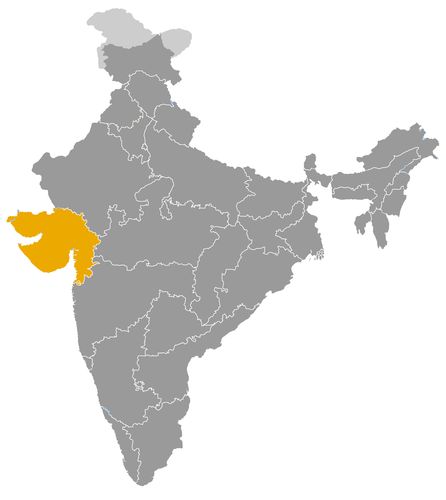
This map illustrates the maximum territory that the Jadeja of Nawanagar Dynasty had reached at its height, covering the current regions of Gujarat in India. Its main purpose is to provide a visual aid to understand the geographical extent of this dynasty. However, it's important to note that the contemporary borders of these regions may not necessarily coincide with the historical territories.
The Jadeja Dynasty of Nawanagar and Its Role in the History of Western India
A Jadeja branch established in Kathiawar
The Jadeja dynasty of Nawanagar was one of the most important regional ruling houses of western India. It belonged to the wider Jadeja Rajput lineage, but it developed as a distinct political branch in Kathiawar, the peninsula now generally known as Saurashtra in Gujarat. The state was founded in the sixteenth century by Jam Rawal, who came from the Jadeja world of Kutch and established Nawanagar in 1540.
Nawanagar, later known as Jamnagar, became the centre of this dynasty’s political identity. The rulers bore the title Jam Sahib, later Maharaja Jam Sahib in the princely period. Their role in Indian history was not imperial, but regional and long lasting. They helped shape the political geography of western Gujarat, participated in the complex diplomacy of Kathiawar and developed a courtly and urban culture around Jamnagar.
Political authority in a fragmented peninsula
Kathiawar was a politically divided region, composed of numerous states, clans and princely houses. In this environment, the Jadejas of Nawanagar had to build their authority through warfare, negotiation, marriage alliances and control of strategic territory. Their state was one of the larger and more influential powers of the peninsula, but it existed among many neighbouring dynasties and local rulers.
Jam Rawal’s foundation of Nawanagar created a new Jadeja centre outside Kutch. His successors consolidated the state in the northwestern part of Kathiawar and made it a recognised regional power. The dynasty had to maintain relations with other Rajput and regional houses, including Jhala, Gohil, Chudasama and other local lineages. Rivalry over forts, villages, routes, grazing rights and fiscal revenues formed part of the political life of the region.
The Jadejas of Nawanagar also faced pressure from larger powers. The Gujarat Sultanate, the Mughal Empire, the Marathas and later the British each influenced the political conditions of western India. Mughal intervention temporarily interrupted effective Jadeja rule in the seventeenth century, but the dynasty later restored its authority. Under British paramountcy, Nawanagar became a princely state with internal autonomy but restricted external sovereignty.
Jamnagar as a dynastic and urban centre
The cultural role of the dynasty is closely linked with the development of Nawanagar, later Jamnagar. The city functioned as the administrative, ceremonial and symbolic centre of the state. Royal authority was expressed through palaces, temples, gates, markets, water structures and urban planning.
Jamnagar’s development reflected the wider pattern of princely urbanism in western India. The city was not only a seat of government, but also a place where courtly culture, religious patronage, merchant activity and craft traditions interacted. The Jadeja rulers supported Hindu religious institutions, while the urban environment also included Jain and Muslim communities active in trade and local society.
The dynasty’s cultural identity was therefore both Rajput and regional. It drew on martial genealogy, Hindu kingship, court ceremonies and architectural patronage, but it also reflected the commercial and plural character of Gujarat. Jamnagar became one of the important urban centres of Saurashtra through this combination of political power and local economic activity.
Economic foundations in land, trade and coastal access
The economy of Nawanagar rested on agricultural revenue, local taxation, trade routes, grazing lands and access to the Arabian Sea. The state controlled part of northwestern Kathiawar, a region connected to inland markets and coastal exchange. Its rulers depended on the productivity of villages, the movement of goods and the cooperation of merchant communities.
The coastal position of the state gave Nawanagar a commercial dimension. It was not as strongly defined by maritime trade as Kutch, but it belonged to the wider economic world of western India, where routes linked Gujarat, Kutch, Sindh, Bombay and the Arabian Sea. Customs duties, market revenues and commercial circulation helped sustain the state.
Water management was also important in a region exposed to climatic variability. Tanks, lakes, wells and other local works contributed to agricultural stability and urban life. Public works under several rulers reflected the practical needs of administration as well as the prestige of princely rule.
Adaptation to Mughal, Maratha and British power
The political survival of the Jadejas of Nawanagar depended on adaptation. In the Mughal period, they faced imperial pressure but retained or recovered their regional base. In the Maratha period, the political environment of Gujarat became more complex, with fiscal demands and shifting alliances affecting many states of Kathiawar.
British paramountcy changed the role of the dynasty more profoundly. Warfare and territorial expansion became less central, while administration, infrastructure, education, health services and ceremonial status gained importance. The Jam Sahibs retained local authority but operated within a colonial framework that limited their independent diplomacy and military action.
In the late nineteenth and early twentieth centuries, Nawanagar participated in the broader modernization of princely India. Jam Ranjitsinhji became internationally known as a cricketer, but his reign also belongs to the history of princely modernization and urban development. His successor Jam Digvijaysinhji governed during the final phase of princely rule and the transition to independent India.
A durable legacy in Saurashtra
The Jadeja dynasty of Nawanagar did not dominate India as a whole, but it played a significant role in the history of western India. It created a lasting state in Kathiawar, contributed to the development of Jamnagar and participated in the regional balance of power among Rajput, Mughal, Maratha and British authorities.
Its impact was political through the formation of a durable princely state, cultural through urban and religious patronage, and economic through the management of land revenue, trade, markets and coastal connections. The dynasty’s legacy remains closely associated with Jamnagar and with the historical identity of Saurashtra in Gujarat.
The Geographical Extent of the Jadeja Dynasty of Nawanagar in Kathiawar
A Jadeja state established in northwestern Saurashtra
The Jadeja dynasty of Nawanagar developed its territorial power in Kathiawar, the peninsula now known as Saurashtra in the Indian state of Gujarat. It was a distinct branch of the wider Jadeja lineage, separate from the Jadejas of Kutch but closely linked to them by origin and dynastic memory. The state was founded in 1540 by Jam Rawal, who left Kutch and established a new political centre in Kathiawar.
Nawanagar, later called Jamnagar, became the capital and territorial core of this Jadeja state. The dynasty did not control a large empire, but it ruled a durable regional kingdom in northwestern Kathiawar. Its power rested on control of agricultural districts, fortified settlements, trade routes, coastal access and relations with local chiefs. In a peninsula divided among many ruling houses, this position gave Nawanagar considerable strategic importance.
Jamnagar as the centre of territorial authority
The main area controlled by the Jadejas of Nawanagar lay around Jamnagar and its surrounding districts. This region gave the Jam Sahibs a stable administrative and military base. From the capital, they governed villages, markets, revenue lands, grazing areas and routes connecting the interior of Kathiawar with the coast.
The territory of Nawanagar was not static throughout its history. Like many states of western India, its borders were shaped by war, alliance, succession disputes, treaties and negotiations with neighbouring rulers. Its core, however, remained concentrated in the northwestern part of Saurashtra. This position gave the state access to inland agrarian resources and to maritime connections through the coast.
Jamnagar’s role as capital was therefore central to territorial cohesion. It was the place where royal authority was displayed, taxes were organised, military resources were gathered and relations with neighbouring states were managed. The city’s development reflected the consolidation of Jadeja rule in a region where authority depended on both dynastic legitimacy and practical control of land and routes.
Coastal access and the western Indian trade zone
The geographical position of Nawanagar gave the dynasty access to the Arabian Sea. Although the state was not as strongly maritime in identity as Kutch with Mandvi, its coastal location connected it to the commercial world of western India. Trade routes linked Nawanagar with Kutch, mainland Gujarat, Bombay, Sindh and ports across the Arabian Sea.
This coastal access influenced the economic and political life of the state. Maritime trade, customs duties, market revenues and the circulation of merchants strengthened the resources available to the Jam Sahibs. Control of routes between the interior and the coast also increased the strategic value of the kingdom.
The sea gave Nawanagar an outward looking dimension. It allowed the state to participate in regional commerce and maintain connections beyond the immediate borders of Kathiawar. At the same time, coastal access required diplomacy with other powers interested in trade, ports and maritime security.
Relations with Kutch and other Jadeja branches
The connection with Kutch was fundamental to the geographical history of Nawanagar. Jam Rawal’s foundation of the state followed his departure from Kutch, so the new kingdom was both a continuation of Jadeja identity and a separate territorial project. This relationship created a complex balance between shared lineage and political autonomy.
The Jadejas of Nawanagar were not subordinate to the Jadejas of Kutch. They formed their own ruling house with their own capital, territory and political interests. However, dynastic kinship remained important for prestige, marriage alliances and regional identity. At the same time, related houses could also become rivals, especially when questions of rank, inheritance or territorial influence were involved.
Other Jadeja branches in Kathiawar, including Rajkot, Gondal and Morbi, added to this network of related but distinct states. The geographical expansion of the Jadejas therefore took the form of branching houses rather than a unified dynastic empire.
Neighbouring dynasties in a fragmented Kathiawar
Kathiawar was a highly fragmented political region. The Jadejas of Nawanagar shared the peninsula with many other ruling houses, including Jhala, Gohil, Chudasama and other Rajput or regional dynasties. This environment deeply influenced the limits of Nawanagar’s expansion.
Territorial growth depended not only on conquest but also on marriage alliances, negotiated settlements, recognition of rights, control of forts and agreements over revenue. Relations with neighbours could shift between rivalry and cooperation. Conflicts over villages, grazing lands, ports and taxes were common in such a divided region, but no state could ignore the need for diplomacy.
The position of Nawanagar in northwestern Kathiawar made it one of the stronger regional powers, but it did not allow it to absorb the whole peninsula. Its authority remained significant yet regional, defined by the balance of power among many states.
Mughal, Maratha and British influence on territorial limits
Larger powers also shaped the geography of Nawanagar. The Mughal Empire expanded into Gujarat and affected the politics of Kathiawar. In the seventeenth century, Mughal intervention temporarily interrupted effective Jadeja rule, showing that Nawanagar’s autonomy could be challenged by imperial power.
Later, the Marathas became influential in Gujarat and Kathiawar, especially through fiscal claims and political pressure. The Jam Sahibs had to preserve their territory within a changing regional order. Their relations with neighbouring states were therefore affected not only by local rivalries but also by wider Maratha influence.
Under British paramountcy, Nawanagar became a princely state. Its borders were more clearly fixed, and warfare with neighbouring dynasties was restricted. Territorial expansion became less important than administration, infrastructure, revenue management and formal princely status.
A regional territory with durable influence
The geographical extent of the Jadeja dynasty of Nawanagar remained centred on Jamnagar and northwestern Kathiawar. Its influence reached Kutch, mainland Gujarat and the Arabian Sea through dynastic ties, trade routes and political relations.
This geography shaped the dynasty’s history. Kutch provided the lineage background, Kathiawar supplied the territorial base, the coast opened commercial networks, and neighbouring dynasties required constant diplomacy. The Jadejas of Nawanagar did not build an empire, but they created one of the most durable regional states of western India and helped shape the political map of Saurashtra until the integration of princely states into independent India.
The Jadeja rulers of Nawanagar mainly bore the title Jam or Jam Sahib, later Maharaja Jam Sahib in the princely period. Nawanagar was founded in 1540 by Jam Rawal in Kathiawar, after his departure from Kutch. The early dates may vary according to dynastic traditions; Mughal occupation interrupted effective Jadeja rule between 1664 and 1673.
- Jam Rawalji Lakhaji (1540–1562) • Founder of Nawanagar, he established the new capital and laid the foundations of Jadeja power in Kathiawar.
- Jam Vibhaji Rawalji (1562–1569) • Jam Sahib of Nawanagar, he succeeded Rawalji and maintained the authority of the young principality.
- Jam Sataji Vibhaji (1569–1608) • Jam Sahib of Nawanagar, he strengthened the state and resisted Mughal expansion in western Gujarat.
- Jam Jasaji Sataji (1608–1624) • Jam Sahib of Nawanagar, he ruled in a context of complex relations with the Mughals.
- Jam Lakhaji I Ajaji (1624–1645) • Jam Sahib of Nawanagar, he restored dynastic continuity after the succession tensions of the early seventeenth century.
- Jam Ranmalji Lakhaji (1645–1661) • Jam Sahib of Nawanagar, he ruled during a phase of continuity before the Mughal crisis.
- Jam Raisinhji I Lakhaji (1661–1664) • Jam Sahib of Nawanagar, his reign preceded the Mughal occupation of the state.
- Jam Tamachi Raisinhji (1673–1690) • Jam Sahib of Nawanagar, he restored Jadeja power after the Mughal interruption.
- Jam Lakhaji II Tamachi (1690–1708) • Jam Sahib of Nawanagar, he consolidated the state after the restoration of dynastic authority.
- Jam Raisinhji II Lakhaji (1708–1711) • Jam Sahib of Nawanagar, he ruled briefly at the beginning of the eighteenth century.
- Jam Tamachi II Raisinhji (1711–1743) • Jam Sahib of Nawanagar, he maintained the kingdom’s continuity in a politically fragmented Kathiawar.
- Jam Lakhaji III Tamachi (1743–1767) • Jam Sahib of Nawanagar, he governed during a period of regional reorganisation and external pressure.
- Jam Jasaji Lakhaji (1767–1814) • Jam Sahib of Nawanagar, his long reign preceded the state’s entry into the British protection system.
- Jam Sataji II Lakhaji (1814–1820) • Jam Sahib of Nawanagar, he ruled briefly before the accession of Ranmalji II.
- Jam Ranmalji II Sataji (1820–1852) • Jam Sahib of Nawanagar, he undertook public works and relief measures during difficult periods.
- Maharaja Jam Vibhaji II Ranmalji (1852–1895) • Maharaja Jam Sahib of Nawanagar, he developed administration, education, medical care and infrastructure.
- Maharaja Jam Jashwantsinhji Vibhaji (1895–1906) • Maharaja Jam Sahib of Nawanagar, he ruled at the end of the nineteenth and the beginning of the twentieth century.
- Maharaja Jam Ranjitsinhji Vibhaji (1907–1933) • Maharaja Jam Sahib of Nawanagar, he modernised Jamnagar and became famous as an international cricketer.
- Maharaja Jam Digvijaysinhji Ranjitsinhji (1933–1948, effective ruler) • Maharaja Jam Sahib of Nawanagar, he ruled until the state’s integration into independent India and later served as Rajpramukh of Saurashtra.
 Links to the main sections of the site