Français (France)
  Nederlands (nl-NL)
 Of Hindu tradition, (with additional Jain influence), the Chahamanas of Shakambhari dynasty ruled for approximately 508 years, ± between 0684 and 1192 over all or part of North India, during the Medieval Period.
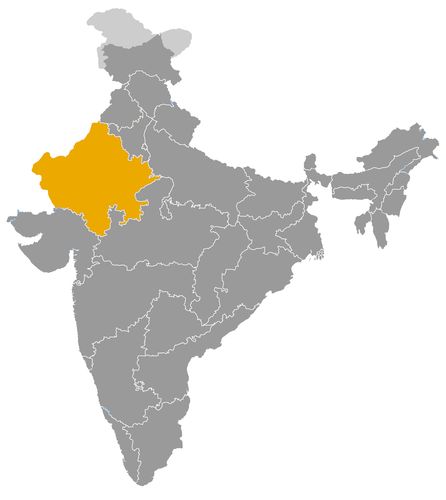
This map illustrates the maximum territory that the Chahamanas of Shakambhari Dynasty had reached at its height, covering the current regions of Rajasthan in India. Its main purpose is to provide a visual aid to understand the geographical extent of this dynasty. However, it's important to note that the contemporary borders of these regions may not necessarily coincide with the historical territories.
The Chahamanas of Shakambhari and the Formation of Rajput Power in Medieval India
A major Rajput dynasty of north western India
The Chahamanas of Shakambhari were one of the most important Rajput dynasties of medieval India. They formed the principal branch of the wider Chauhan or Chahamana tradition and were closely associated with the region of present day Rajasthan. Their early political centre was Shakambhari, usually identified with the area of Sambhar, before their authority became increasingly linked with Ajayameru, present day Ajmer.
Their history belongs to the period in which several regional powers emerged after the decline of earlier imperial formations in northern India. From a local or subregional base, the Chahamanas gradually developed into a major political force. By the twelfth century, they had become one of the leading powers of Rajasthan and an important actor in the politics of northern India.
The rise of a regional kingdom in Rajasthan
The early history of the Chahamanas of Shakambhari is partly uncertain, but their rulers are generally placed from the seventh century onward. At first, they probably operated within the sphere of larger regional powers, especially in a political environment shaped by the Gurjara Pratiharas and other ruling houses of western and northern India. Over time, they strengthened their autonomy and transformed their local authority into a more durable kingdom.
This development reflects a wider pattern in medieval India. Political power was often built through the control of forts, water resources, agricultural zones, routes, temples and market centres. The Chahamanas of Shakambhari used these foundations to consolidate their influence in central Rajasthan. Their rise shows how Rajput lineages could move from local prominence to regional kingship through military capacity, territorial management and dynastic legitimacy.
Ajmer as a strategic centre of power
The development of Ajayameru, now Ajmer, was a decisive stage in the history of the dynasty. Ajmer became one of the main centres of Chahamana power and allowed the dynasty to control a more strategic position between Rajasthan and the plains of northern India. Its location gave access to routes leading toward Delhi, Gujarat and the wider north Indian political sphere.
The shift from Shakambhari to Ajmer also represented a change in scale. The dynasty was no longer only a power rooted in the Sambhar region. It became a kingdom capable of intervening in broader conflicts and rivalries. Ajmer provided a fortified and urban centre from which the Chahamanas could project authority across Rajasthan and beyond.
Political power under Vigraharaja IV and Prithviraja III
The power of the Chahamanas of Shakambhari reached a high point in the twelfth century. Vigraharaja IV, also known as Visaladeva, is remembered as one of the most significant rulers of the dynasty. His reign was associated with military strength, political ambition and cultural patronage. Under him, Chahamana authority expanded and the dynasty gained increased prestige among the ruling powers of northern India.
Prithviraja III, better known as Prithviraj Chauhan, became the most famous ruler of the line. His reign represents both the peak and the turning point of the main Chahamana branch. The defeat of Prithviraja III by the Ghurids in 1192 ended the dynasty’s effective control over Ajmer and Delhi. This event had major consequences for northern India, because it contributed to the establishment of new Muslim political authority in the region and prepared the ground for the later Delhi Sultanate.
Cultural patronage and dynastic memory
The Chahamanas of Shakambhari were not only military rulers. Like many medieval Indian dynasties, they used religious, literary and architectural patronage to express legitimacy. Their courts supported Sanskrit learning, temple culture and forms of royal representation that connected political authority with dharma, prestige and regional identity.
Vigraharaja IV is especially associated with literary and cultural activity. The dynasty’s rulers participated in a broader world of temple building, inscriptions, courtly praise and public works. These forms of patronage helped present the king as protector, warrior and supporter of religious order.
The later memory of the Chahamanas became strongly connected with heroic Rajput traditions. Prithviraj Chauhan, in particular, became a symbolic figure in later narratives. These traditions are not always reliable as literal political history, but they show the durable cultural importance of the dynasty in Rajasthan and northern India.
Economic foundations of Chahamana authority
The economic strength of the Chahamanas rested on their control of strategic territory. The Sambhar region was important because of its association with salt production, a valuable resource in premodern India. Ajmer, later, gave the dynasty access to routes linking Rajasthan with northern India and western India. Control over such routes supported trade, military movement and the collection of revenue.
The dynasty also depended on agricultural lands, fortified centres, local markets and religious institutions. Temples and urban settlements were not only spiritual or political centres. They also concentrated donations, artisans, pilgrims and economic activity. Through patronage and territorial control, the Chahamanas helped organize the economic life of their region.
A dynasty central to the history of medieval India
The Chahamanas of Shakambhari occupy a central place in the history of medieval Rajasthan and northern India. Their rise illustrates the formation of Rajput regional power, while their expansion toward Ajmer and Delhi shows how a dynasty rooted in Rajasthan could become a major north Indian force.
Their defeat in 1192 ended the dominance of the main branch, but it did not erase the wider Chauhan tradition. Other Chahamana branches continued to rule in regions such as Naddula, Jalor, Ranastambhapura and Chandravati. The importance of the Chahamanas of Shakambhari therefore lies in their political power, their cultural patronage, their economic base and their lasting place in the historical memory of Rajasthan and India.
The Geographic Expansion of the Chahamanas of Shakambhari in Medieval India
An original power base around Shakambhari and Sambhar
The Chahamanas of Shakambhari developed from a regional power centred on Shakambhari, generally identified with the area of present day Sambhar in Rajasthan. This early centre was strategically important because it lay near the Sambhar Salt Lake, one of the major salt producing zones of north western India. Control of this area gave the dynasty access to a valuable economic resource and to routes connecting the arid regions of Rajasthan with the wider plains of northern India.
In their earliest phase, the Chahamanas probably controlled a relatively limited territory around Sambhar and its surrounding settlements. Their authority was not yet that of a large kingdom with clearly defined borders. Like many medieval Indian powers, their rule was based on the control of strategic places, rural zones, resources, fortified positions and networks of local allegiance. Their first expansion should therefore be understood as a gradual consolidation of authority rather than a sudden conquest of a large territory.
Consolidation across central Rajasthan
From their base at Shakambhari, the Chahamanas gradually extended their influence across parts of central Rajasthan. Their territory came to include areas connected with Sambhar, Ajmer, Nagaur and surrounding districts. This expansion gave them a stronger position within the political geography of Rajasthan, where control of routes and fortified points was often more important than continuous territorial administration.
The dynasty’s rise took place in a region where several powers competed for influence. Earlier in their history, the Chahamanas may have operated within the broader sphere of the Gurjara Pratiharas, whose authority shaped much of north western India. As Pratihara power weakened, the Chahamanas were able to act with greater independence. This pattern of growth was typical of the early medieval period, when former subordinate or regional families transformed themselves into autonomous dynasties.
Ajayameru as the centre of territorial enlargement
The development of Ajayameru, present day Ajmer, marked a decisive stage in the geographic expansion of the Chahamanas of Shakambhari. Ajmer was better placed than Sambhar for wider political control. It stood near routes leading toward Delhi, Gujarat, Malwa and the interior of Rajasthan. Its fortified and urban character made it an effective centre from which the dynasty could manage a broader territory.
With Ajmer, the Chahamanas became a more ambitious regional power. Their authority was no longer limited to the Sambhar region. They could project influence toward the Aravalli range, central Rajasthan and the routes linking western India with the northern plains. Ajmer also strengthened the dynasty’s military capacity, because it provided a defensible base in a politically contested area.
Expansion toward Delhi and the northern plains
The greatest extension of Chahamana power occurred in the twelfth century, especially under rulers such as Vigraharaja IV and Prithviraja III. During this period, the dynasty’s influence reached beyond Rajasthan toward Delhi and the Yamuna region. Control or strong influence over Delhi gave the Chahamanas a much wider political role and placed them among the leading powers of northern India.
This northward expansion had major consequences. Delhi was not only a city of regional importance. It was a key point between the north western approaches to India and the fertile plains of the Ganges and Yamuna. By extending their authority in this direction, the Chahamanas gained prestige and strategic depth. At the same time, they became more exposed to external pressure, particularly from the Ghurids, whose expansion into northern India directly challenged Chahamana power.
Relations with Gujarat, Malwa and neighbouring Rajput powers
The territorial growth of the Chahamanas shaped their relations with neighbouring dynasties. To the south west, they came into contact and rivalry with the Chaulukyas, also known as the Solankis of Gujarat. The zones between Rajasthan and Gujarat were economically and politically valuable, especially because they included routes, fortified settlements and areas of exchange. Relations between the two powers alternated between conflict, competition and diplomatic adjustment.
To the south east and east, the Chahamanas also had to take into account the Paramaras of Malwa and other regional powers. In Rajasthan itself, their expansion affected relations with the Guhilas of Mewar and with other Rajput lineages. The growth of Shakambhari and Ajmer also helped create or reinforce related Chahamana branches in places such as Naddula, Jalor, Ranastambhapura and Chandravati. These branches were not always directly subordinate to the main line, but they shared a dynastic memory and formed part of the wider Chauhan political world.
The impact of the Ghurid conquest on the main territory
The defeat of Prithviraja III in 1192 marked a major rupture in the geographic history of the Chahamanas of Shakambhari. The main branch lost effective control over Ajmer and Delhi, ending its position as one of the dominant powers of northern India. This defeat opened the way for Ghurid authority and for the political developments that later led to the Delhi Sultanate.
The loss of Ajmer and Delhi reduced the territorial power of the principal branch, but it did not erase the broader Chahamana presence in Rajasthan. Regional branches survived in other centres, especially Ranthambore, Jalor, Nadol and Chandravati. The history of Chahamana expansion therefore continued in a more fragmented form after the fall of the main Shakambhari Ajmer line.
A territorial network that shaped medieval Rajasthan
The geographic expansion of the Chahamanas of Shakambhari transformed them from a local power around Sambhar into a major dynasty of Rajasthan and northern India. Their territory was not a modern state with fixed borders, but a network of centres, forts, routes, resources and dependent territories.
Their rise altered the political balance of Rajasthan, intensified rivalry with Gujarat and Malwa, and brought them into direct conflict with the Ghurids. Their expansion toward Ajmer and Delhi gave the dynasty its historical prominence, while their regional branches preserved the Chauhan legacy after 1192. In this way, the Chahamanas of Shakambhari played a central role in shaping the territorial and political landscape of medieval north western India.
The rulers of the Chahamanas of Shakambhari mainly held the title of king or raja. The dates of the earliest reigns are approximate and may vary according to historical reconstructions.
- Samantaraja (c. 684–709) • Probable historical founder of the Shakambhari line, he established Chahamana authority in the Sambhar region.
- Naradeva (c. 709–721) • An early ruler known from dynastic traditions, he belonged to the initial phase of consolidation.
- Jayaraja (c. 721–734) • He continued the local assertion of the line in medieval Rajasthan.
- Vigraharaja I (c. 734–759) • His reign belongs to the period in which Chahamana power became rooted around Shakambhari.
- Chandraraja I (c. 759–771) • He maintained dynastic continuity in a still poorly documented phase.
- Gopendraraja (c. 771–784) • His reign forms part of the gradual development of Chahamana authority.
- Durlabharaja I (c. 784–809) • He is associated with the rise of the line within the regional powers of north western India.
- Govindaraja I (c. 809–836) • Also called Guvaka I, he strengthened the prestige of the Chahamana house.
- Chandraraja II (c. 836–863) • He ensured the continuity of power in the Shakambhari region.
- Govindaraja II (c. 863–890) • Also called Guvaka II, he belonged to a phase of regional stabilization.
- Chandana (c. 890–917) • He consolidated dynastic authority before the more visible expansion of the tenth century.
- Vakpatiraja I (c. 917–944) • He increased the political importance of the Chahamanas in Rajasthan.
- Vindhyaraja (c. 944) • His reign was probably brief and remains poorly documented.
- Simharaja (c. 944–971) • He strengthened the autonomy and royal prestige of the line.
- Vigraharaja II (c. 971–998) • He pursued an active policy against neighbouring powers and asserted the military role of the Chahamanas.
- Durlabharaja II (c. 998–1012) • He maintained dynastic authority at the turn of the eleventh century.
- Govindaraja III (c. 1012–1026) • His reign belongs to a period of increasing regional rivalries.
- Vakpatiraja II (c. 1026–1040) • He continued the political continuity of the Shakambhari branch.
- Viryarama (c. 1040) • His reign was short and probably marked by regional conflicts.
- Chamundaraja (c. 1040–1065) • He restored or consolidated the position of the dynasty after a troubled period.
- Durlabharaja III (c. 1065–1070) • He ruled briefly in a context of military pressure.
- Vigraharaja III (c. 1070–1090) • He strengthened the political and military ties of the dynasty in Rajasthan.
- Prithviraja I (c. 1090–1110) • He consolidated Chahamana authority before the political centre shifted toward Ajmer.
- Ajayaraja II (c. 1110–1135) • He founded or developed Ajayameru, present day Ajmer, which became a major centre of the dynasty.
- Arnoraja (c. 1135–1150) • He campaigned against several neighbouring powers and strengthened the kingdom.
- Jagaddeva (c. 1150) • His reign was brief and connected with a troubled succession.
- Vigraharaja IV (c. 1150–1164) • Also called Visaladeva, he brought Chahamana power to a high political and cultural level.
- Aparagangeya (c. 1164–1165) • His reign was very short and preceded a new dynastic reorganization.
- Prithviraja II (c. 1165–1169) • He maintained the power of the line during a transitional phase.
- Someshvara (c. 1169–1178) • He ensured dynastic continuity before the reign of Prithviraj III.
- Prithviraja III (c. 1178–1192) • Better known as Prithviraj Chauhan, he was defeated by the Ghurids in 1192, an event that ended the main dominance of the Chahamanas of Shakambhari.
 Links to the main sections of the site