Français (France)
  Nederlands (nl-NL)
 Of Hindu tradition, (with additional Jain influence), the Chahamanas of Naddula dynasty ruled for approximately 247 years, ± between 0950 and 1197 over all or part of North India and West India, during the Medieval Period.
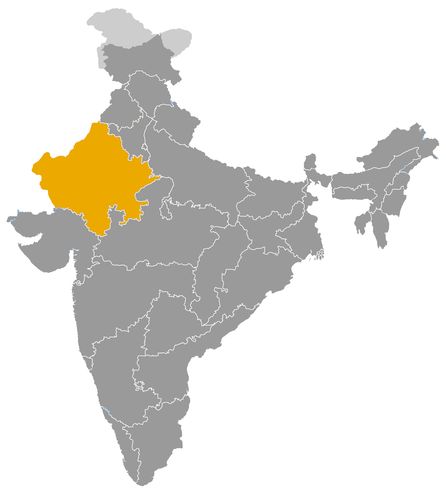
This map illustrates the maximum territory that the Chahamanas of Naddula Dynasty had reached at its height, covering the current regions of Gujarat and Rajasthan in India. Its main purpose is to provide a visual aid to understand the geographical extent of this dynasty. However, it's important to note that the contemporary borders of these regions may not necessarily coincide with the historical territories.
The Chahamanas of Naddula and the Role of Regional Powers in Medieval India
A Chauhan branch rooted in western Rajasthan
The Chahamanas of Naddula, also known as the Chauhans of Nadol, formed one of the important regional branches of the wider Chahamana or Chauhan tradition. Their political centre was Naddula, present day Nadol, in western Rajasthan. Their history belongs mainly to the period between the tenth and late twelfth centuries, when the political landscape of northern and western India was shaped by regional kingdoms, Rajput lineages and shifting relations of rivalry and dependence.
Although they were less famous than the main Chahamana branch of Shakambhari and Ajmer, the Chahamanas of Naddula played a significant role in the history of south western Rajasthan. Their territory stood between Marwar, Mount Abu, Gujarat and the routes connecting western India with the interior of Rajasthan. This position gave them an importance that was not only dynastic, but also strategic and economic.
The formation of an autonomous centre at Nadol
The Naddula branch is generally associated with Lakshmana, who is regarded as its founder. From Nadol, the dynasty developed a local authority that gradually became distinct from the main Chahamanas of Shakambhari. This process reflects a common feature of medieval Indian politics. A lineage connected with a larger dynastic tradition could form an autonomous branch when it acquired durable control over a city, a fort, a route or a regional territory.
Nadol occupied a favourable position in western Rajasthan. It lay near important routes leading toward Gujarat, Mount Abu, Marwar and the central regions of Rajasthan. Control of such a location allowed the Chahamanas of Naddula to participate in trade, supervise movements, defend local interests and engage in the political rivalries of neighbouring powers. Their rise demonstrates how a secondary dynasty could become a meaningful regional actor.
Political authority between independence and subordination
The political role of the Chahamanas of Naddula was shaped by a constant balance between local autonomy and dependence on stronger powers. At some moments, they acted as independent rulers of a compact regional territory. At other times, they were connected with the Chaulukyas of Gujarat, also known as the Solankis, in relations that may be described as vassalage, alliance or political subordination.
This situation should not be interpreted simply as weakness. In medieval India, sovereignty was often layered and flexible. A regional ruler could acknowledge the superiority of a more powerful king while retaining effective authority over his own lands. The Chahamanas of Naddula used this intermediate position to maintain their local power, protect their territory and navigate between larger political formations.
Relations with Gujarat, Mount Abu and neighbouring dynasties
The proximity of Gujarat strongly influenced the history of the Chahamanas of Naddula. The Chaulukyas of Gujarat were one of the major powers of western India, with a strong political, commercial and cultural base. Nadol’s location placed the Chahamanas close to this powerful kingdom, making conflict, alliance and dependency almost unavoidable.
Mount Abu was another important zone of contact. The region around Abu stood at the intersection of Rajasthan and Gujarat and was contested by several lineages, including the Paramaras and the Chaulukyas. For the Chahamanas of Naddula, influence in or near this area was valuable because it affected access to routes, religious centres and strategic uplands. Their political history was therefore shaped by frontier conditions rather than by isolation.
Cultural patronage in a regional setting
The cultural impact of the Chahamanas of Naddula must be understood on a regional scale. Like other Rajput dynasties of medieval India, they used religious and architectural patronage to express authority and legitimacy. Their rulers were associated with the support of temples, religious communities, inscriptions and forms of royal representation.
Such patronage had both spiritual and political functions. By supporting sanctuaries and religious institutions, rulers strengthened their public image as protectors of order and benefactors of their territory. Temples also helped structure local society. They received donations, employed specialists, attracted visitors and preserved dynastic memory. In a region of passage such as Nadol, religious patronage helped connect political authority with social and economic life.
The cultural importance of the Naddula branch should not be measured only by comparison with larger kingdoms. Its value lies in showing how smaller courts and regional lineages contributed to the broader architectural and religious landscape of Rajasthan. Their patronage formed part of the same cultural world that linked forts, temples, inscriptions and clan memory across western India.
Economic importance of routes and local resources
The economic role of the Chahamanas of Naddula was closely tied to geography. Nadol lay near routes connecting Rajasthan with Gujarat and western India. These routes were used by merchants, armies, pilgrims and local elites. Control over such corridors allowed the dynasty to benefit from movement, taxation, protection and regional exchange.
Their economic base also included villages, agricultural production, pastoral resources, markets and religious endowments. In medieval Rajasthan, power depended on the ability to control both mobile wealth and settled resources. A ruler needed access to land revenue, trade routes, fortified centres and networks of loyalty. The Chahamanas of Naddula appear to have operated within this framework, using their position to sustain a regional polity of moderate but real importance.
A significant branch within the wider Chauhan world
The Chahamanas of Naddula are important because they reveal the diversity of the Chauhan political world. Their history was not merely a continuation of Shakambhari, nor simply an extension of Gujarat’s influence. They formed a regional branch with its own rulers, territory, alliances and conflicts.
Their role in Indian history lies in their ability to show how medieval Rajasthan was shaped by many levels of power. Large kingdoms influenced major military and diplomatic events, but smaller dynasties organized routes, fortified places, local economies and religious institutions. Through Nadol, the Chahamanas of Naddula maintained a Chauhan presence in western India and contributed to the complex political structure of medieval Rajasthan.
The Geographic Extent of the Chahamanas of Naddula in Medieval India
A regional power centred on Nadol in western Rajasthan
The Chahamanas of Naddula, also known as the Chauhans of Nadol, controlled a regional territory in western Rajasthan during the medieval period. Their main centre was Naddula, identified with present day Nadol, near Pali. This location placed the dynasty in a strategically important zone between Marwar, Mount Abu, Gujarat and the routes leading toward the interior of Rajasthan.
Their geographic expansion was not that of a large empire with fixed borders. Like many medieval Indian dynasties, their authority was based on the control of towns, villages, fortified places, routes, religious establishments and zones of local allegiance. The Chahamanas of Naddula ruled a compact but valuable territory whose importance came from its position between several larger political and economic regions.
The consolidation of authority in southern Marwar
The core territory of the dynasty lay in southern Marwar. From Nadol, the Chahamanas extended their influence over nearby rural areas and local settlements. The region around present day Pali was especially significant because it connected the more arid lands of western Rajasthan with routes toward Gujarat and the Aravalli region.
This territory gave the dynasty a practical base for revenue collection, military organization and local administration. Agricultural villages, pastoral communities, market points and road corridors formed the economic foundation of their rule. The Chahamanas did not need to control an extensive kingdom to become politically relevant. Their power depended on their ability to dominate a key passage zone and to maintain authority over the communities and resources connected with it.
The frontier zone near Mount Abu
The area around Mount Abu was one of the most important zones affecting the geographic history of the Chahamanas of Naddula. Mount Abu stood near the boundary between Rajasthan and Gujarat and was associated with religious, strategic and political importance. It was also a contested region where several dynasties had interests.
The Chahamanas of Naddula were drawn into this frontier environment because their territory lay close to the routes leading toward Abu and Gujarat. Their influence in this direction brought them into contact with the Paramaras of Abu and with the Chaulukyas of Gujarat. Control or influence over the approaches to Mount Abu could strengthen a ruler’s prestige, provide access to religious centres and improve control over movements between Rajasthan and Gujarat.
Relations with the Chaulukyas of Gujarat
The geographic position of Naddula made relations with the Chaulukyas of Gujarat unavoidable. Gujarat was one of the strongest powers of western India during much of the period in which the Chahamanas of Naddula were active. Its political influence, commercial wealth and military capacity affected the smaller dynasties along its northern and eastern frontiers.
At times, the Chahamanas of Naddula acted as autonomous regional rulers. At other times, they appear to have been connected with the Chaulukyas through relations of subordination, alliance or vassalage. This did not necessarily eliminate their local authority. In medieval Indian politics, a dynasty could recognize the supremacy of a stronger ruler while retaining practical control over its own territory.
The proximity to Gujarat therefore gave the Chahamanas both opportunities and constraints. It connected Nadol to wider trade and political networks, but it also exposed the dynasty to pressure from a more powerful neighbour. Their frontier position made diplomacy, military adaptation and changing alliances essential for survival.
Contacts with the Paramaras and other Rajput lineages
The Chahamanas of Naddula were also linked to the political world of the Paramaras, especially in the regions around Abu and Malwa. The Paramaras represented another important power in western and central India, and their influence intersected with that of the Chaulukyas and the Chahamanas. The territories between southern Rajasthan, Mount Abu and Malwa were therefore shaped by overlapping ambitions.
Within Rajasthan, the Naddula branch also had connections with the broader Chauhan world. It shared dynastic origins or memory with the Chahamanas of Shakambhari, while later branches such as the Chahamanas of Jalor emerged in related regional contexts. These connections did not always imply direct political unity. They show instead that the Chauhan world was fragmented into several centres, each rooted in a particular city, fort or territorial corridor.
Strategic routes as the basis of territorial value
The value of the Naddula territory lay largely in its routes. Nadol stood near corridors used by merchants, armies, pilgrims and local chiefs travelling between Rajasthan and Gujarat. Such routes were economically useful and politically sensitive. A ruler who controlled them could collect revenue, protect movement, restrict enemies and maintain links with neighbouring courts.
The dynasty’s territory also supported local production. Villages, grazing lands, markets and religious endowments contributed to its economy. Temples and monastic establishments could function as religious centres, landholders and economic nodes. By controlling these institutions and the surrounding settlements, the Chahamanas of Naddula helped organize the regional landscape.
A limited territory with broad political consequences
The Chahamanas of Naddula never ruled a territory as large as that of the main Shakambhari Ajmer branch. Their geographic extent remained centred on Nadol, southern Marwar and the routes toward Mount Abu and Gujarat. Yet this limited territory was highly strategic.
Their position placed them between larger dynasties and made them important participants in the politics of western India. Relations with the Chaulukyas of Gujarat, the Paramaras and neighbouring Rajput lineages were shaped by geography as much as by dynastic ambition. The Chahamanas of Naddula show how a regional power of modest size could influence military, economic and diplomatic networks in medieval Rajasthan. Their history illustrates the importance of frontier zones, route control and local authority in the political geography of medieval India.
The Chahamanas of Naddula, or Chauhans of Nadol, were an offshoot of the Chahamanas of Shakambhari. The reign dates are approximate, and the dynasty was at times autonomous and at times connected with the Chaulukyas of Gujarat as a vassal power.
- Lakshmana (c. 950–982) • Founder of the Naddula branch, he established his authority at Nadol in Marwar.
- Shobhita (c. 982–986) • He succeeded Lakshmana and is associated with early regional conflicts around Mount Abu.
- Baliraja (c. 986–990) • He ruled briefly and was connected with rivalries involving the Paramaras of Malwa.
- Vigrahapala (c. 990–994) • He maintained dynastic continuity after Baliraja, probably without a major break in local power.
- Mahindra (c. 994–1015) • Also called Mahindu, he took part in rivalries among western Rajasthan lineages.
- Ashvapala (c. 1015–1019) • His reign was short and belongs to the dynasty’s phase of consolidation.
- Ahila (c. 1019–1024) • He appears to have resisted military pressure from the Chaulukyas of Gujarat.
- Anahilla (c. 1024–1055) • He was one of the most important rulers of Naddula and greatly expanded the dynasty’s influence.
- Balaprasada (c. 1055–1070) • He succeeded Anahilla and maintained Chahamana authority in south western Rajasthan.
- Jendraraja (c. 1070–1080) • He continued rivalries with neighbouring powers, especially the Chaulukyas.
- Prithvipala (c. 1080–1090) • He strengthened Naddula’s regional position in a context of alliances and conflicts.
- Jojalladeva (c. 1090–1110) • He is associated with a phase of military activity against the Chaulukyas of Gujarat.
- Asharaja (c. 1110–1119) • Also called Ashvaraja, he was overthrown during a dynastic crisis and sought Chaulukya support.
- Ratnapala (c. 1119–1132) • He took power after Asharaja’s removal and represented a rival branch of the line.
- Rayapala (c. 1132–1145) • He succeeded Ratnapala before being displaced by Katukaraja.
- Katukaraja (c. 1145–1148) • He restored the branch descended from Asharaja and ruled briefly at Naddula.
- Alhanadeva (c. 1148–1163) • He ruled as an important local king, often under the political supremacy of the Chaulukyas of Gujarat.
- Kelhanadeva (c. 1163–1193) • He retained Naddula during a period of strong pressure, especially from the Ghurids and the Yadavas.
- Jayatasimha (c. 1193–1197) • Last principal ruler of Naddula, he was probably defeated during Ghurid expansion in the region.
 Links to the main sections of the site