Français (France)
  Nederlands (nl-NL)
 Of Hindu tradition, (with additional Jain influence), the Chahamanas of Jalor dynasty ruled for approximately 151 years, ± between 1160 and 1311 over all or part of North India, during the Medieval Period.
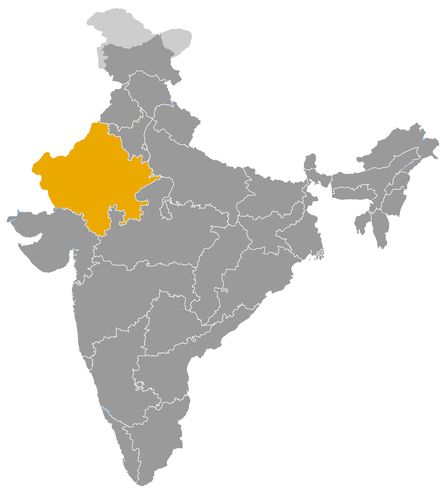
This map illustrates the maximum territory that the Chahamanas of Jalor Dynasty had reached at its height, covering the current regions of Rajasthan in India. Its main purpose is to provide a visual aid to understand the geographical extent of this dynasty. However, it's important to note that the contemporary borders of these regions may not necessarily coincide with the historical territories.
The Chahamanas of Jalor and Regional Resistance in Medieval Rajasthan
A Chauhan branch established in western Rajasthan
The Chahamanas of Jalor, also known as the Chauhans of Jalore, were a regional branch of the wider Chahamana political tradition. Their centre was Jalor, in present day western Rajasthan, where a strong hill fortress became the foundation of their authority. The dynasty emerged from the political world of Naddula and developed into an autonomous regional power between the late twelfth and early fourteenth centuries.
The Chahamanas of Jalor did not rule a vast kingdom comparable to the main Chahamana line of Shakambhari and Ajmer. Their importance lay instead in their control of a strategic frontier zone between Marwar, Gujarat, Mount Abu and the routes of western India. This location gave the dynasty military, economic and diplomatic significance beyond the apparent size of its territory.
The rise of Jalor as a fortified political centre
The formation of the Jalor branch is generally associated with Kirtipala, who established Chahamana authority around the fortress of Jalor. In medieval Rajasthan, forts were not merely defensive structures. They were centres of rule, symbols of sovereignty, refuges in times of conflict and instruments for controlling surrounding territory.
Jalor’s fort gave the dynasty a durable political base. It allowed the rulers to supervise routes, protect local settlements and resist pressure from neighbouring powers. The fortress also made Jalor a recognizable centre of regional identity. Through it, the Chahamanas of Jalor were able to present themselves as a distinct political line within the broader Chauhan world.
Political relations with Gujarat, Marwar and neighbouring powers
The political role of the Chahamanas of Jalor was shaped by their position between several important regions. To the south west lay Gujarat, where the Chaulukyas, also known as the Solankis, had long been one of the dominant powers of western India. To the north and east were other Rajput lineages and the older Chauhan centres of Naddula and Shakambhari Ajmer. The area around Mount Abu also formed a contested zone of influence.
This setting required a flexible political strategy. The rulers of Jalor had to defend their autonomy while recognizing the strength of larger neighbours. At times, they benefited from the weakening of other regional powers. At other moments, they faced direct pressure from stronger dynasties. Their history reflects the fragmented and competitive nature of medieval Rajasthan, where a compact kingdom could survive through fortification, diplomacy and careful control of routes.
Udayasimha and the consolidation of regional authority
The reign of Udayasimha is usually regarded as one of the strongest periods of the Jalor line. Under his rule, the dynasty consolidated its position in western Rajasthan and strengthened its independence. Jalor became a stable regional centre, supported by the fortress, surrounding rural zones and links with neighbouring territories.
His successors, including Chachigadeva, Samantasimha and Kanhadadeva, maintained the role of Jalor as an active political power. During their time, the political environment changed significantly. The expansion of the Delhi Sultanate placed increasing pressure on Rajput strongholds across Rajasthan. Jalor’s later history became closely associated with resistance to this expansion, especially under Kanhadadeva.
Resistance to the Delhi Sultanate
The final phase of the Chahamanas of Jalor is important in the history of medieval India because it illustrates the confrontation between regional Rajput powers and the expanding Delhi Sultanate. By the late thirteenth and early fourteenth centuries, several forts and kingdoms of Rajasthan came under military pressure from Delhi.
Kanhadadeva became the most famous ruler of the Jalor branch because of his resistance to the Sultanate. The fall of Jalor in the early fourteenth century marked the end of the dynasty’s effective political autonomy. It also represented a broader transformation in the political landscape of Rajasthan, as older regional powers were forced to adapt to new imperial structures.
Cultural patronage and Rajput political identity
The cultural role of the Chahamanas of Jalor must be understood within the wider traditions of Rajput rulership. Like other medieval Indian dynasties, they used patronage to strengthen legitimacy. Temples, inscriptions, religious donations and courtly memory all helped present the ruler as protector of territory, supporter of religious order and guardian of dynastic honour.
The fortress of Jalor itself became part of this cultural memory. In Rajasthan, forts were closely associated with identity, resistance and sovereignty. They were architectural expressions of power as much as military installations. Through their control of Jalor, the Chahamanas contributed to a broader Rajput landscape in which fortresses, temples and genealogies shaped historical memory.
Their cultural significance was not limited to monumental construction. The dynasty also formed part of the literary and historical traditions that remembered Rajput resistance, local sovereignty and the defence of fortified centres. These traditions later amplified the reputation of rulers such as Kanhadadeva.
Economic foundations of a strategic kingdom
The economy of the Jalor kingdom rested on its geography. The dynasty controlled a region located near routes linking Marwar, Gujarat, Mount Abu and other parts of western India. These corridors were used by merchants, armies, pilgrims and local elites. Control over them allowed the rulers to secure movement, collect revenue and maintain contact with neighbouring political centres.
The territory also depended on villages, agriculture, pastoral activity, local markets and religious institutions. Temples could receive donations, hold land and support networks of artisans and specialists. The economic strength of Jalor was therefore regional rather than imperial, but it was sufficient to sustain a fortified kingdom for more than a century.
A regional dynasty with lasting historical significance
The Chahamanas of Jalor occupy an important place in Indian history because they represent the persistence of Chauhan regional power after the decline of the main Shakambhari Ajmer line. Their history shows that medieval Rajasthan was not shaped only by large kingdoms, but also by smaller dynasties controlling forts, routes and frontier zones.
Their political resistance, cultural patronage and economic control of a strategic region made Jalor one of the notable Rajput centres of western India. The fall of the dynasty to the Delhi Sultanate did not erase its historical significance. Instead, it marked the end of one regional order and the emergence of a new political balance in medieval Rajasthan.
The Geographic Extent of the Chahamanas of Jalor in Medieval India
A fortified regional power in western Rajasthan
The Chahamanas of Jalor, also known as the Chauhans of Jalore, controlled a regional territory in western Rajasthan between the late twelfth and early fourteenth centuries. Their principal centre was Jalor, a fortified site that gave the dynasty a strong defensive and political base. The kingdom developed from the wider Chahamana world of Naddula but soon acquired its own territorial identity.
The geographic extent of the Jalor branch should not be understood as a large empire with fixed and continuous borders. Like many medieval Indian polities, its authority depended on the control of forts, towns, villages, road corridors, religious centres and local networks of allegiance. Its importance came from the strategic value of its location between Marwar, Gujarat, Mount Abu and the routes of western India.
Jalor as the centre of territorial control
The core of the dynasty’s territory lay around the fortress of Jalor. This site dominated the surrounding landscape and provided a secure base for administration, military defence and royal representation. In the political geography of Rajasthan, such forts were essential instruments of power. They allowed rulers to control movement, protect dependants, store resources and resist external attacks.
The territory of the Chahamanas of Jalor probably included the town and fort of Jalor, nearby villages, rural zones and routes linking the area with Bhinmal, Nadol and the approaches to Gujarat. Their control was not necessarily uniform everywhere. It depended on military strength, local alliances, tribute, hereditary authority and the ability to maintain the loyalty of subordinate chiefs.
Links with Nadol and the wider Chauhan world
The Jalor branch was connected to the Chahamanas of Naddula, whose centre was Nadol. This relationship explains the dynastic continuity between Nadol and Jalor, but it does not mean that Jalor remained merely a secondary possession. From the time of Kirtipala and his successors, Jalor became the centre of a distinct regional kingdom.
This development reflects the fragmentation of the Chauhan political world into several branches. After the weakening of older centres, different lines established themselves in separate fortified or urban bases. Jalor, Nadol, Ranthambore and Chandravati became distinct centres of Chahamana or Chauhan power. The geographic separation of these branches shaped their political behaviour, since each had to respond to its own neighbours, resources and strategic pressures.
The frontier with Gujarat as a decisive factor
The proximity of Gujarat was one of the most important factors in the history of Jalor. To the south west, the Chaulukyas of Gujarat, also known as the Solankis, had long been a major force in western India. Their influence extended into the frontier zones near Mount Abu, southern Rajasthan and the routes leading toward Marwar.
For the Chahamanas of Jalor, this geography created both opportunity and vulnerability. The routes toward Gujarat allowed access to trade, political contacts and regional exchange. At the same time, the presence of a powerful neighbour limited Jalor’s freedom of action. The dynasty had to balance autonomy with diplomatic caution, military preparedness and shifting alliances. Its relations with Gujarat were therefore shaped less by distance than by immediate territorial proximity.
Bhinmal, Mount Abu and western route networks
The surrounding region gave Jalor additional strategic value. Bhinmal, located in the broader western Rajasthan zone, had long been an important historical and cultural centre. The routes linking Jalor with Bhinmal, Nadol and Mount Abu connected the kingdom to a wider regional network. These routes were used by merchants, religious communities, soldiers and local elites.
Mount Abu also formed a significant zone of contact between Rajasthan and Gujarat. Influence over the approaches to Abu was valuable because the area combined religious prestige, military importance and control of movement between regions. The Chahamanas of Jalor did not necessarily dominate all these surrounding territories continuously, but their position made them part of the political struggles that affected them.
Relations with neighbouring Rajput dynasties
The geographic extent of Jalor influenced its relations with other Rajput powers. The dynasty stood near the older Chahamana centre of Naddula, the Paramara connected zones of Abu and Malwa, and other regional lineages of Marwar and western Rajasthan. These neighbours could be rivals, allies or political intermediaries depending on the circumstances.
Because Jalor was a compact but well defended kingdom, its rulers could sometimes preserve a high degree of independence. However, they could not ignore the ambitions of surrounding powers. Their political history was shaped by the need to secure routes, defend boundaries, maintain fortresses and negotiate with stronger or related dynasties. Geography therefore made Jalor both a defensive stronghold and a participant in wider regional politics.
The pressure of the Delhi Sultanate on Rajasthan
By the late thirteenth and early fourteenth centuries, the expansion of the Delhi Sultanate changed the political geography of Jalor. The fortresses of Rajasthan became important objectives for the sultans of Delhi, who sought to control routes, reduce regional resistance and extend their authority into western India.
Jalor’s position made it a natural target. Its fortress protected a strategic zone, and its rulers represented one of the remaining Chauhan powers in western Rajasthan. Under Kanhadadeva, the kingdom became associated with resistance to the Sultanate. The conquest of Jalor in the early fourteenth century ended the independent rule of the dynasty and marked the incorporation of this region into a new political order.
A limited territory with high strategic value
The Chahamanas of Jalor did not rule a vast kingdom, but their geographic position gave them considerable importance. Their territory was centred on Jalor and extended through influence over nearby villages, routes and regional corridors connected with Bhinmal, Nadol, Mount Abu and Gujarat.
Their history shows that the significance of a medieval Indian dynasty cannot be measured only by the size of its territory. A compact kingdom could play a major role if it controlled a fortress, a frontier zone and routes between larger political regions. The Chahamanas of Jalor were therefore important not because they governed an extensive empire, but because they occupied one of the strategic nodes of western Rajasthan.
The Chahamanas of Jalor, or Chauhans of Jalore, were a branch of the wider Chahamana world of Naddula. The reign dates are approximate and vary according to historical reconstructions, especially for the transition between Samantasimha and Kanhadadeva.
- Kirtipala (c. 1160–1182) • Founder of the Jalor branch, he established Chahamana authority around the fort of Jalor in western Rajasthan.
- Samarasimha (c. 1182–1204) • He consolidated dynastic power after Kirtipala and maintained Jalor as an important regional centre.
- Udayasimha (c. 1204–1257) • He was one of the strongest rulers of the line and reinforced Jalor’s autonomy against neighbouring powers.
- Chachigadeva (c. 1257–1282) • He continued the consolidation of the kingdom and preserved Jalor’s strategic importance in western Rajasthan.
- Samantasimha (c. 1282–1305) • He ruled during a period of increasing pressure from the Delhi Sultanate and regional rivalries.
- Kanhadadeva (c. 1305–1311) • Last major ruler of Jalor, he resisted the expansion of the Delhi Sultanate before the conquest of the fortress.
- Viramadeva (c. 1311) • He is associated with the final phase of Jalor’s resistance and the fall of the dynasty to the Delhi Sultanate.
 Links to the main sections of the site