

 Français (France)
  Nederlands (nl-NL)
 The Magoki-i-Attari Mosque is an Islamic religious monument located in the historic centre of Bukhara, Uzbekistan. Built on a site that has been occupied for many centuries, it reflects the continuity of the city’s urban and religious development. Its name is linked to the former quarter of perfume merchants that once surrounded the building. Over time, the mosque has remained part of Bukhara’s evolving urban landscape while preserving its religious function. Today, it forms part of the Historic Centre of Bukhara, a UNESCO World Heritage property, and represents an important component of the city’s Islamic heritage.
Monument profile
Magoki-i-Attari Mosque
Monument category: Mosque
Monument family: Mosque, Minaret or Madrasa
Monument genre: Religious
Cultural heritage: Islamic
Geographic location: Bukhara • Uzbekistan
Construction period: 12th century AD
This monument in Bukhara is inscribed on the UNESCO World Heritage List since 1993 and is part of the serial property "Historic Centre of Bukhara".See the UNESCO monuments featured on this site
• Links to •
• List of videos about Bukhara on this site •
Bukhara, oasis on the silk road • Uzbekistan
Historical Development of the Magoki-i-Attari Mosque in Bukhara
Origins and Early Religious Context
The Magoki-i-Attari Mosque occupies a site whose religious significance predates the construction of the present building. Archaeological investigations have revealed the existence of earlier structures beneath the mosque, indicating that the location had long been associated with places of worship. Historical sources suggest that the area was connected to pre-Islamic religious practices before the spread of Islam in Central Asia.
Following the Arab conquest of Bukhara in the eighth century, Islamic religious buildings gradually replaced earlier sanctuaries. The site of Magoki-i-Attari became part of this transformation. The name “Magoki-i-Attari” is generally interpreted as referring to a mosque located in a depressed area near a market associated with spice and perfume merchants. Its position within a commercial district linked the building closely to the daily life of the city.
The earliest mosque on the site appears to have been established during the first centuries of Islamic rule. Although little survives from this initial phase, archaeological evidence demonstrates that the monument evolved through several successive construction campaigns rather than resulting from a single building project.
Reconstruction and Development During the Medieval Period
The present structure largely reflects rebuilding campaigns carried out between the eleventh and twelfth centuries under the Qarakhanid dynasty. During this period, Bukhara experienced significant urban development, and numerous religious buildings were renovated or reconstructed.
The reconstruction of Magoki-i-Attari transformed the site into a permanent masonry mosque incorporating architectural features characteristic of the period. The project reflected both the religious needs of the surrounding neighbourhood and the desire of local authorities to reinforce Islamic institutions within the city.
Unlike large congregational mosques intended for major public gatherings, Magoki-i-Attari functioned primarily as a neighbourhood mosque serving residents and merchants active in the surrounding markets. Its role was therefore closely connected to the commercial district in which it stood.
Several later interventions modified parts of the building while preserving its religious function. Additional repairs and reconstructions were carried out after periods of deterioration and changing urban conditions. These successive phases contributed to the complex historical character of the monument visible today.
Use of the Mosque Through Successive Political Periods
The mosque remained active throughout the centuries that followed, including periods marked by political change and shifts in regional power. During the Timurid era and later under the Uzbek dynasties, the building continued to serve the local Muslim community.
As the level of the surrounding city gradually rose through repeated cycles of construction and rebuilding, parts of the mosque became increasingly buried beneath accumulated urban layers. Rather than abandoning the structure, local communities adapted its use to changing conditions. This unusual process explains why the building today stands considerably below the level of nearby streets.
During the nineteenth century, when the Emirate of Bukhara came under growing Russian influence, the mosque continued to function as a place of worship. Its religious role remained largely unchanged despite political developments affecting the region.
The Soviet period brought more substantial changes. Religious institutions throughout Central Asia were subjected to restrictions, and many historic mosques lost their original functions. Magoki-i-Attari survived this period largely because of its historical and architectural value. Although religious activity was reduced or interrupted at various times, the monument itself was preserved and attracted increasing scholarly interest.
Global Historical Context
The principal reconstruction of Magoki-i-Attari during the eleventh and twelfth centuries coincided with the period of the Crusades in the eastern Mediterranean. In China, the Song dynasty governed a state known for its economic and technological development. In western Europe, Romanesque architecture was flourishing and many cathedrals and monasteries were under construction. In the Indian subcontinent, several regional kingdoms were competing for influence before the establishment of the Delhi Sultanate.
Preservation, UNESCO Recognition and Present Role
Archaeological studies conducted during the twentieth century greatly improved understanding of the monument’s history. Excavations revealed evidence of earlier religious structures beneath the existing mosque and helped clarify the sequence of construction phases that shaped the building.
Restoration campaigns focused on stabilizing masonry, conserving decorative elements and protecting structures affected by centuries of burial beneath rising urban levels. These interventions sought to preserve both the visible monument and the archaeological evidence contained within the site.
Since the independence of Uzbekistan in 1991, conservation efforts have continued as part of broader initiatives aimed at protecting the historic monuments of Bukhara. The mosque is now recognized not only as a religious building but also as an important source of information about the city’s urban and cultural development.
The monument forms part of the UNESCO World Heritage property Historic Centre of Bukhara, inscribed on the World Heritage List in 1993. This designation includes the historic urban fabric surrounding the mosque and acknowledges the significance of the city’s architectural heritage accumulated over many centuries.
Today, Magoki-i-Attari serves primarily as a historical and cultural monument. Its survival through multiple periods of reconstruction, political change and urban transformation provides valuable insight into the long-term development of Bukhara. The building remains closely associated with the historic identity of the city and illustrates the continuity of religious life within one of Central Asia’s oldest urban centres.
Architectural Configuration and Building Characteristics of the Magoki-i-Attari Mosque
Urban Setting and Spatial Organization
The Magoki-i-Attari Mosque occupies a distinctive position within the historic fabric of Bukhara. Located in the former commercial quarter of the city, it stands in an area historically associated with markets and trade. Unlike many religious monuments that dominate large open spaces, the mosque is integrated into a dense urban environment shaped by successive phases of construction.
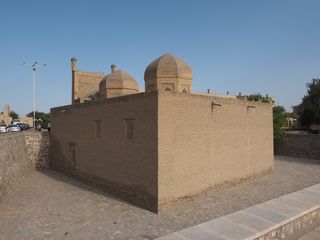
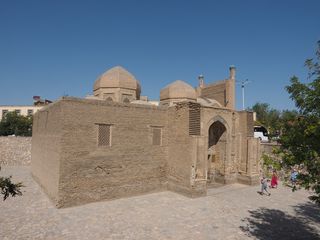
One of its most unusual characteristics is its position below the present street level. Over centuries, repeated rebuilding and the accumulation of urban deposits raised the surrounding ground surface. As a result, substantial portions of the mosque became buried beneath later layers of the city. Visitors must now descend from the modern street level to reach the monument, creating a rare spatial relationship within Central Asian Islamic architecture.
The mosque follows a relatively compact plan reflecting its role as a neighborhood mosque rather than a large congregational institution. The principal prayer hall occupies the core of the building, while secondary spaces are arranged around it according to functional requirements.
Archaeological investigations have revealed remains from multiple historical periods beneath and within the structure. The present building incorporates elements belonging to different construction phases, producing an architectural composition shaped by adaptation over many centuries.
Structural System, Construction Techniques and Materials
The mosque is constructed primarily of baked brick. Thick load-bearing walls form the structural framework and support vaults, domes and roofing systems. The durability of brick construction has contributed significantly to the monument’s survival despite extensive urban transformation.
Excavations have shown that parts of the mosque rest upon earlier foundations incorporated into later rebuilding campaigns. Builders frequently reused existing masonry rather than replacing it entirely, creating a complex architectural stratigraphy in which structural components from different periods coexist.
The roofing system relies mainly on masonry vaults and arches. Loads are transferred through carefully arranged brick arches toward supporting walls. In larger spaces, more advanced structural solutions allow wider spans while maintaining stability.
Brick also contributes directly to the building’s visual appearance. Variations in bonding patterns, relief work and surface articulation create decorative effects integrated into the architecture itself. The long history of partial burial generated structural challenges related to moisture and soil pressure, leading to conservation campaigns aimed at reinforcing weakened masonry while preserving original materials.
Façades, Architectural Volumes and Interior Spaces
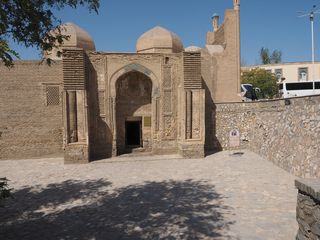
The southern portal is the most remarkable architectural feature of the mosque. Considered one of the finest surviving examples of carved brick decoration in Bukhara, it forms the principal focus of scholarly attention. Although much of the structure remains visually subdued because of its position below ground level, the portal stands out through the sophistication of its design and ornamentation.
The façade is organized around a large central arch framed by richly articulated decorative zones. Geometric compositions carved directly into the brickwork create a highly textured surface. Unlike later monuments that rely heavily on glazed tile decoration, the Magoki-i-Attari Mosque derives much of its architectural effect from the manipulation of brick.
The proportions of the portal reveal careful attention to balance and hierarchy. Decorative panels, niches and framing elements direct attention toward the entrance while maintaining overall harmony. Vertical emphasis is achieved without overwhelming the modest scale of the monument.
The external volumes remain restrained compared with later monumental mosques and madrasas of Bukhara. The partially buried condition of the structure reduces its visible mass and creates a contrast between the monument’s archaeological depth and the refinement of its façade.
Inside, the mosque is organized around interconnected spaces designed for worship. The prayer hall forms the principal interior volume, while smaller auxiliary areas support circulation and religious functions. Successive reconstruction campaigns modified parts of the structure while preserving earlier elements, producing an interior that reflects multiple architectural phases rather than a single unified design.
Decorative Program and Stylistic Characteristics
The decorative treatment of the Magoki-i-Attari Mosque constitutes one of its most significant architectural qualities. The southern façade displays an exceptional combination of carved brick ornament, geometric patterning and ornamental relief. These elements belong to decorative traditions that flourished before the widespread adoption of extensive ceramic revetments in Central Asia.
Decorative panels are arranged according to a carefully controlled hierarchy. Framing bands emphasize structural divisions, while intermediate surfaces are filled with repeating geometric motifs. The resulting composition achieves remarkable visual richness despite the limited range of materials employed.
Floral and vegetal designs appear alongside geometric ornament and are integrated directly into the brickwork. Calligraphic inscriptions occupy selected decorative zones and follow the architectural framework of the façade, helping define transitions between different ornamental sections. Their placement demonstrates the close relationship between decoration and structure.
The relative absence of large polychrome ceramic coverings distinguishes the mosque from many later monuments in Bukhara. Architectural expression relies primarily on craftsmanship in brick rather than colour. This emphasis on sculpted masonry preserves valuable evidence of decorative practices associated with earlier phases of Islamic architecture in the region.
Many scholars regard the portal as one of the most complete surviving examples of Qarakhanid decorative brickwork in Central Asia, allowing detailed study of techniques and compositional principles that influenced later architectural developments.
Architectural Conservation and Preservation
The gradual burial of the mosque contributed both to its preservation and its deterioration. While certain decorative elements were protected from extensive alteration, prolonged exposure to underground moisture created structural problems affecting masonry and foundations.
Twentieth-century archaeological investigations uncovered previously concealed portions of the monument and clarified its complex construction history. These studies provided essential information for conservation planning and revealed evidence of earlier architectural phases beneath the existing structure.
Restoration campaigns focused on stabilizing masonry walls, repairing vaults, consolidating decorative brickwork and addressing damage caused by humidity. Particular attention was devoted to preserving the southern portal, whose carved surfaces represent the most delicate architectural component of the building.
Today the mosque retains its principal historical characteristics: its unusual position below modern street level, compact spatial organization, brick structural system and exceptionally refined decorative façade. As part of the UNESCO World Heritage property Historic Centre of Bukhara, inscribed in 1993, the monument preserves important evidence of medieval construction techniques and decorative traditions within the architectural heritage of Bukhara.