

 Français (France)
  Nederlands (nl-NL)
 The Kurinish Khana is a palace complex located within the Ark Citadel in Bukhara, Uzbekistan. It was used for official audiences and ceremonies associated with the authority of the emirs who ruled the city. The complex includes a reception courtyard and a pavilion intended for formal meetings and diplomatic gatherings. Its layout reflects the administrative and ceremonial functions of the Bukharan court during the pre-modern period. As part of the historic citadel, the Kurinish Khana illustrates the political role of the Ark as the governmental and public centre of the Emirate of Bukhara.
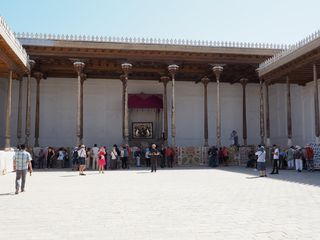
Bukhara • Kurinish Khana
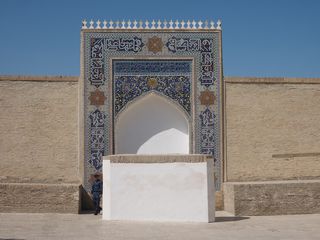
Bukhara • Kurinish Khana
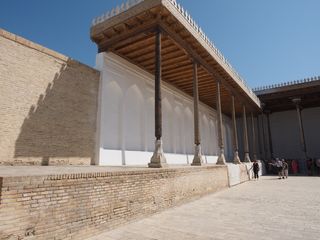
Bukhara • Kurinish Khana
Monument profile
Kurinish Khana
Monument category: Palace coutyard
Monument family: Palace and Annexes
Monument genre: Residential
Cultural heritage: Islamic
Geographic location: Bukhara • Uzbekistan
Construction period: 17th century AD
This monument in Bukhara is inscribed on the UNESCO World Heritage List since 1993 and is part of the serial property "Historic Centre of Bukhara".See the UNESCO monuments featured on this site
• Links to •
• List of videos about Bukhara on this site •
Bukhara, oasis on the silk road • Uzbekistan
Kurinish Khana and the Political Ceremonies of the Ark Citadel
Establishment of the Audience Hall Complex
Kurinish Khana, also known as Kurnysh Khana, was constructed in the early seventeenth century within the Ark Citadel of Bukhara, the fortified residence of the rulers of the Emirate of Bukhara. The complex is generally associated with the first years of Astrakhanid rule, following the dynasty’s accession to power at the end of the sixteenth century. It was designed as the official setting for audiences, state ceremonies and formal receptions conducted by the emir.
Its location within the administrative sector of the citadel reflected its role in the operation of government. The complex formed a controlled ceremonial space where the ruler could meet representatives of the state, members of the court and foreign envoys. Access to the area was regulated according to rank and protocol, reinforcing the political hierarchy of the emirate.
Ceremonial and Diplomatic Functions
For several centuries, Kurinish Khana served as the principal venue for official receptions and diplomatic encounters. Foreign ambassadors arriving in Bukhara were received in the audience court before appearing before the emir. State ceremonies, public proclamations and formal gatherings of court officials were also held there.
The arrangement of the complex supported the ceremonial requirements of the Bukharan court. Different areas accommodated officials, guards, visitors and diplomatic delegations while maintaining strict separation between groups. The audience platform allowed the emir to preside over ceremonies from a prominent position overlooking the assembled participants. Through these functions, Kurinish Khana became an important instrument of political representation within the Ark.
Historical accounts describe the complex as a setting where authority was publicly displayed through carefully organised ceremonies. The physical arrangement of the court and reception spaces contributed directly to the formal presentation of state power and the administration of diplomatic relations.
Changes During the Late Emirate and Soviet Period
Kurinish Khana remained in use throughout the existence of the Emirate of Bukhara. Repairs and modifications were undertaken by successive rulers to preserve the ceremonial character of the complex and maintain its suitability for official functions. Some architectural elements visible today reflect interventions carried out during different phases of the emirate’s history.
Its original role ended after the political transformation of Bukhara in the late nineteenth and early twentieth centuries. Russian influence gradually reduced the independence of the emirate, and the establishment of Soviet rule in 1920 brought the traditional political system to an end. As a result, the audience court ceased to function as a centre of government and lost the ceremonial purpose for which it had been created.
During the Soviet period, the Ark Citadel was preserved as a historical and cultural site. Kurinish Khana became part of the broader effort to conserve the architectural remains of the former emirate rather than a functioning governmental space.
Historical Context at the Time of Construction
When Kurinish Khana was built in the early seventeenth century, the Mughal Empire was expanding under Emperor Akbar and his successors in South Asia. In the Ottoman Empire, Sultan Ahmed I commissioned the construction of the Blue Mosque in Istanbul. In Europe, the reign of Henry IV of France was ending, while the first permanent English settlements were being established in North America. These developments were contemporary with the creation of the audience complex within the Ark of Bukhara.
Preservation and Heritage Status
Today, Kurinish Khana forms part of the preserved architectural ensemble of the Ark Citadel. Conservation work has focused on stabilising structures, maintaining decorative elements and protecting the complex from deterioration. The site is open to visitors as part of the historical monuments of Bukhara and continues to illustrate the ceremonial organisation of government within the former emirate.
Since 1993, Kurinish Khana has been included within the UNESCO World Heritage property known as the Historic Centre of Bukhara. Its inclusion reflects its association with the political and administrative functions of the Ark Citadel and its contribution to the historical urban landscape of Bukhara.
Architectural Layout of Kurinish Khana in the Ark Citadel of Bukhara
Position Within the Citadel and Overall Spatial Arrangement
Kurinish Khana occupies a prominent position within the Ark Citadel, the fortified governmental centre of Bukhara. Rather than standing as an isolated structure, it forms part of a ceremonial complex integrated into the administrative core of the citadel. Its layout is organised around a large open audience court that defines the principal axis of the ensemble.
The arrangement reflects a hierarchical organisation of movement and visibility. Visitors entering the court were directed toward the audience area, while access to restricted sectors remained controlled. The open court serves as the central organising element around which the principal architectural components are distributed. This configuration established a clear distinction between public ceremonial space and areas reserved for the ruler and court officials.
The dimensions of the court allow large gatherings while maintaining direct visual connections between the audience platform and the surrounding structures. The composition relies primarily on spatial organisation and controlled sightlines rather than enclosed monumental buildings.
The Audience Court and Ceremonial Composition
The audience court is the dominant architectural feature of Kurinish Khana. Its rectangular plan creates a broad ceremonial enclosure bordered by walls and administrative structures. The court functioned as the setting for official receptions and state ceremonies conducted under the authority of the emir.
One of the most distinctive elements is the large decorative iwan positioned along one side of the enclosure. This feature introduces a strong vertical accent into an otherwise horizontal composition. The iwan is framed by brick masonry and decorated with ceramic ornamentation incorporating geometric motifs, floral patterns and calligraphic bands. Its richly decorated surface forms a visual focal point that contrasts with the simpler surrounding walls.
Decoration is concentrated on selected architectural elements rather than distributed across the entire complex. This selective approach establishes a hierarchy of visual emphasis and directs attention toward the principal ceremonial areas. Large surfaces of exposed brick surrounding the decorated sections reinforce the clarity of the composition.
The enclosure walls remain comparatively austere. Their primary purpose is to define and contain the ceremonial space, allowing the audience platform and decorated structures to dominate the visual experience.
Audience Pavilion and Columned Structures
The audience pavilion forms the architectural centre of the complex. Raised above the level of the court, it occupies a commanding position from which the ruler could oversee ceremonies. The structure consists of a broad platform supporting a roof carried by tall wooden columns.
These columns are among the most recognisable features of Kurinish Khana. Their slender proportions create a strong sense of verticality while preserving visual openness beneath the roof. Resting on stone bases, they combine structural stability with protection against ground moisture. Many display carved decorative details associated with court architecture.
The roof structure relies on a system of timber beams capable of spanning large areas without heavy masonry supports. The resulting space remains open toward the court, maintaining a direct visual relationship between the ruler and assembled visitors. The pavilion therefore functioned as both an architectural structure and a ceremonial setting.
The ceiling incorporates painted and carved wooden elements arranged in geometric patterns. These decorative surfaces remain closely integrated with the structural framework. Extending from the pavilion are covered galleries that continue the rhythm established by the columns. They provide sheltered circulation routes and transitional spaces between the audience court and adjacent sectors of the citadel.
Construction Techniques and Material Palette
Kurinish Khana combines brick masonry and timber construction in a manner that defines both its appearance and structural character. Fired brick forms the principal material of the walls, platforms and enclosure structures, creating visual continuity with the rest of the Ark Citadel.
Wood dominates the ceremonial portions of the complex. The audience pavilion, galleries, columns and ceilings all depend on timber construction for both structural and decorative purposes. This extensive use of wood creates a clear contrast with the more massive masonry elements surrounding the court.
Ceramic decoration is concentrated on focal architectural features. Glazed tiles introduce colour and texture while emphasising important visual axes. Blue, turquoise, white and ochre tones dominate the decorative surfaces, creating a marked contrast with the natural colour of the brickwork.
Stone is used more selectively, mainly in column bases and structural details requiring greater durability. Although less visually prominent, it contributes significantly to the stability of the ensemble.
Architectural Modifications and Preservation
The present appearance of Kurinish Khana reflects centuries of repairs, reconstruction and conservation. Wooden elements have required periodic replacement because of weathering and natural deterioration. Several columns and roof components represent restoration work intended to preserve the structural integrity of the pavilion while respecting its historical appearance.
Conservation efforts have also focused on stabilising masonry structures and protecting ceramic decoration. Restored sections generally follow the original spatial arrangement, allowing the audience court, pavilion and galleries to retain their historical relationships. The complex therefore continues to illustrate how ceremonial space, architectural hierarchy and political representation were expressed within the administrative centre of the Ark Citadel.