

 Français (France)
  Nederlands (nl-NL)
 The Kalyan Mosque is one of the most important religious monuments in Bukhara, Uzbekistan. Located within the Po-i-Kalyan complex, it forms a distinguished ensemble together with the Kalyan Minaret and the Mir-i-Arab Madrasa. For centuries, it has served as a major place of worship and gathering for the city’s Muslim community. Its large courtyard and impressive scale reflect its significance in the religious and urban life of Bukhara. Today, the Kalyan Mosque remains one of the most visited landmarks in the historic centre, which is included on UNESCO’s World Heritage List.
Monument profile
Kalyan Mosque
Monument category: Mosque
Monument family: Mosque, Minaret or Madrasa
Monument genre: Religious
Cultural heritage: Islamic
Geographic location: Bukhara • Uzbekistan
Construction period: 16th century AD
This monument in Bukhara is inscribed on the UNESCO World Heritage List since 1993 and is part of the serial property "Historic Centre of Bukhara".See the UNESCO monuments featured on this site
• Links to •
• List of videos about Bukhara on this site •
Bukhara, oasis on the silk road • Uzbekistan
• References •
Wikipedia EN: Po-i-Kalyan
Wikipedia EN: Kalyan Minaret
UNESCO: Historic Centre of Bukhara
The Kalyan Mosque and the Development of Bukhara’s Religious Centre
Earlier Mosques and the Historical Significance of the Site
The Kalyan Mosque occupies a location that had already served as Bukhara’s principal congregational mosque for centuries before the construction of the present building. Historical sources indicate that earlier Friday mosques stood on or near the same site following the spread of Islam in Transoxiana. These structures were periodically rebuilt as a result of fires, urban redevelopment and political upheavals affecting the city.
The importance of the area increased during the Qarakhanid period. In 1127, the Kalyan Minaret was erected beside the existing mosque, establishing a monumental religious focus within Bukhara. The minaret survived the Mongol invasion of 1220, whereas the associated mosque suffered severe damage and eventually disappeared. Although the original structure was lost, the location retained its religious significance and continued to function as the city’s principal place for large communal gatherings and Friday prayers.
Reconstruction under the Shaybanids
The present Kalyan Mosque was built between 1514 and 1515 during the reign of Ubaydullah Khan of the Shaybanid dynasty. The project formed part of a broader programme aimed at strengthening Bukhara’s position as a political and religious centre after a period of regional instability. Constructing a monumental congregational mosque served both practical and symbolic purposes, reaffirming the authority of the ruling dynasty and the prominence of Islamic institutions within the city.
The new building was designed to accommodate a large number of worshippers and to restore the monumental character of the site surrounding the surviving minaret. Shortly afterwards, the construction of the Mir-i-Arab Madrasa on the opposite side of the square completed the architectural ensemble known today as Po-i-Kalyan. Together, the mosque, madrasa and minaret formed the principal religious complex of Bukhara.
The mosque became the venue for Friday prayers, major religious celebrations and official ceremonies attended by political and religious leaders. Its role extended beyond worship, as sermons delivered within the mosque often reflected the relationship between religious authority and the ruling power.
Religious Function and Historical Transformations
From the sixteenth century onward, the Kalyan Mosque remained the principal congregational mosque of Bukhara. Successive rulers maintained the building because of its importance to the prestige of the city and its central role in public religious life. Historical records mention repairs and maintenance campaigns undertaken to preserve the structure and its decorative elements.
During the nineteenth century, when Bukhara functioned as the capital of the Emirate of Bukhara, the mosque continued to serve as a major religious institution. Its location within the city’s principal ceremonial space reinforced its significance during public gatherings and religious observances.
Following the Russian conquest of the region and the subsequent establishment of Soviet rule, religious activity was increasingly restricted. Like many Islamic monuments in Central Asia, the mosque experienced periods during which its traditional functions were reduced or closely supervised by state authorities. Nevertheless, its historical and architectural importance protected it from large-scale destruction. Conservation measures undertaken during the Soviet period contributed to the survival of the monument and preserved many of its original features.
Global Historical Context
The construction of the present Kalyan Mosque in the early sixteenth century coincided with the reign of Selim I in the Ottoman Empire. In Western Europe, the Renaissance was entering a period of major artistic and intellectual development under rulers such as Francis I of France. The Ming dynasty governed China from Beijing, while Babur would soon establish the Mughal Empire in northern India.
UNESCO Recognition and Present-Day Role
Since the independence of Uzbekistan in 1991, the Kalyan Mosque has regained its full religious function. It remains an active place of worship and continues to host major communal prayers within Bukhara.
The mosque forms part of the “Historic Centre of Bukhara,” which was inscribed on the UNESCO World Heritage List in 1993. Within this protected urban ensemble, the Kalyan Mosque remains one of the most significant religious monuments. Its continued use, combined with ongoing conservation efforts, has preserved its role as both a functioning mosque and a major component of Bukhara’s historical heritage.
Architectural Layout and Structural Features of the Kalyan Mosque
Position within the Po-i-Kalyan Ensemble and Overall Plan
The Kalyan Mosque occupies the southern side of the Po-i-Kalyan complex in the historic centre of Bukhara. Its position establishes a direct architectural relationship with the Kalyan Minaret and the Mir-i-Arab Madrasa, creating one of the most recognizable urban compositions in Central Asia. The mosque is aligned toward the minaret, while the madrasa faces it across an open square, producing a carefully balanced arrangement of religious buildings.
The structure follows a large rectangular plan organized around a central courtyard. This courtyard forms the principal spatial element of the mosque and determines the arrangement of all surrounding structures. Covered galleries, prayer halls and ancillary spaces are distributed along the perimeter, creating a continuous enclosure around the open centre.
The scale of the building is remarkable. The complex occupies a large area and was designed to accommodate several thousand worshippers. The courtyard serves both as a circulation space and as an extension of the prayer areas during major religious gatherings. The regular geometry of the plan contributes to a clear spatial hierarchy, guiding movement from the entrance portal toward the main prayer hall.
Structural System and Construction Techniques
The mosque was built primarily of fired brick, the dominant structural material throughout the monument. Thick load-bearing walls provide stability while also moderating temperature variations. The extensive use of brick allowed the builders to create large spans and monumental elevations without relying on stone construction.
A repetitive system of arches, vaults and domes forms the principal structural framework. The galleries surrounding the courtyard are composed of a succession of brick arcades supported by massive piers. These elements distribute loads efficiently while creating long covered passages around the central space.
The roofing system relies on numerous small domes and vaults. Transitional architectural devices permit the transfer of loads from square or rectangular spaces to circular domed coverings. The precision of these transitions demonstrates advanced engineering knowledge and a high level of craftsmanship.
The main prayer hall employs larger structural volumes than the surrounding galleries. Its dominant dome marks the location of the mihrab and creates a focal point within the overall composition. The hierarchy between the central prayer space and the subsidiary structures is expressed through differences in height, scale and roof configuration.
Courtyard, Prayer Hall and Spatial Organization
The courtyard constitutes the visual and functional centre of the mosque. Its large dimensions create an open area framed by arcaded façades on all sides. The rhythm of arches surrounding the courtyard produces a sense of architectural continuity while maintaining clear access to the covered sections of the complex.
Around the courtyard extends a network of roofed spaces covered by numerous small domes. Historical descriptions refer to more than two hundred domes distributed throughout the surrounding structures. These domes cover individual bays and generate a highly repetitive roofscape that is particularly visible from elevated viewpoints.
The main prayer hall occupies the qibla side of the mosque. This section contains the principal liturgical elements, including the mihrab indicating the direction of Mecca. The hall is distinguished by greater vertical emphasis and more elaborate decorative treatment than the surrounding spaces. Large arches frame the interior volumes and create visual connections between different parts of the structure.
Natural illumination enters through openings positioned within façades, drum structures and transitional zones beneath the domes. The resulting light is generally diffuse, reducing strong contrasts and emphasizing architectural surfaces rather than individual decorative details.
Decorative Programme and Architectural Expression
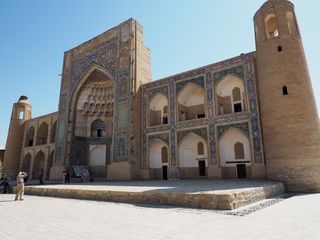
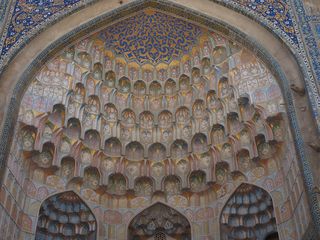
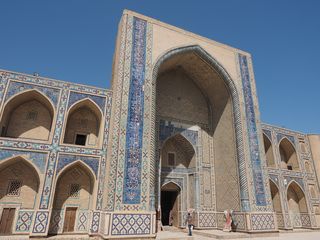
The decorative scheme combines exposed brickwork with glazed ceramic ornamentation. The monumental entrance portal represents the most elaborate exterior element of the mosque. Its proportions, recessed surfaces and decorative framing establish a strong visual presence within the Po-i-Kalyan complex.
Glazed tiles in blue, turquoise and white are concentrated around key architectural features such as portals, arches and domed structures. Geometric compositions dominate the decorative programme. Calligraphic inscriptions are integrated into the architectural framework rather than treated as independent decorative panels.
Within the prayer hall, ornamentation is focused on the mihrab zone and on major structural elements. Decorative surfaces follow the geometry of arches, vaults and domes, reinforcing the organization of space. Brick patterns also contribute to the visual appearance of the monument, creating texture and variation even in areas where ceramic decoration is limited.
The contrast between plain brick surfaces and concentrated decorative zones forms one of the defining visual characteristics of the mosque. This balance emphasizes the scale of the architecture while preserving the legibility of its structural components.
Conservation and Architectural Preservation
The Kalyan Mosque has undergone several restoration campaigns intended to preserve both its structural integrity and decorative features. Interventions have focused on stabilizing masonry, repairing domes and vaults, and conserving ceramic surfaces affected by weathering and age.
Twentieth-century conservation projects addressed deterioration in several sections of the monument and ensured the continued stability of the main structural elements. Later restoration efforts concentrated on preserving original materials wherever possible while maintaining the building’s religious function.
Today, the mosque retains the essential characteristics of its sixteenth-century design. Its courtyard, arcaded galleries, extensive system of domes and monumental prayer hall continue to define one of the largest and most significant religious structures in the historic centre of Bukhara.