

 Français (France)
  Nederlands (nl-NL)
 The Mir-i-Arab Madrasa is one of the most famous monuments in Bukhara, Uzbekistan. Located within the Po-i-Kalyan complex, it occupies an important place in the city’s historical and religious landscape. Built in the sixteenth century, it served for centuries as a centre of Islamic education and continues to function as an active religious institution. Its large blue domes are among the most recognizable features of Bukhara’s skyline. The madrasa contributes significantly to the character of the historic centre, which was inscribed on the UNESCO World Heritage List in 1993.
Monument profile
Mir-i-Arab Madrasa
Monument category: Madrasa
Monument family: Mosque, Minaret or Madrasa
Monument genre: Religious
Cultural heritage: Islamic
Geographic location: Bukhara • Uzbekistan
Construction period: 16th century AD
This monument in Bukhara is inscribed on the UNESCO World Heritage List since 1993 and is part of the serial property "Historic Centre of Bukhara".See the UNESCO monuments featured on this site
• Links to •
• List of videos about Bukhara on this site •
Bukhara, oasis on the silk road • Uzbekistan
The Mir-i-Arab Madrasa in the Religious and Intellectual History of Bukhara
Foundation of the Madrasa under the Shaybanids
The Mir-i-Arab Madrasa was constructed between approximately 1530 and 1536 within the Po-i-Kalyan complex in Bukhara. Its foundation took place during the reign of the Shaybanid ruler Ubaydullah Khan, at a time when Bukhara was emerging as the principal political and religious centre of Transoxiana.
The institution was named after Mir-i-Arab, also known as Abdullah al-Yamani, an influential Sufi scholar and spiritual adviser to Ubaydullah Khan. Historical accounts indicate that the ruler commissioned the madrasa in honour of his mentor and as part of a broader effort to strengthen Islamic education within the khanate. The project reflected both religious patronage and political ambition, reinforcing Bukhara’s position as a centre of learning and Islamic scholarship.
The location of the madrasa opposite the Kalyan Mosque and beside the Kalyan Minaret was carefully chosen. Together, these monuments formed a unified religious ensemble that symbolized the close relationship between political authority, Islamic learning and public worship. From the moment of its completion, the madrasa became one of the most prestigious educational institutions in Central Asia.
A Centre of Islamic Learning and Scholarship
Throughout the sixteenth and seventeenth centuries, the Mir-i-Arab Madrasa played a major role in the education of religious scholars. Students from various parts of Central Asia travelled to Bukhara to study theology, Islamic law, Qur’anic interpretation and related disciplines. The institution contributed significantly to the intellectual influence of the city.
Its reputation was strengthened by its association with prominent religious figures and by the presence of the tombs of Mir-i-Arab and Ubaydullah Khan within the complex. These burials gave the madrasa an additional symbolic and spiritual dimension, making it both a place of study and a site of religious importance.
Unlike some educational institutions that gradually lost their academic function, the Mir-i-Arab Madrasa maintained an active role in religious education for centuries. Its graduates occupied influential positions within the religious hierarchy of the region, helping to extend the institution’s influence far beyond Bukhara itself.
Survival through Imperial and Soviet Rule
During the nineteenth century, when Bukhara served as the capital of the Emirate of Bukhara, the madrasa continued to function as a respected centre of Islamic education. Political changes brought by Russian expansion into Central Asia affected the region, yet the institution remained active and retained its importance within the religious life of the emirate.
The situation changed significantly after the establishment of Soviet authority. Many religious schools throughout Central Asia were closed, repurposed or abandoned as part of state policies directed against religious institutions. The Mir-i-Arab Madrasa also experienced restrictions and periods of reduced activity.
Its historical prestige, however, contributed to its survival. In 1945, Soviet authorities authorized the reopening of the institution. From that time onward, it became one of the very few officially recognized Islamic educational centres within the Soviet Union. For several decades, it trained a large proportion of the Muslim clergy permitted to serve in Central Asia and other Soviet territories. This unique status made the madrasa an exceptional institution in the religious history of the twentieth-century Soviet world.
Global Historical Context
The construction of the Mir-i-Arab Madrasa in the 1530s coincided with the reign of Suleiman the Magnificent in the Ottoman Empire. In Western Europe, the Renaissance was fostering major developments in art, science and scholarship. In northern India, the Mughal Empire established by Babur was becoming firmly rooted. China remained under the rule of the Ming dynasty from its capital in Beijing.
UNESCO Recognition and Present-Day Function
Since the independence of Uzbekistan in 1991, the Mir-i-Arab Madrasa has continued to serve as an active religious and educational institution. It remains one of the country’s most respected centres of Islamic learning and continues to train students in theological studies.
The monument forms part of the “Historic Centre of Bukhara,” which was inscribed on the UNESCO World Heritage List in 1993. Within this protected urban ensemble, the madrasa is recognized as one of the most significant historical landmarks. Conservation programmes have focused on preserving the structure while allowing it to maintain its original educational and religious functions. Today, the Mir-i-Arab Madrasa remains a symbol of Bukhara’s scholarly tradition and one of the most important surviving institutions of Islamic education in Central Asia.
Architectural Composition and Spatial Organization of the Mir-i-Arab Madrasa
Position within the Po-i-Kalyan Ensemble and General Layout
The Mir-i-Arab Madrasa occupies the northern side of the Po-i-Kalyan complex in Bukhara. Its position directly opposite the Kalyan Mosque creates one of the most balanced architectural compositions in the historic centre. Between the two buildings rises the Kalyan Minaret, establishing a visual axis that organizes the surrounding urban space. The madrasa was deliberately integrated into this monumental arrangement, where each structure contributes to the overall coherence of the ensemble.
The building follows a rectangular plan organized around a large central courtyard. This courtyard forms the core of the institution and serves as the principal circulation space. The surrounding structures contain student cells, teaching rooms, religious spaces and access galleries. The organization reflects both educational and residential functions while maintaining a strict geometric order.
The madrasa consists of two storeys surrounding the courtyard. The regular arrangement of rooms creates a strong sense of symmetry. The main entrance occupies the central axis of the façade and aligns with the principal spaces beyond it. This axial organization guides movement through the building and reinforces the monumentality of the composition.
The proportions of the structure contribute significantly to its visual impact. Although smaller in footprint than the Kalyan Mosque, the madrasa achieves an equivalent presence through the height of its façade, the scale of its portal and the prominence of its domes.
Structural System, Construction Techniques and Materials
The building is constructed primarily of fired brick, which forms both the structural framework and the visible architectural surface. Thick masonry walls support the weight of vaults, arches and domes while providing thermal insulation. The extensive use of brick allowed builders to create large volumes and substantial elevations without relying on stone construction.
The structural system is based on a combination of load-bearing walls, brick piers and vaulted roofing. Arches transfer loads from the upper levels toward the foundations, while vaults distribute structural forces across the building. The construction demonstrates a sophisticated understanding of masonry engineering and geometric design.
Large domed chambers required advanced transitional elements between square rooms and circular dome bases. These transitions were achieved through carefully designed architectural devices that gradually transformed one geometry into another. Such solutions made it possible to create spacious interiors beneath large domes without compromising stability.
The exterior surfaces combine exposed brickwork with glazed ceramic decoration. The contrast between structural masonry and ornamental surfaces contributes to the visual character of the monument. Decorative elements emphasize important architectural features rather than concealing the construction beneath them.
Monumental Façade and Exterior Architectural Features
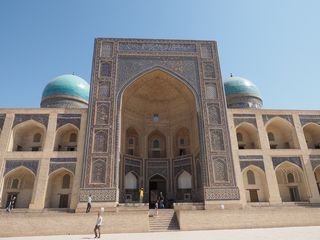
The principal façade is dominated by a monumental pishtak, or entrance portal, which rises above the surrounding structures and serves as the visual focus of the building. Its recessed arch creates depth and establishes a strong vertical emphasis. The proportions of the portal allow it to compete visually with the monumental façade of the Kalyan Mosque across the square.
The portal is framed by symmetrical wings containing niches, windows and decorative panels. The façade displays a carefully controlled balance between solid surfaces and architectural openings. This arrangement creates a sense of order while directing attention toward the entrance.
Behind the façade rise two large blue domes that define the skyline of the madrasa. These domes are among the most recognizable elements of Bukhara’s architectural landscape. Their position behind the entrance façade creates a layered composition in which the portal and domes interact visually from different viewpoints within the Po-i-Kalyan complex.
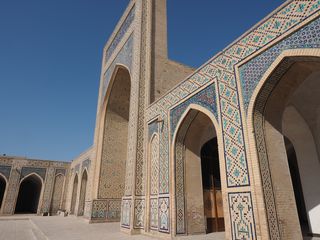
The exterior decoration relies heavily on glazed tilework. Blue, turquoise and white tones dominate the decorative scheme. Geometric patterns, floral motifs and calligraphic inscriptions are integrated into the architectural framework. Rather than covering every surface, decoration is concentrated around the portal, domes and key structural elements, allowing the overall form of the building to remain clearly legible.
Courtyard, Educational Spaces and Interior Organization
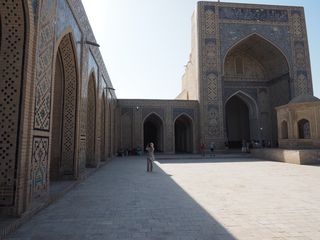
The interior is structured around a spacious courtyard surrounded by arcaded façades. This open area provided light, ventilation and circulation for the institution’s residents. The courtyard also established a visual centre from which all major spaces could be accessed.
Student cells occupy much of the perimeter. Arranged on two levels, these rooms were designed for accommodation and study. Their regular repetition creates a rhythmic architectural pattern around the courtyard. Staircases positioned at strategic points connect the upper and lower levels without disrupting the symmetry of the composition.
The principal halls occupy the most important axes of the building. Larger volumes indicate spaces intended for teaching, prayer or ceremonial functions. These halls are distinguished by greater height, more elaborate vaulting and richer decoration than the surrounding residential areas.
Interior surfaces feature a combination of brickwork, plaster and ceramic ornamentation. Decorative programmes concentrate around significant spaces rather than being distributed uniformly throughout the building. Arches, niches and vaulted ceilings are often highlighted through geometric patterns and inscriptions integrated directly into the architecture.
The tombs associated with Mir-i-Arab and Ubaydullah Khan are housed within domed chambers that occupy prominent positions inside the complex. These spaces form an integral part of the architectural composition and contribute to the monument’s dual educational and commemorative functions.
Restoration and Architectural Conservation
Over the centuries, the Mir-i-Arab Madrasa has undergone multiple restoration campaigns intended to preserve both its structure and decorative elements. Conservation efforts have addressed deterioration of masonry, stabilization of domes, repair of vaulting systems and restoration of ceramic surfaces damaged by weathering.
During the twentieth century, several interventions focused on maintaining structural stability while preserving the historical appearance of the monument. Particular attention was given to the façade, domes and decorative tilework, which are among the most exposed elements of the building.
More recent conservation programmes have sought to preserve original materials wherever possible while ensuring the continued use of the madrasa as an active religious institution. These efforts have helped maintain the essential characteristics of the sixteenth-century design. The monumental portal, twin domes, symmetrical courtyard and extensive decorative programme remain the defining architectural features of one of the most important educational monuments in the historic centre of Bukhara.