

 Français (France)
  Nederlands (nl-NL)
 The Nadir Divan-Begi Madrasa is an Islamic religious institution located in Bukhara, Uzbekistan. It forms part of the Lyab-i Hauz complex, an urban ensemble developed around a historic pool that served for centuries as a gathering and social space. Built during the seventeenth century, the madrasa reflects Bukhara’s role as a centre of learning and religious life in Central Asia. Over time, the monument has experienced different uses while remaining an integral part of the city’s historic landscape. Today, it is included within the Historic Centre of Bukhara, a UNESCO World Heritage property inscribed in 1993.
Monument profile
Nadir Divan-Begi Madrasa
Monument category: Madrasa
Monument family: Mosque, Minaret or Madrasa
Monument genre: Religious
Cultural heritage: Islamic
Geographic location: Bukhara • Uzbekistan
Construction period: 17th century AD
This monument in Bukhara is inscribed on the UNESCO World Heritage List since 1993 and is part of the serial property "Historic Centre of Bukhara".See the UNESCO monuments featured on this site
• Links to •
• List of videos about Bukhara on this site •
Bukhara, oasis on the silk road • Uzbekistan
Development of the Nadir Divan-Begi Madrasa in Bukhara
Foundation and Transformation from Caravanserai to Madrasa
The Nadir Divan-Begi Madrasa was constructed between approximately 1622 and 1623 during the reign of the Janid ruler Imam Quli Khan. The project was commissioned by Nadir Divan-Begi, a powerful statesman who held the office of vizier and played a major role in the urban development of Bukhara during the first half of the seventeenth century.
Historical sources indicate that the building was originally intended to serve as a caravanserai. Its location within the newly developed Lyab-i Hauz district made it particularly suitable for accommodating merchants and travellers arriving in the city. According to traditional accounts, the ruler publicly announced the structure as a madrasa during its inauguration. As a result, the building’s function was altered, and it was adapted to serve as an institution of Islamic education.
This transformation influenced the later history of the monument. Although it acquired the status of a madrasa, certain elements of its layout retained characteristics associated with its original purpose. The building therefore occupies a distinctive place among the educational institutions of Bukhara because its development followed a different path from that of structures conceived as madrasas from the outset.
Educational Role and Position within the Lyab-i Hauz Ensemble
After its conversion, the Nadir Divan-Begi Madrasa became part of a larger urban complex that included the Lyab-i Hauz reservoir and the Khanqah of Nadir Divan-Begi. Together, these structures formed one of the principal public and religious spaces of seventeenth-century Bukhara.
The madrasa functioned as a centre of Islamic learning where students received instruction in theology, jurisprudence and other religious disciplines. Residential cells accommodated students and teachers, while communal spaces supported educational and religious activities. Its position within a mixed urban environment distinguished it from some other educational institutions located closer to major congregational mosques.
The association between the madrasa, the khanqah and the reservoir contributed to the vitality of the surrounding district. The area became a focal point of social, intellectual and religious life. The monument’s role extended beyond education, as it participated in the broader functioning of a quarter designed to serve multiple urban purposes.
The richly decorated façade also contributed to the visibility of the institution. Over time, the madrasa became one of the most recognizable components of the Lyab-i Hauz ensemble and remained closely associated with the identity of this part of the city.
Changes During the Russian and Soviet Periods
The political transformations that affected Bukhara during the nineteenth and twentieth centuries also influenced the history of the madrasa. During the period of Russian influence over the Emirate of Bukhara, the institution largely retained its educational and religious functions, although changing economic and political conditions gradually altered its environment.
More significant changes occurred after the establishment of Soviet authority in Central Asia. Religious institutions faced restrictions, and many madrasas ceased their traditional educational activities. The Nadir Divan-Begi Madrasa was among the buildings affected by these policies.
Its original role as a centre of Islamic instruction declined substantially. Various parts of the structure were reassigned to other uses, reflecting broader changes in state policy toward religious institutions. Despite these transformations, the building avoided major destruction and remained an important historic structure within the city.
During the Soviet period, increasing attention was given to the preservation of architectural monuments. The historical and artistic value of the madrasa contributed to efforts aimed at maintaining the building, even though its original educational function had largely disappeared.
Global Historical Context
The construction of the Nadir Divan-Begi Madrasa in the early seventeenth century coincided with the reign of James I in England and the final years of the Ming dynasty in China. In the Ottoman Empire, Sultan Osman II had recently been succeeded by Murad IV. In India, the Mughal Empire was approaching the period of Shah Jahan, during which several major architectural projects would be undertaken. Across Europe, the early Baroque period was influencing artistic and architectural developments.
Preservation, Heritage Recognition and Present Status
Throughout the twentieth century and after the independence of Uzbekistan in 1991, restoration campaigns were undertaken to preserve the structure and its decorative elements. Particular attention was devoted to stabilizing masonry, conserving ceramic ornamentation and protecting the distinctive façade for which the monument is known.
Today the madrasa is no longer used primarily as an educational institution. Instead, it functions largely as a historic and cultural monument within the historic urban landscape of Bukhara. Its location within the Lyab-i Hauz complex continues to make it an important component of one of the city’s best-preserved historic quarters.
The monument forms part of the UNESCO World Heritage property Historic Centre of Bukhara, inscribed on the World Heritage List in 1993. This designation recognizes the exceptional historical continuity of Bukhara’s urban fabric and the contribution of monuments such as the Nadir Divan-Begi Madrasa to that heritage.
The building remains an important testimony to the urban policies of the Janid period, the development of educational institutions in seventeenth-century Central Asia and the transformation of historic religious buildings through changing political and social circumstances. Its preservation allows the historical evolution of the Lyab-i Hauz district to remain clearly visible within the city today.
Architectural Configuration and Spatial Organization of the Nadir Divan-Begi Madrasa
Urban Setting and General Layout
The Nadir Divan-Begi Madrasa occupies a prominent position within the Lyab-i Hauz complex in the historic centre of Bukhara. Rather than standing as an isolated monument, it forms part of an urban composition organized around a large reservoir and maintains a close relationship with the neighbouring Khanqah of Nadir Divan-Begi.
The building follows a rectangular plan arranged around a large central courtyard. This configuration reflects its original function as a caravanserai before conversion into a madrasa. The courtyard serves as the principal circulation space and provides access to surrounding rooms and student cells.
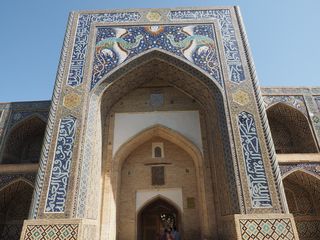
The main façade faces the open area of the Lyab-i Hauz ensemble. A monumental portal marks the entrance and links the urban environment with the interior spaces. The building rises on two storeys, with student chambers arranged around the courtyard on both levels. This layout separates communal circulation zones from residential spaces.
Although substantial in size, the madrasa remains more restrained than some of Bukhara’s largest educational institutions. Its architectural presence derives largely from its decorative treatment and strategic location within the historic urban landscape.
Structural System, Construction Techniques and Materials
The madrasa is built primarily of baked brick, which forms its structural framework and defines its appearance. Thick load-bearing walls support upper floors, vaults and masonry roofing systems.
Interior spaces are covered by various brick vaults adapted to their dimensions and functions. Corridors, student cells and secondary rooms employ relatively simple solutions, while larger spaces incorporate more complex forms. Arches integrated into the masonry transfer loads efficiently toward the perimeter walls.
Several important chambers are crowned by domes supported through transitional devices that convert square or rectangular plans into circular bases. These systems demonstrate the technical expertise of seventeenth-century builders.
The conversion from caravanserai to madrasa was made possible by the flexibility of the original structure. Robust foundations and walls allowed functional adaptation without major alterations to the overall layout. This adaptability remains one of the building’s most distinctive architectural features.
Brickwork also contributes to the monument’s visual character. Variations in bonding patterns and surface treatment create decorative effects even where ceramic ornamentation is absent.
Façade Composition and Spatial Hierarchy
The principal façade is the most distinctive element of the monument. Dominated by a large pishtaq, or recessed portal, it rises above adjoining sections and establishes a strong vertical emphasis. The portal functions both as the architectural focal point and as the symbolic entrance to the complex.
The composition follows a symmetrical arrangement. Niches, windows and decorative panels are distributed on either side of the portal, creating a balanced relationship between solid walls and openings.
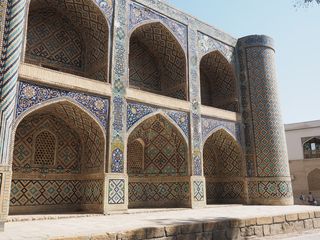
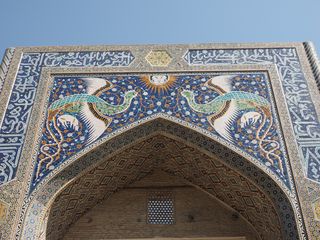
One of the most remarkable features of the madrasa is the decoration of the portal. Large ceramic panels occupy prominent positions on both sides of the entrance and transform the façade into the dominant visual element of the building. These decorative zones were conceived as integral parts of the architecture rather than as applied ornament.
Behind the entrance lies the central courtyard around which the building’s functions are organized. Student cells occupy most of the perimeter, while larger rooms associated with educational and religious activities are located near the principal circulation axes. This hierarchy reflects the adaptation of a commercial structure to educational use.
The courtyard also provides light and ventilation to the surrounding rooms while reinforcing the geometric order of the composition. Arcaded sections and repetitive architectural elements contribute to the coherence of the space.
Compared with some contemporary monuments in Bukhara, the elevation remains relatively restrained. Horizontal lines generated by galleries and residential ranges dominate much of the structure, while the portal supplies the principal vertical accent.
Decorative Program and Architectural Particularities
The decorative program of the Nadir Divan-Begi Madrasa is among its most distinctive architectural characteristics. The principal portal is covered with glazed ceramic decoration employing blue, turquoise, white and ochre tones. Geometric patterns structure much of the decorative surface and reinforce the architectural framework of the façade.
The monument is especially notable for its figurative imagery, a rare feature in monumental Islamic architecture of Central Asia. Large panels depict mythical birds generally identified as Simorgh figures holding deer in their talons, surmounted by stylized solar motifs. These representations distinguish the madrasa from nearly every other major educational monument in Bukhara.
The figurative panels are integrated into a broader decorative scheme that includes geometric designs and calligraphic inscriptions. These elements are carefully coordinated within the overall composition.
Calligraphic bands emphasize structural divisions and frame significant architectural features. Their placement demonstrates a close relationship between decoration and architectural design.
Interior decoration is generally more restrained than that of the portal. Student cells and circulation areas emphasize functionality, while decorative resources are concentrated around the entrance and principal halls. This hierarchy directs attention toward the most visible and symbolically important areas of the building.
The combination of geometric ornament, ceramic revetment and rare figurative imagery creates a decorative program unique within Bukhara’s architectural heritage.
Conservation and Architectural Integrity
The Nadir Divan-Begi Madrasa has undergone several restoration campaigns since the nineteenth century. Conservation efforts have focused on masonry stabilization, repairs to vaults and domes, and preservation of ceramic decoration affected by weathering.
Particular attention has been devoted to the figurative ceramic panels of the main façade. Restoration work has sought to retain original materials wherever possible while reinforcing weakened sections.
Structural interventions have also addressed walls, foundations and roofing systems, ensuring the stability of the monument while preserving its historic organization.
Today the madrasa retains the essential characteristics of its seventeenth-century configuration. Its rectangular plan, central courtyard, two-storey arrangement of student cells, monumental portal and distinctive decorative program remain clearly legible. The building’s transformation from caravanserai to madrasa can still be understood through its spatial organization.
As part of the UNESCO World Heritage property Historic Centre of Bukhara, inscribed in 1993, the monument contributes to the preservation of one of Central Asia’s most complete historic urban environments. Its architectural significance lies in the combination of adaptive planning, coherent spatial organization, technical mastery in brick construction and a highly distinctive decorative façade.