

 Français (France)
  Nederlands (nl-NL)
 The Po-i-Kalyan Ensemble is the principal historic religious complex in Bukhara, Uzbekistan. It brings together several major monuments of Islamic culture, including the Kalyan Mosque, the Kalyan Minaret and the Mir-i-Arab Madrasa. For centuries, the complex played an important role in the religious, educational and urban life of the city. Its monumental organization reflects Bukhara’s significance as a major cultural centre of Central Asia. Today, the ensemble forms part of the Historic Centre of Bukhara, which has been included on the UNESCO World Heritage List since 1993.
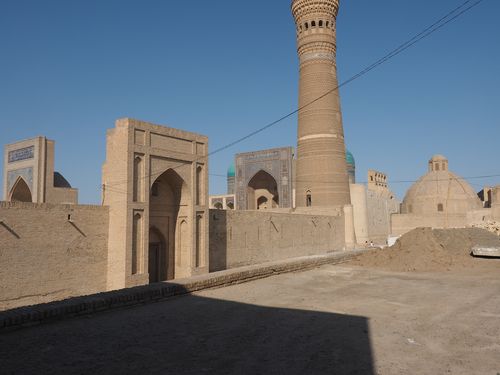
Bukhara • Po-i-Kalyan Complex: Kalyan mosque
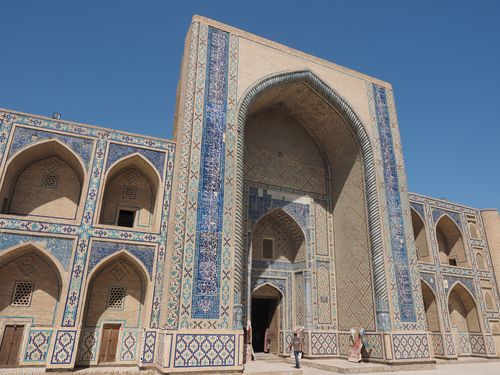
Bukhara • Po-i-Kalyan Complex: Mir-i-Arab madrasa
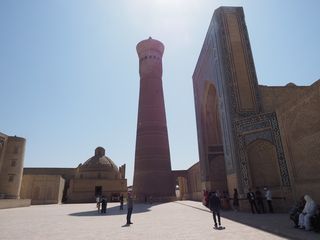
Bukhara • Po-i-Kalyan Complex: mosque, madrasa and minaret
Monument profile
Po-i-Kalyan Complex
Monument category: Set of Monuments
Monument family: Museum, remarkable architecture or group of buildings
Monument genre: Cultural or scientific
Cultural heritage: Islamic
Geographic location: Bukhara • Uzbekistan
Construction period: 12th century AD
This monument in Bukhara is inscribed on the UNESCO World Heritage List since 1993 and is part of the serial property "Historic Centre of Bukhara".See the UNESCO monuments featured on this site
• Links to •
• List of videos about Bukhara on this site •
Bukhara, oasis on the silk road • Uzbekistan
Historical Development of the Po-i-Kalyan Ensemble in Bukhara
Formation of the Religious Complex under the Qarakhanids
The history of the Po-i-Kalyan Ensemble begins in the early twelfth century, when Bukhara was one of the principal urban and religious centres of Central Asia. The earliest surviving element of the complex is the Kalyan Minaret, constructed between 1121 and 1127 during the reign of the Qarakhanid ruler Arslan Khan. Built alongside the city’s congregational mosque, the minaret served both religious and civic purposes, acting as a focal point within the urban landscape.
The original mosque associated with the minaret no longer survives. Nevertheless, the construction of these monumental structures reflected the political ambitions of the Qarakhanid rulers and their desire to reinforce Bukhara’s status as an important centre of Islamic scholarship and worship. The exceptional scale of the minaret distinguished it from contemporary buildings and established it as a prominent landmark visible across the city and surrounding region.
A major turning point occurred in 1220 during the Mongol invasion led by Genghis Khan. Much of Bukhara was devastated, and numerous religious and civic structures were destroyed. The Kalyan Minaret, however, survived the invasion. Its preservation allowed it to remain a tangible link between the pre-Mongol city and the later architectural developments that would reshape the site.
Reconstruction and Expansion during the Shaybanid Period
The present appearance of the Po-i-Kalyan Ensemble largely dates from the sixteenth century, when the Shaybanid dynasty transformed Bukhara into the capital of a powerful Central Asian state. Seeking to reinforce both political authority and religious legitimacy, the rulers launched ambitious building projects throughout the city.
Around 1514, the Kalyan Mosque was rebuilt on a monumental scale near the surviving minaret. Designed to accommodate large congregations, the mosque became one of the most important religious buildings in the region. Its reconstruction established the foundation for a new architectural composition centred on the historic minaret.
Between 1530 and 1536, the Mir-i-Arab Madrasa was constructed opposite the mosque under the patronage of Ubaydullah Khan. The institution was intended to train religious scholars, jurists and theologians while strengthening the influence of Islamic learning within the khanate. The placement of the madrasa directly facing the mosque created a balanced monumental ensemble organized around an open ceremonial space.
By integrating the twelfth-century minaret into a newly planned complex, the Shaybanid rulers connected their own achievements to the prestige of earlier dynasties. The resulting composition became one of the defining architectural and religious centres of Bukhara.
Religious, Educational and Urban Functions
For centuries, the Po-i-Kalyan Ensemble occupied a central place in the religious life of the city. The Kalyan Mosque served as the principal congregational mosque, hosting major communal prayers and religious gatherings. At the same time, the Mir-i-Arab Madrasa became one of the leading centres of Islamic education in Central Asia.
Students from various regions travelled to Bukhara to study theology, jurisprudence and related disciplines. The educational activities of the madrasa contributed significantly to the intellectual influence of the city. The close relationship between the mosque and the madrasa allowed religious instruction and worship to function within a unified architectural setting.
The minaret maintained its role as a visual landmark and symbolic element throughout successive political changes. Although dynasties rose and fell, the ensemble continued to represent continuity within the urban landscape. Its presence shaped the surrounding district and reinforced Bukhara’s reputation as a major centre of Islamic culture.
During the period of the Emirate of Bukhara and later under Russian influence, the complex retained much of its symbolic importance. While political circumstances changed, the ensemble remained closely associated with the city’s historical identity.
Global Historical Context
The construction of the Kalyan Minaret in the twelfth century coincided with the development of major Romanesque cathedrals in Western Europe and the final decades of the Northern Song dynasty in China. The sixteenth-century reconstruction of the mosque and the construction of the Mir-i-Arab Madrasa took place during the reign of Suleiman the Magnificent in the Ottoman Empire. At the same time, the Renaissance was flourishing in Europe, the Mughal Empire was becoming firmly established in northern India, and the Ming dynasty continued to govern China from Beijing.
Preservation, UNESCO Recognition and Contemporary Role
During the twentieth century, several restoration campaigns were undertaken to preserve the principal monuments of the ensemble. These interventions focused on masonry, domes, ceramic decoration and structural stability. Particular attention was given to the conservation of the Kalyan Minaret, whose survival for nearly nine centuries made it one of the most significant historic structures in the city.
Following the independence of Uzbekistan in 1991, the Po-i-Kalyan Ensemble continued to function as an important religious and cultural site. The Mir-i-Arab Madrasa remains active as an institution of Islamic learning, while the mosque continues to host religious activities.
The ensemble forms part of the UNESCO World Heritage property known as the “Historic Centre of Bukhara,” inscribed on the World Heritage List in 1993. Within this historic urban landscape, Po-i-Kalyan occupies a particularly prominent position because of its architectural coherence and its long association with religious, educational and civic life.
Today, the complex remains one of the most significant historical ensembles in Central Asia. The combination of the twelfth-century minaret, the sixteenth-century mosque and the Mir-i-Arab Madrasa provides a unique record of the political, religious and architectural development of Bukhara across several centuries.
Spatial Organization and Architectural Composition of the Po-i-Kalyan Ensemble
Urban Layout and Monumental Configuration
The Po-i-Kalyan Ensemble occupies a prominent position within the historic centre of Bukhara and represents one of the most coherent monumental compositions in Central Asia. Rather than functioning as a single building, it consists of a carefully organized group of structures arranged around a large open space. The principal components are the Kalyan Minaret, the Kalyan Mosque and the Mir-i-Arab Madrasa, each occupying a distinct position while contributing to a unified composition.
The spatial organization is based on a clear axial relationship. The Kalyan Mosque occupies the southwestern side of the complex, while the Mir-i-Arab Madrasa stands directly opposite on the northeastern side. Between them rises the Kalyan Minaret, which serves as the dominant vertical element and visual anchor of the ensemble.
The open area separating the mosque and madrasa plays an essential architectural role. It allows both monumental facades to be viewed simultaneously and creates a ceremonial urban space where the scale and proportions of the structures can be fully appreciated. The ensemble functions not only as a group of monuments but also as a deliberately designed architectural setting.
The present configuration reflects the integration of structures erected during different historical periods. The twelfth-century minaret became the focal point around which the sixteenth-century mosque and madrasa were organized, creating a dialogue between successive phases of construction.
The Kalyan Minaret as the Structural and Visual Centre
The Kalyan Minaret forms the oldest surviving element of the ensemble and its principal architectural landmark. Rising approximately forty-six metres above the surrounding buildings, it establishes a strong vertical axis throughout the complex.
Its cylindrical form contrasts with the broad horizontal masses of the mosque and madrasa, creating a balanced composition in which height and width complement one another. The minaret remains visible from many parts of Bukhara and continues to function as an urban point of orientation.
Constructed entirely of baked brick, the tower is characterized by a gently tapering profile. Decorative brick bands encircle the shaft and create a rhythmic articulation of the surface. The upper gallery projects outward through a system of brick corbels, producing a clear transition between the main shaft and the crowning structure.
Architecturally, the minaret serves as a visual focal point, a historical link between different construction phases and a compositional element balancing the monumental facades of the mosque and madrasa. Its position provides coherence to the entire ensemble.
Spatial Organization of the Mosque and Madrasa
The Kalyan Mosque is organized around a vast rectangular courtyard enclosed by arcaded galleries and prayer spaces. The courtyard provides access to the various architectural components and reflects the mosque’s role as a congregational building intended for large numbers of worshippers.
The principal entrance is marked by a monumental pishtaq dominating the main facade. Behind this portal extends a complex arrangement of galleries, domed spaces and arcades distributed around the courtyard. Numerous small domes cover the surrounding structures, creating a varied roofscape while maintaining overall unity.
Opposite the mosque stands the Mir-i-Arab Madrasa, whose internal organization reflects its educational function. The building is arranged around a central courtyard bordered by student cells and teaching spaces distributed on two levels. The symmetrical plan combines residential, educational and religious functions within a highly ordered composition.
The relationship between the mosque and madrasa constitutes one of the defining architectural characteristics of the ensemble. Their monumental facades face one another across the open square, creating a balanced composition. The dimensions of the portals, the alignment of the principal axes and the proportional relationship between the buildings generate a strong sense of equilibrium.
The square itself functions as an architectural element, enhancing visibility and reinforcing the dialogue between the two major structures.
Construction Materials, Decorative Programs and Architectural Unity
Baked brick is the dominant construction material throughout the ensemble. It is employed for structural walls, vaults, domes, decorative elements and exterior surfaces. The extensive use of a common material contributes significantly to the visual coherence of the complex.
Ceramic decoration plays an equally important role. Glazed tiles in shades of blue, turquoise, white and occasionally ochre cover major architectural features, particularly portals, domes and selected wall surfaces. These revetments emphasize important structural elements while creating strong contrasts with the warm tones of the brickwork.
The decorative programs rely heavily on geometric patterns and calligraphic inscriptions. Rather than functioning as isolated ornaments, these elements are integrated into the architectural composition. Decorative panels reinforce structural divisions, frame openings and emphasize facade proportions.
The domes of the mosque and madrasa contribute substantially to the visual identity of the ensemble. Their blue-tiled surfaces stand out against the surrounding masonry and create recognizable silhouettes visible from various points within the historic city. They also establish a formal relationship between the two buildings, strengthening their architectural dialogue.
Despite the chronological difference between the twelfth-century minaret and the sixteenth-century mosque and madrasa, the ensemble exhibits remarkable stylistic consistency. Similar materials, decorative techniques and proportional systems ensure that the buildings function as parts of a unified composition.
Conservation, Restoration and Architectural Integrity
The architectural integrity of the Po-i-Kalyan Ensemble has been preserved through restoration campaigns undertaken during the twentieth and twenty-first centuries. These interventions have focused on structural stability, masonry conservation, dome maintenance and the preservation of ceramic decoration.
Particular attention has been given to the Kalyan Minaret because of its age and historical significance. Conservation efforts have addressed brickwork deterioration, structural monitoring and stabilization of the upper gallery while preserving the monument’s original appearance.
The mosque and madrasa have also undergone restoration work aimed at protecting domes, portals and decorative surfaces. Repairs have generally sought to maintain the historic character of the buildings while ensuring their continued functionality.
Today the ensemble retains the essential characteristics of its historic composition. The spatial relationship between the minaret, mosque and madrasa remains intact, allowing the original urban concept to be clearly understood. The continuity of materials, decorative schemes and monumental proportions continues to define the architectural identity of the site.
As part of the UNESCO World Heritage property “Historic Centre of Bukhara,” inscribed in 1993, the Po-i-Kalyan Ensemble represents one of the most complete examples of monumental Islamic urban design in Central Asia. Its significance lies both in the quality of its individual structures and in the exceptional coherence of their architectural arrangement.