

 Français (France)
  Nederlands (nl-NL)
 The Juma Mosque is a religious building located within the Ark Citadel in Bukhara, Uzbekistan. Constructed in the 17th century, it formed part of the complex used by the emirs who ruled the city. Its layout combines covered spaces with a large courtyard designed for religious gatherings. Today, it is included within the Historic Centre of Bukhara, a UNESCO World Heritage Site, and reflects the citadel’s former role as a political, administrative, and religious centre. The mosque also serves as a venue for exhibitions related to the history and cultural heritage of the region.
Monument profile
Juma Mosque
Monument category: Mosque
Monument family: Mosque, Minaret or Madrasa
Monument genre: Religious
Cultural heritage: Islamic
Geographic location: Bukhara • Uzbekistan
Construction period: 17th century AD
This monument in Bukhara is inscribed on the UNESCO World Heritage List since 1993 and is part of the serial property "Historic Centre of Bukhara".See the UNESCO monuments featured on this site
• Links to •
• List of videos about Bukhara on this site •
Bukhara, oasis on the silk road • Uzbekistan
The Juma Mosque within the Ark Citadel of Bukhara
Construction within the Emir’s Citadel
The Juma Mosque is located inside the Ark Citadel, the fortified residence of the rulers of Bukhara. The building was erected in the late seventeenth century during the reign of Subhan Quli Khan of the Astrakhanid dynasty. Unlike the city’s large congregational mosques, it was designed specifically for the religious needs of the emir, his court, and the administrative elite living within the citadel.
Its construction formed part of the development of the Ark as the political and ceremonial centre of the emirate. The mosque provided a dedicated place of worship within the fortified enclosure, allowing members of the ruling court to attend religious services without leaving the seat of government. Its location reflected the close relationship between political authority and religious practice within the emir’s residence.
Religious Function under the Emirate of Bukhara
For more than two centuries, the Juma Mosque served as the principal place of worship for those residing within the Ark. Friday prayers and religious ceremonies associated with the court were held there, making it an integral component of the citadel’s daily life.
The mosque formed part of a larger complex that included palaces, reception halls, administrative offices, residential quarters, and service buildings. Its use remained closely connected to the ruling institution of the emirate until the early twentieth century. While the surrounding city possessed numerous public mosques, the Juma Mosque fulfilled a more restricted role linked directly to the governing elite.
Damage to the Ark and Preservation of the Mosque
A major turning point occurred in 1920 when Bolshevik forces attacked Bukhara. The Ark Citadel was heavily bombarded during the military campaign that led to the fall of the Emirate of Bukhara. Numerous structures within the fortress were destroyed or severely damaged.
The Juma Mosque survived these events and remained one of the best-preserved religious buildings within the citadel. Following the abolition of the emirate, the Ark lost its political function and entered a new phase of use. During the Soviet period, preservation efforts focused on stabilising surviving structures and adapting parts of the complex for cultural and museum purposes. The mosque benefited from restoration programmes aimed at maintaining its historical fabric while integrating it into the evolving heritage landscape of Bukhara.
Historical Context during the Period of Construction
The Juma Mosque was built at the end of the seventeenth century. During the same period, the Palace of Versailles reached its height under the rule of Louis XIV in France. In Russia, Peter the Great began reforms that would transform the Russian state. In China, the Qing dynasty consolidated its authority across a vast imperial territory.
Current Role and Heritage Protection
Today, the Juma Mosque forms part of the preserved architectural ensemble of the Ark Citadel. Its original religious role has largely been replaced by cultural and educational functions associated with the site’s museum activities. Visitors encounter the building as part of a broader interpretation of the history of the emirate and the organisation of life within the fortress.
Since 1993, the mosque has been protected as part of the UNESCO World Heritage property Historic Centre of Bukhara. This inscription includes the principal historical monuments of the city as well as the surviving structures within the Ark. The Juma Mosque remains an important document of the religious institutions that operated inside the residence of Bukhara’s rulers and illustrates the organisation of worship within the political centre of the emirate.
Architectural Layout of the Juma Mosque in the Ark Citadel of Bukhara
Position within the Citadel and General Spatial Arrangement
The Juma Mosque occupies a prominent location within the Ark Citadel, the fortified residence of the rulers of Bukhara. Its position reflects its function as a court mosque serving the emir and the administrative elite living inside the fortress. Rather than forming an isolated structure, the mosque is integrated into the broader architectural fabric of the citadel, where religious, administrative, and residential buildings were concentrated within a protected enclosure.
The complex is organised around a large open courtyard that serves as the principal gathering space. This courtyard establishes the main axis of circulation and connects the different architectural components of the mosque. The arrangement favours direct visual relationships between the open areas and the covered prayer spaces. The overall composition is restrained and functional, reflecting the building’s role within a working seat of government rather than a monumental urban religious complex.
Courtyard, Prayer Hall, and Portico System
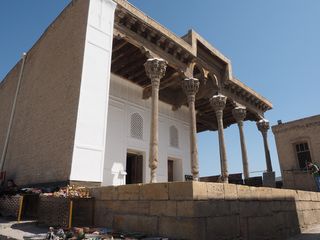
The most distinctive architectural feature of the mosque is the long columned portico extending along one side of the courtyard. This structure creates a transitional zone between the open court and the enclosed prayer areas. The portico provides shade while maintaining visual openness, allowing worshippers to use both covered and uncovered spaces according to seasonal conditions.
Behind the colonnade lies the principal prayer hall. The relationship between the hall and the portico produces a layered spatial sequence, with the courtyard functioning as the outer gathering area and the covered spaces serving liturgical purposes. The arrangement allows the mosque to accommodate larger numbers of worshippers during communal prayers without relying on a single enclosed hall.
The repetitive alignment of the columns generates a strong sense of depth. Viewed from the courtyard, the sequence of vertical supports creates a rhythmic perspective that guides movement along the façade. The proportions of the portico contribute significantly to the architectural character of the building and remain one of its most recognisable visual elements.
Construction Materials and Structural Techniques
The mosque combines masonry construction with extensive use of timber. The walls are primarily built of brick and finished with light-coloured plaster, creating broad uniform surfaces that reflect sunlight into the courtyard. This treatment enhances the perception of openness and reinforces the visual contrast between masonry elements and wooden structural components.
Timber plays a central role in the construction of the portico. The wooden columns support a roof structure composed of beams and transverse members that distribute loads across the colonnade. This system makes it possible to create large sheltered areas without introducing massive masonry supports that would obstruct the courtyard frontage.
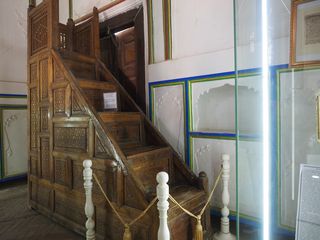
The columns demonstrate a high degree of craftsmanship. Their carved surfaces reveal the work of specialised woodworkers who combined structural requirements with decorative treatment. The wooden elements perform both practical and aesthetic functions, contributing to the stability of the roof while defining the visual identity of the mosque.
Decorative Features and Architectural Character
Decoration is concentrated primarily on the wooden architectural elements rather than on monumental ceramic surfaces. The columns are enriched with carved geometric and vegetal motifs that animate the vertical supports and create variations in light and shadow throughout the day. Similar decorative treatment appears in portions of the ceiling structure, where painted and carved details enhance the visual complexity of the covered spaces.
The façades facing the courtyard remain relatively restrained. Openings and arcades establish connections between adjacent spaces without overwhelming the overall composition. The limited use of large-scale ornament reinforces the mosque’s courtly character and distinguishes it from the more extensively decorated religious monuments found elsewhere in Bukhara.
Architecturally, the building derives much of its impact from proportion, repetition, and craftsmanship rather than from monumental scale. The contrast between the bright masonry surfaces and the darker wooden structures contributes to the mosque’s distinctive appearance.
Restoration and Architectural Preservation
The destruction that affected large portions of the Ark Citadel in 1920 altered the architectural context surrounding the mosque. Although many neighbouring structures disappeared, the Juma Mosque retained its principal architectural features, including its courtyard arrangement and wooden colonnade.
Subsequent restoration campaigns focused on preserving the masonry walls, stabilising structural elements, and maintaining the carved timber components. Particular attention has been devoted to the conservation of the wooden columns, which remain among the most significant architectural features of the building. Modern interventions have generally aimed to preserve the historical layout while adapting parts of the monument to its present role within the museum complex of the Ark. The continued maintenance of both timber and masonry remains essential to preserving the architectural integrity of the mosque within the historic citadel.